UnitedHealth Group – A Stock Analysis of One of the Leading Healthcare Giants in the World

UnitedHealth Group Incorporated is a leading American multinational healthcare and insurance company, widely recognized as one of the world’s most powerful players in health services, technology-driven care solutions, and managed healthcare.

UnitedHealthcare's Medicare Advantage Plans Review | SeniorLiving.org

Illustration 1: The UnitedHealth Group logo – symbolizing trust

Headquartered in Minnetonka, Minnesota, UnitedHealth is best known for its massive scale in health insurance through its UnitedHealthcare brand, but it also operates the highly influential Optum segment, which focuses on data analytics, pharmacy services, care delivery, and tech-enabled health solutions.

While traditional health insurers operate in narrow verticals, UnitedHealth has evolved into a diversified, tech-integrated healthcare conglomerate. Its model focuses not only on coverage but on driving improved patient outcomes, reducing healthcare costs, and leveraging digital solutions to reshape modern medicine.

UnitedHealth consistently ranks among the top Fortune 500 companies by revenue, often trailing only global titans like Walmart and Amazon. Its scale, data assets, and vertically integrated services place it at the forefront of the healthcare industry’s transformation.

$2.5M UnitedHealthcare TCPA class action settlement

Illustration 2: UnitedHealthcare headquarters in Minnetonka, Minnesota

A major turning point in the company’s evolution came in 2011 with the creation of Optum, a health services platform designed to address systemic inefficiencies in American healthcare. Optum was split into three divisions: Optum Health, which focuses on direct clinical care and outpatient services; Optum Insight, which manages data analytics and technology solutions; and Optum Rx, which handles pharmacy benefit management and prescription drug services.


Over the past decade, Optum has become a vital engine of growth for UnitedHealth Group, accounting for nearly half of the company’s total revenue. Its integration of tech-driven healthcare with clinical and administrative services has allowed UnitedHealth to become far more than just an insurer, it is now a platform company with deep influence across every major component of the health economy.

UnitedHealth Group founder to retire from the board after more than 40 years

Illustration 3: Richard Burke founder of UnitedHealthcare

Today, UnitedHealth Group operates in all 50 U.S. states and increasingly abroad. Its insurance division remains the largest private health insurer in the United States, while Optum is one of the country’s largest employers of doctors, one of the biggest processors of healthcare data, and one of the top pharmacy service providers.

UnitedHealth Group operates through two core business segments which is 1. UnitedHealthcare and 2. Optimum

At the heart of its operational engine is the UnitedHealthcare division, which administers health insurance to over 50 million Americans across employer-sponsored plans, Medicare Advantage, Medicaid, individual exchanges, and military health programs.

This division handles millions of claims per day, coordinates provider networks, manages risk pools, and ensures regulatory compliance in all 50 states and abroad. Its operations rely heavily on automation, proprietary algorithms, and customer service teams trained to navigate the complex U.S. healthcare landscape.

Optum , is a health services platform divided into: Optum Health which is a clinical services including surgery centers, primary care, urgent care, and behavioral health, Optum Insight which is a data analytics, software, and AI-driven platforms used by providers and governments and Optum Rx which is a pharmacy care services including PBM (pharmacy benefit management) operations.

Team Of Doctors And Nurses Doing Surgery To Their Patient Vector  Illustration PNG Images | EPS Free Download - Pikbest

Illustration 4: UnitedHealth is the largest employer of doctors in the US


What makes UnitedHealth Group truly stand out from traditional insurers is its deep integration of technology and healthcare data. Through its Optum Insight division, the company manages one of the largest health analytics operations in the world.

It works with health systems, governments, and employers to create AI-based tools that can detect patterns in patient data, identify at-risk populations, reduce readmissions, and optimize treatment pathways.

UnitedHealth now says 190 million impacted by 2024 data breach

Illustration 5: UnitedHealth is on the forefront in the interconnection of AI and medicine.

The company’s focus on digital tools also includes consumer-facing products. Members of UnitedHealthcare plans can use mobile apps to track claims, compare procedure costs, and receive virtual care. The company is increasingly shifting toward value-based care, where hospitals and doctors are rewarded not for the number of procedures they perform, but for the outcomes they deliver.

UnitedHealth is at the forefront of this movement, offering financial incentives to physicians who reduce avoidable hospitalizations, control chronic conditions, and improve patient satisfaction.

UnitedHealth Maintains the Hack Won't Have an Impact. That's Harder to  Believe Now. - Barron's

Illustration 6: UnitedHealth make use of app and other new technology in healthcare

UnitedHealth is also a massive player in behavioral health, a segment of care that has grown significantly in demand since the COVID-19 pandemic. Its services in teletherapy, psychiatric care, and substance use treatment now reach millions of Americans.

UnitedHealth Group operates in a fiercely competitive landscape that spans health insurance, data analytics, pharmacy benefit management, and digital health.

1. Helath Insurance

CVS Health / Aetna has become a vertically integrated healthcare player, and its ability to cross-sell insurance with retail and pharmacy services poses a long-term strategic challenge to UnitedHealth


Anthem (Elevance Health) is one of the largest Blue Cross Blue Shield affiliates, offering strong competition in employer-sponsored and Medicaid health plans,, but lacks the services depth of Optum.


Cigna focuses on commercial insurance and owns Express Scripts, giving it strength in employer plans and pharmacy benefit management. Cigna’s model is leaner and more focused, but lacks the vertical integration that gives UnitedHealth its scalability and efficiency edge.

2. Health Technology and Services

Centene dominates in Medicaid and ACA exchanges, often underpricing rivals to win contracts, which pressures margins for everyone. Centene’s strength in low-income markets exposes UnitedHealth to pricing pressure, though UHG typically competes with better operational efficiency and outcomes.

Humana is a pure play in Medicare Advantage and is investing aggressively in home health and chronic care, areas that overlap with Optum Health.

Amazon has entered healthcare with One Medical and Amazon Clinic, using its tech expertise and logistics network to disrupt primary care and telehealth. Amazon’s entry is early-stage but significant if it scales, it could threaten Optum’s retail clinic and digital engagement strategies over time.

3. Pharmacy and PBM Players

Express Scripts, owned by Cigna, remains a top PBM and competes directly with Optum Rx in controlling drug spending and managing large employer accounts.

CVS Caremark, part of CVS Health, handles PBM services for millions and leverages its in-store footprint to drive pharmacy traffic.

Health Insurance Companies in India in 2025 Approved by IRDAI

Illustration 7; Health Insurance is a big part of UnitedHealth’s expenses

Walgreens Boots Alliance is expanding into primary care via partnerships and acquisitions, aiming to become a service-based health company rather than just a retail chain.

UnitedHealth’s greatest strategic advantage lies in its vertical integration. By owning the insurance business, the care delivery network, the pharmacy services infrastructure, and the data analytics tools, the company is able to control both the cost and quality of care in a way that few others can replicate.

Its scale gives it access to data on tens of millions of patients, allowing it to build predictive models that improve care outcomes and drive down costs.


Its brand is trusted by employers, providers, and patients alike. And its ongoing investment in technology ensures that it is not just keeping pace with the transformation of healthcare, it is leading it.

Rather than waiting for the future of healthcare to arrive, UnitedHealth is actively building it, one acquisition, data platform, and clinic at a time.

As the healthcare industry undergoes rapid transformation toward digitization, personalization, and value-based care, UnitedHealth Group appears better positioned than any other company to thrive.

Healthcare medical cartoon | Premium Vector

Illustration 8: The outlook of UnitedHealth looks healthy

The company has outlined ambitious growth targets, including expanding its Medicare Advantage footprint, increasing the reach of its clinical care network under Optum Health, and leveraging its data platforms to deliver AI-driven solutions for both public and private sector clients.

International expansion is also on the horizon, with the company targeting opportunities in India, South America, and Europe. At the same time, domestic healthcare spending continues to rise, driven by aging demographics and chronic disease management, ensuring sustained demand for UnitedHealth’s services.

By 2026, UnitedHealth projects that annual revenue will exceed $450 billion, with much of that growth coming from the continued integration of insurance and care delivery. Its long-term vision is to be the digital backbone of healthcare—a platform that processes claims, delivers care, dispenses medications, and improves outcomes across the entire continuum of health.


In this section we will analyze UnitedHealth Group’s stock to see if it is a good stock to buy or not. Our philosophy is value investing meaning that we try to find good quality companies that are undervalued. However, we will give a holistic overview so all kind of investors with different philosophies can judge the stock for themselves.

Revenue and Profits

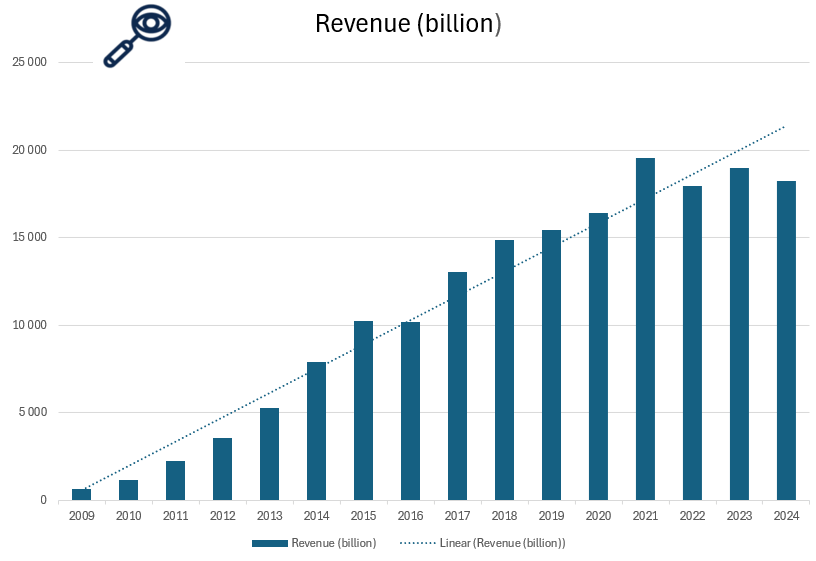
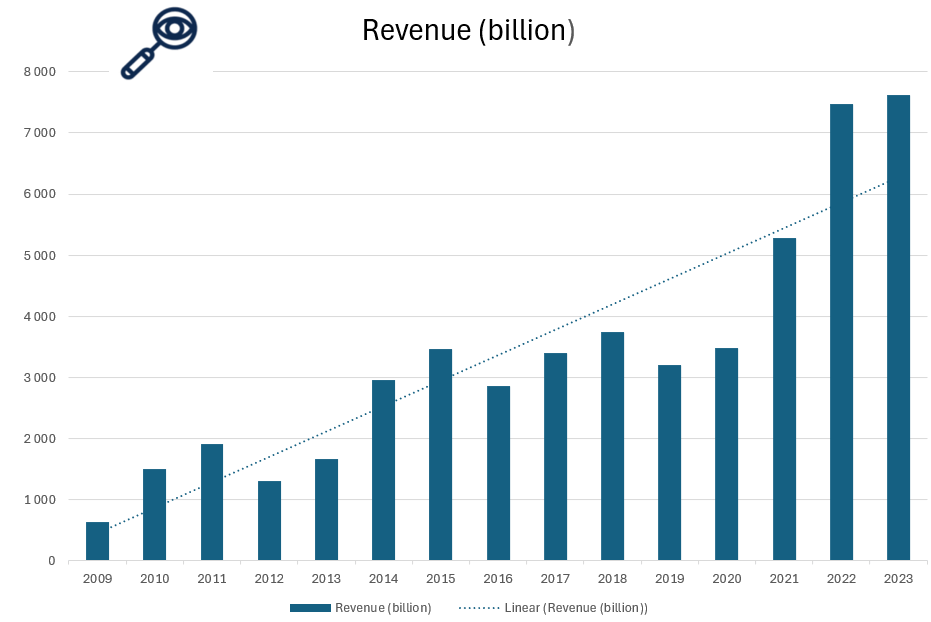
Illustration 9 and 10: Revenue of UnitedHealth Group from 2009 to 2025

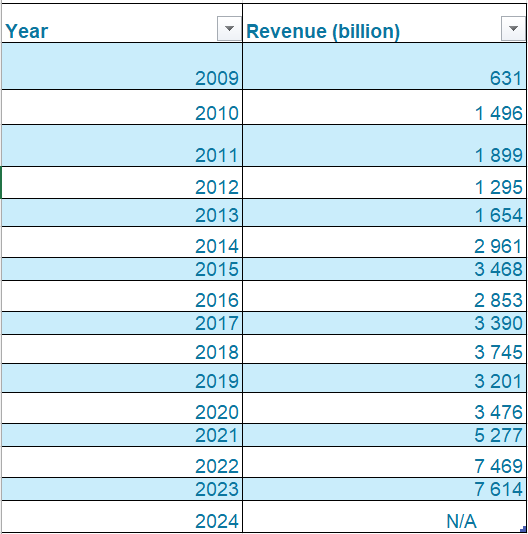
As shown in Illustrations 9 and 10, UnitedHealth Group has delivered steady and consistent revenue growth, rising from approximately USD 87 billion in 2009 to over USD 400 billion in 2025. This long-term upward trend, with no major drops or erratic spikes, signals operational discipline, a resilient business model, and effective long-term planning.

Even during disruptive events like the COVID-19 pandemic and broader macroeconomic uncertainty, UnitedHealth continued to grow thanks to its diversified structure across insurance, pharmacy benefits, and healthcare services. The expansion of Optum, its data, technology, and clinical care platform, has added a high-growth, high-margin engine alongside its core insurance operations.

In short, UnitedHealth’s financial performance sends a strong green flag to long-term investors. It has demonstrated resilience through crises, maintained consistent top-line expansion, and continues to evolve through innovation and scale, all signs of a mature, well-managed company with staying power.

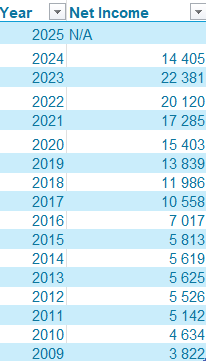
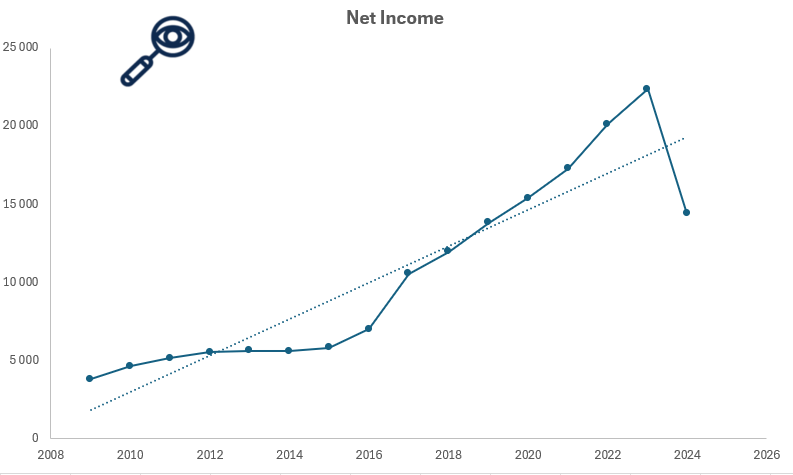
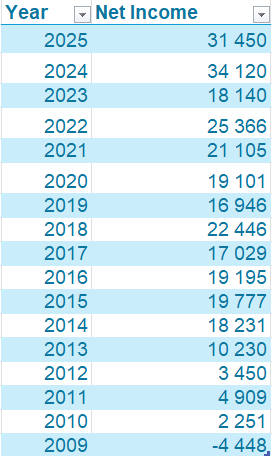
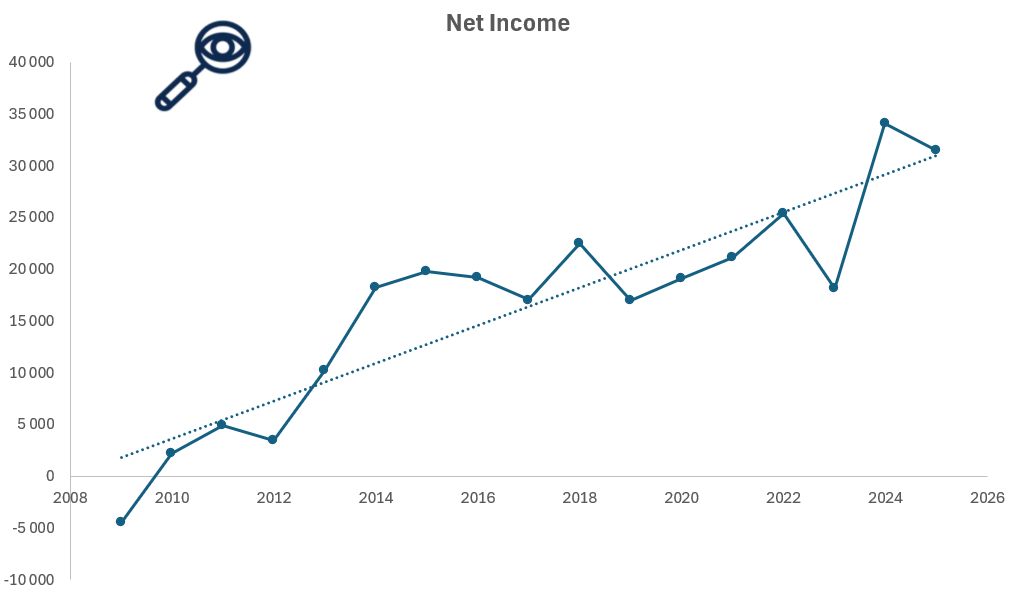
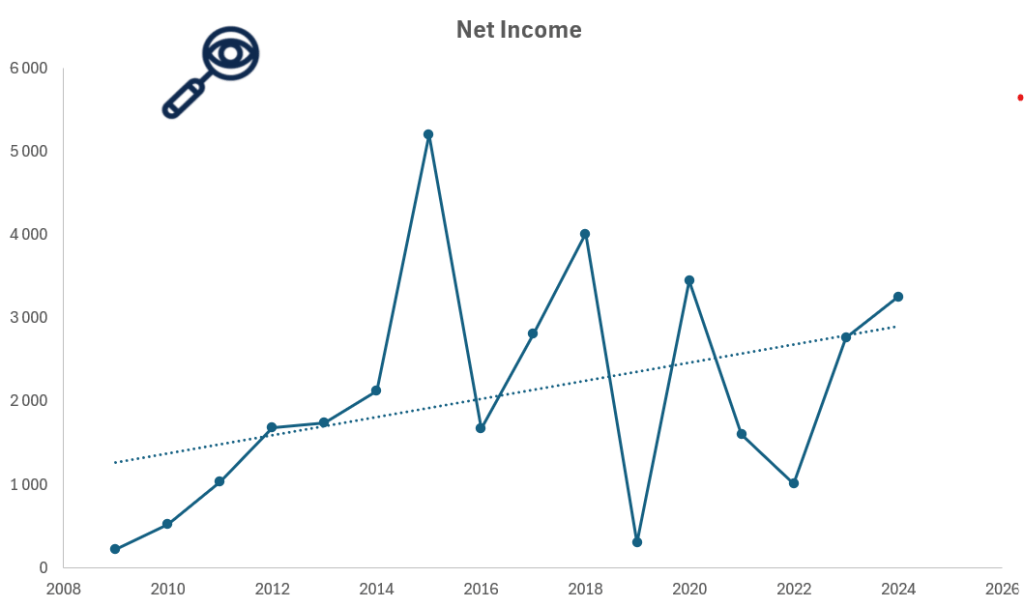
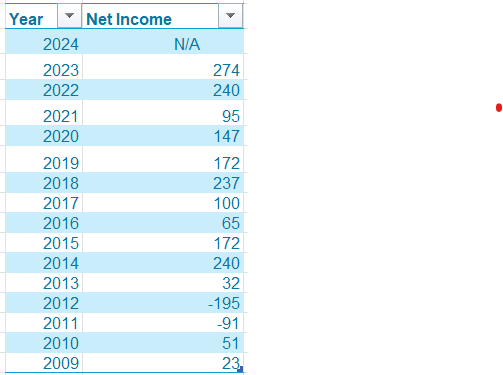
Illustration 11 and 12: Net Income of UnitedHealth Group from 2009 to 2025

Net income is a crucial metric to evaluate when determining whether a company is a worthwhile investment. It represents a company’s net profit or loss after accounting for all revenues, income items, and expenses, calculated as Net Income = Revenue – Expenses.

As seen in Illustrations 11 and 12, UnitedHealth Group’s net income had followed a remarkably steady upward trajectory for over a decade, closely aligned with its revenue growth. However, 2023–2024 marked a sharp departure from that trend, with net income taking an unexpected dip. This drop was primarily triggered by higher-than-expected medical care costs, particularly a spike in outpatient surgeries and elective procedures as patients resumed care that had been delayed during the pandemic. Additionally, increased regulatory scrutiny and pricing pressure in the Medicare Advantage space placed added stress on margins, especially as competitors intensified their push into the same market.

While the decline was noticeable, it’s important to put it in context. This was not a structural failure or sign of long-term weakness, but rather a short-term correction after years of strong growth. UnitedHealth has already responded by adjusting its pricing strategy, tightening cost controls, and expanding high-margin segments within Optum.

For investors, this dip is worth noting, but not panicking over. If anything, it serves as a reminder that even healthcare giants are not immune to volatility in utilization trends. That said, UnitedHealth’s strong fundamentals, diversified operations, and rapid operational response suggest this was a temporary setback, not a red flag for the company’s long-term outlook.

Revenue Breakdown

UnitedHealth Group Inc's Meteoric Rise: Unpacking the 17% Surge in Just 3  Months

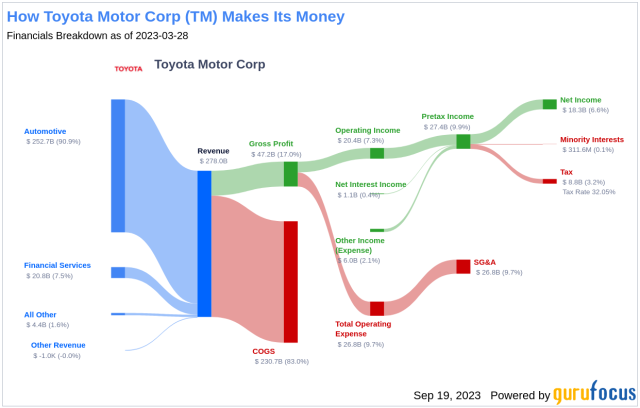
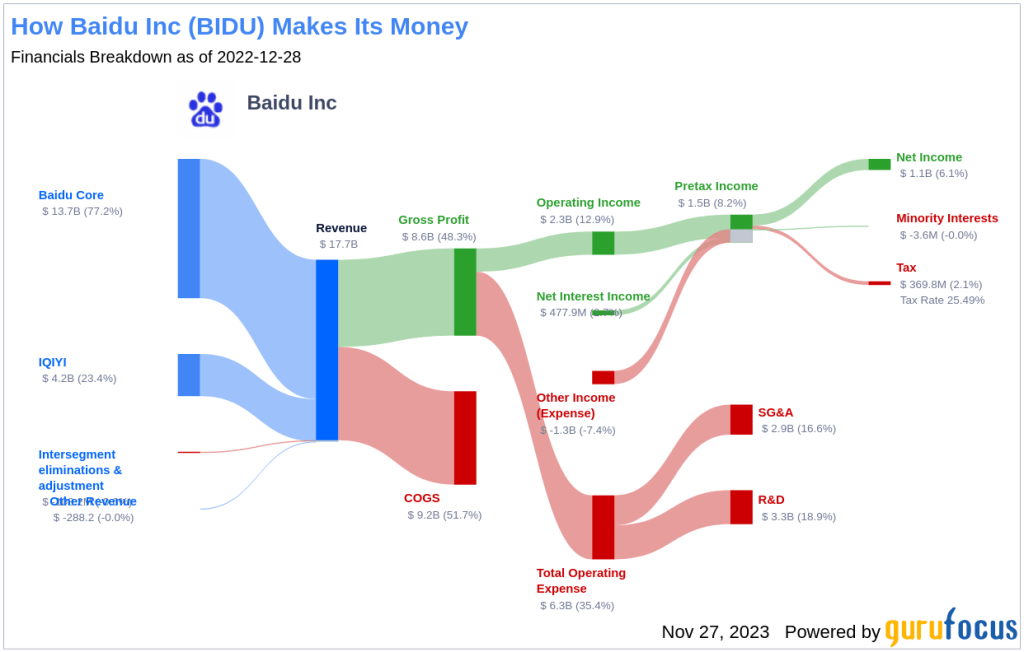
Illustration 13: Revenue breakdown of UnitedHealth Group made by gurufocus.

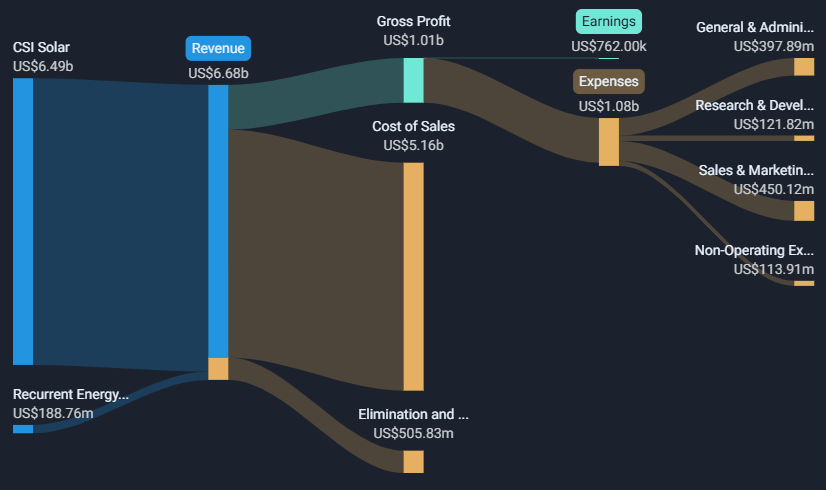
As shown in Illustration 13, UnitedHealth Group’s core health insurance operations remain the primary driver of revenue, consistently contributing the vast majority of total income around 77%. This includes its broad portfolio of commercial insurance plans, Medicare Advantage, Medicaid services, and individual health plans, which together serve millions of members across the United States. UnitedHealth’s extensive network and scale provide it with a competitive edge, enabling stable growth and strong member retention.

Optum Rx, responsible for pharmacy benefit management, represents approximately 12% of revenue. By leveraging extensive data analytics and scale, Optum Rx negotiates drug prices and manages medication use to control overall costs. The segment faces challenges from rising drug prices and regulatory scrutiny, which can pressure margins. Still, its operational efficiency and technological capabilities help maintain strong profitability.ver

Optum Health contributes about 9% of revenue and focuses on delivering integrated care services such as primary care, ambulatory care, and home-based services. This segment invests heavily in care infrastructure and value-based care models, which can increase operating costs in the short term. However, these investments aim to reduce long-term healthcare expenses by improving patient outcomes and lowering hospitalizations, positioning Optum Health as a key driver of future growth in a shifting healthcare landscape.

Optum Insight makes up about 1.6% of revenue and provides health IT, data analytics, and consulting services to healthcare providers and payers. This segment has relatively lower costs compared to others and offers high-margin growth potential as demand for healthcare technology and analytics expands.

UnitedHealth balances costs and investments by leveraging UnitedHealthcare’s scale to manage claims volatility and Optum’s innovation to drive efficiency. Despite high costs from medical claims and services, this approach supports steady revenue growth and stable margins, making it a strong choice for investors seeking resilience and growth.

Earnings per Share

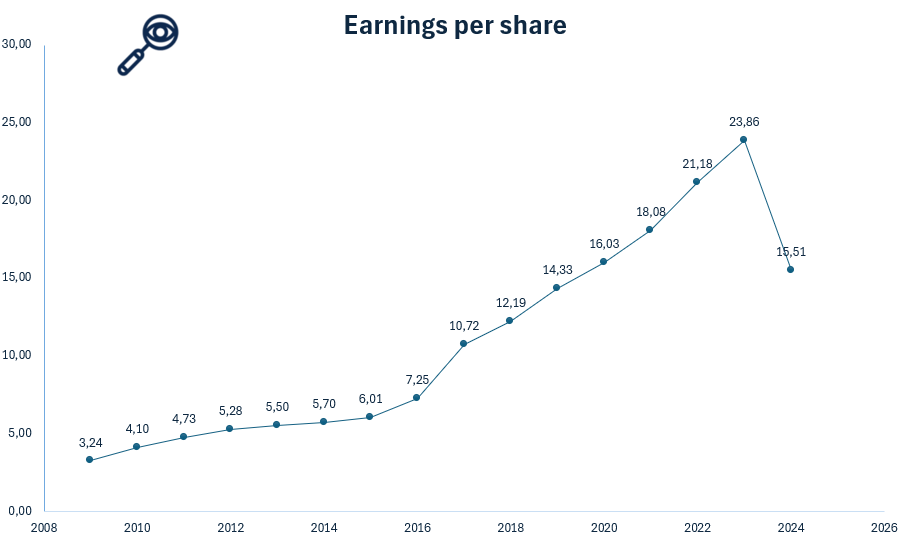
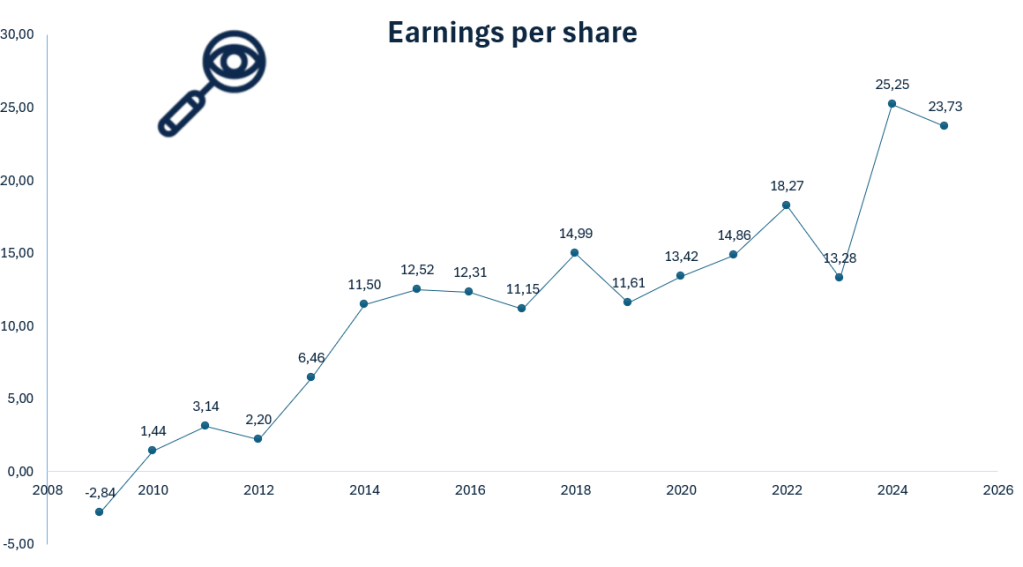
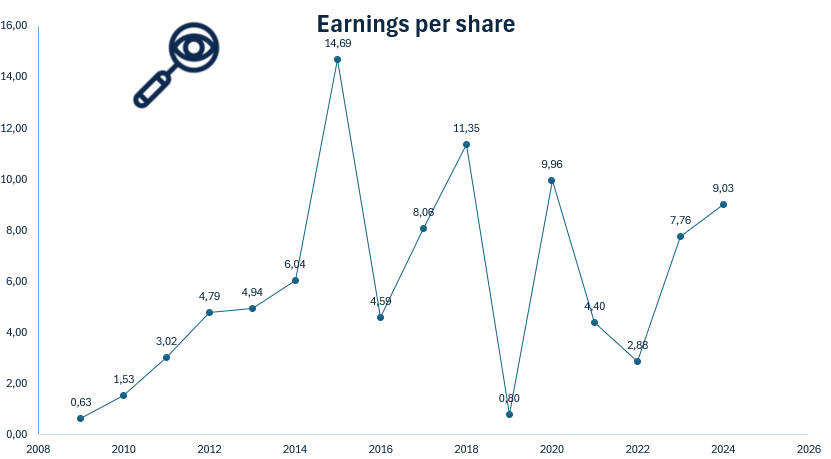
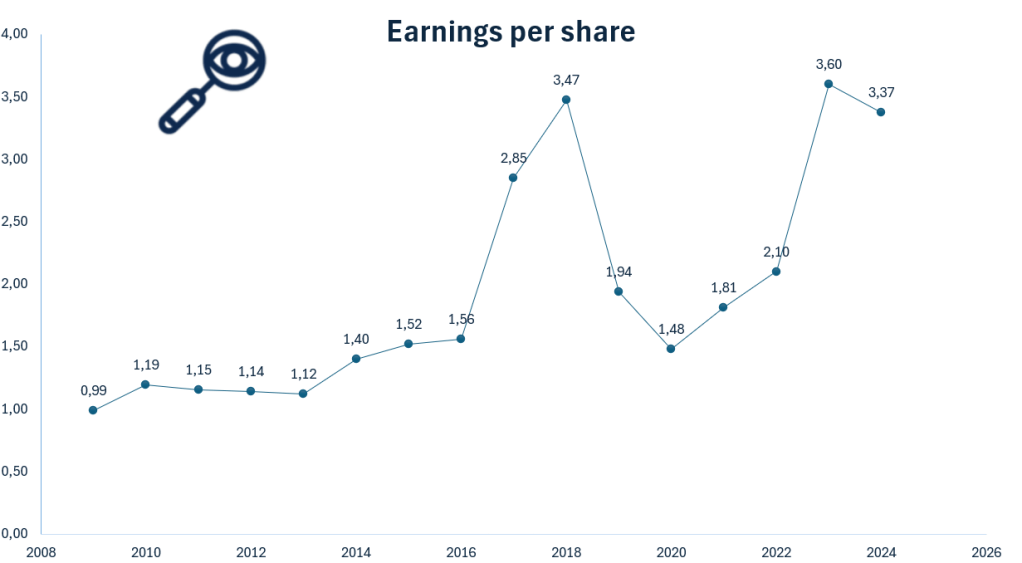
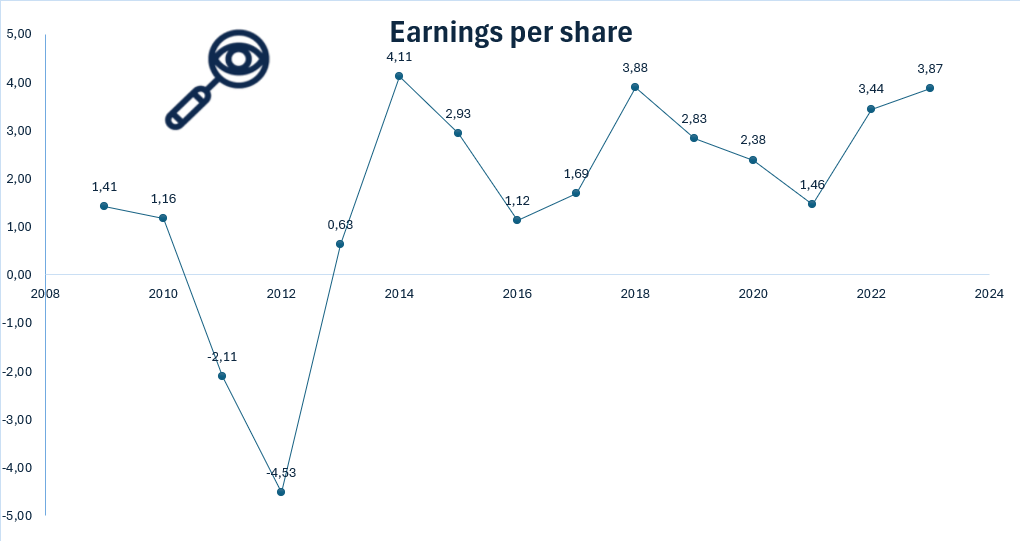
Illustration 14; Earnings per share for UnitedHealth Group from 2009 to 2024

Earnings Per Share (EPS) is a crucial measure of how much profit UnitedHealth Group generates for each share of its stock, offering insight into its profitability and financial health. For investors, what truly matters is consistent growth in EPS over time, which signals strong performance and long-term value.

The EPS figure itself isn’t the primary focus for value investors, it can be 0.2 or 10, but what truly matters is the company’s ability to generate consistent earnings growth. A steadily increasing EPS over time signals strong financial health, profitability, and long-term value creation.

UnitedHealth’s EPS showed steady growth for years, reflecting its ability to deliver reliable profits through diversified healthcare services and efficient operations. However, there was a noticeable drop in EPS from 2023 to 2024, mainly due to increased medical claims costs and investments in new care initiatives. While this decline might raise some concerns, it’s important to see it in context: UnitedHealth is investing heavily in innovation and expanding its services, which could drive future growth.

Overall, the company’s strong track record of EPS growth combined with its strategic investments suggests resilience and potential for recovery, making it a compelling option for investors focused on long-term gains rather than short-term fluctuations.

Assets and Liabilities

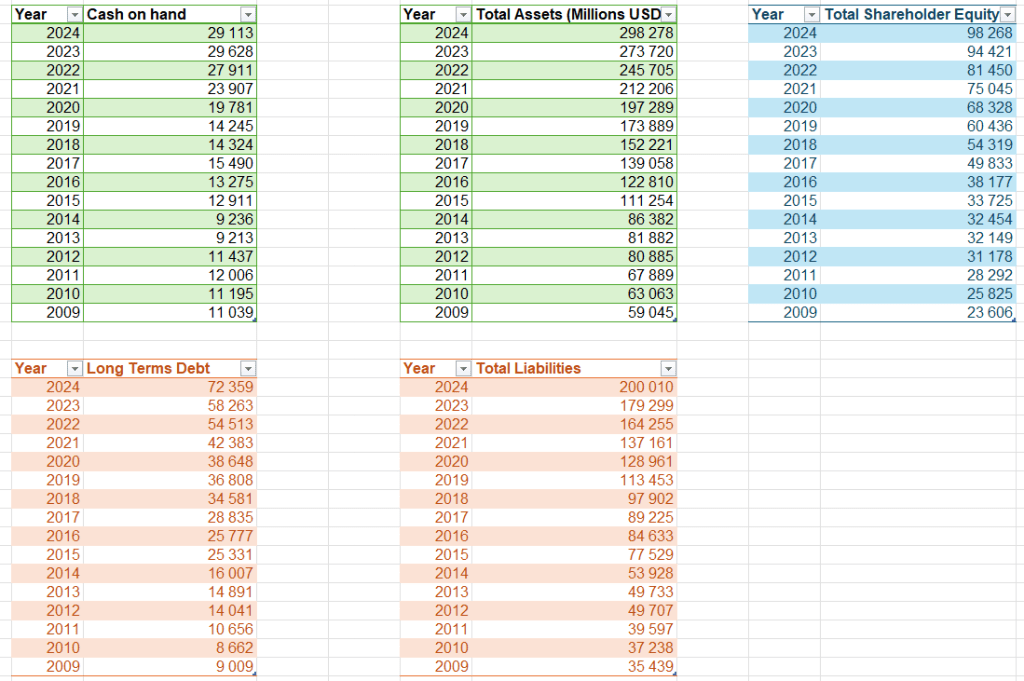
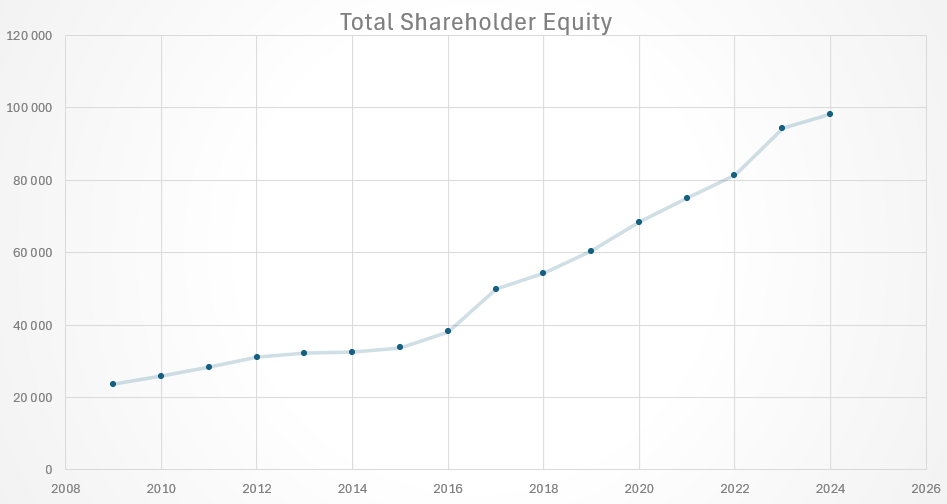
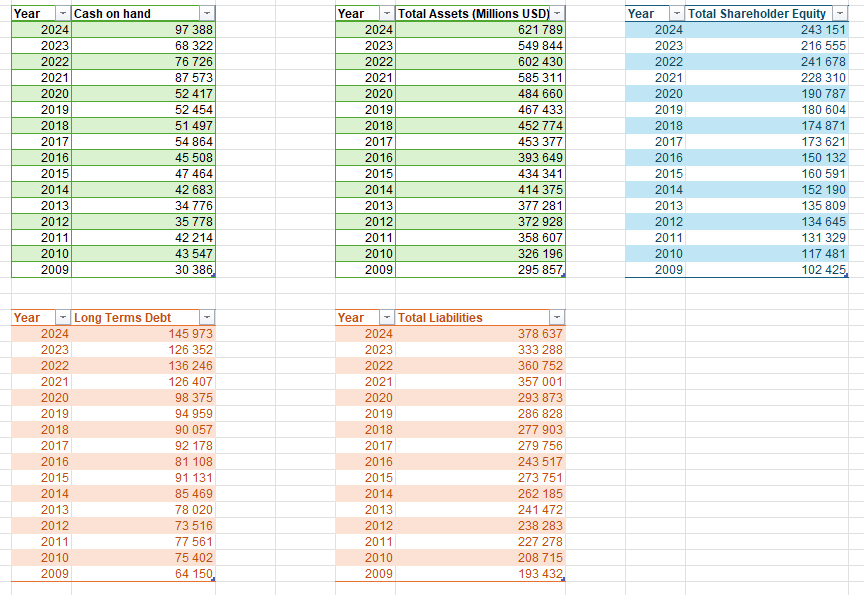
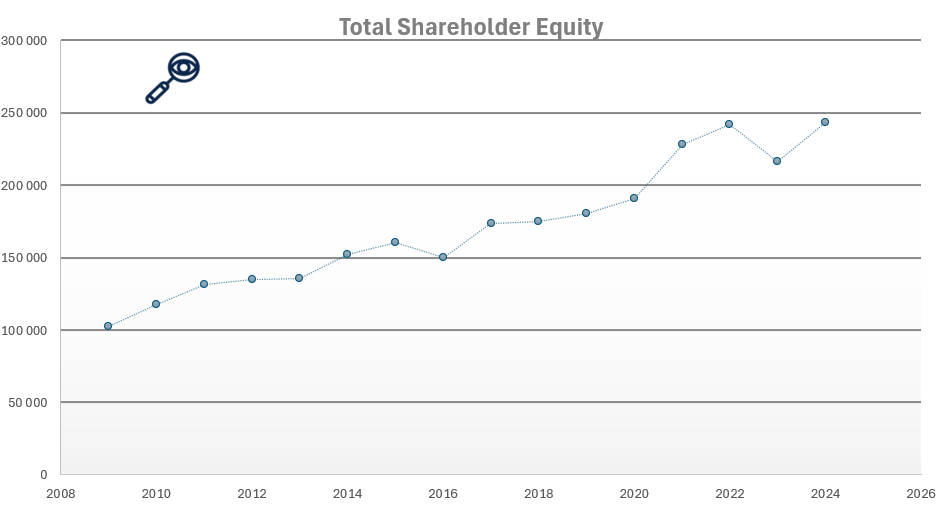
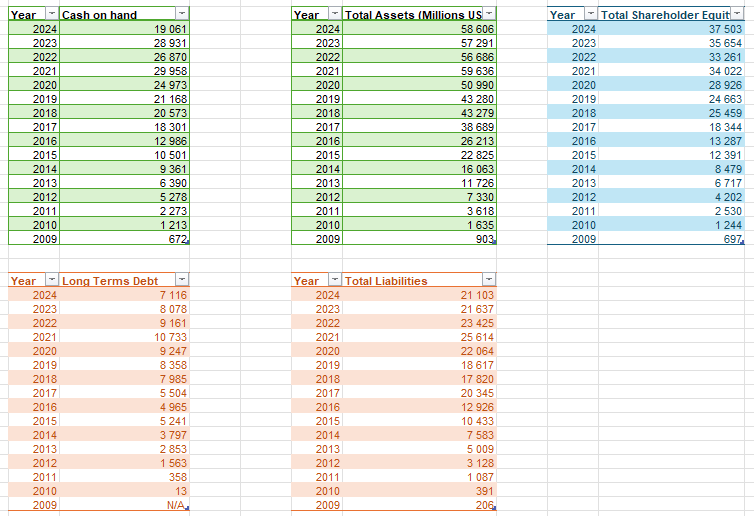
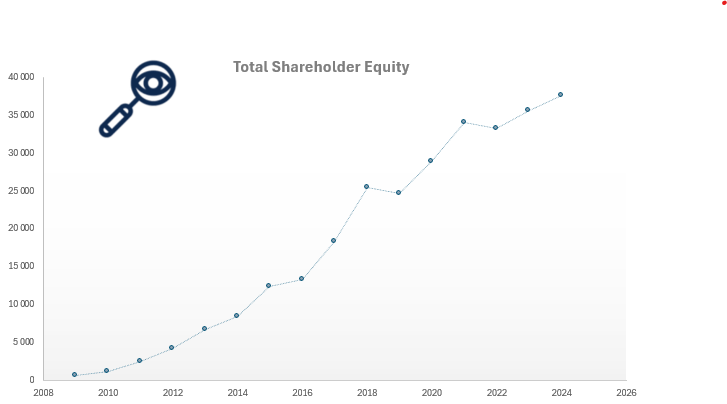
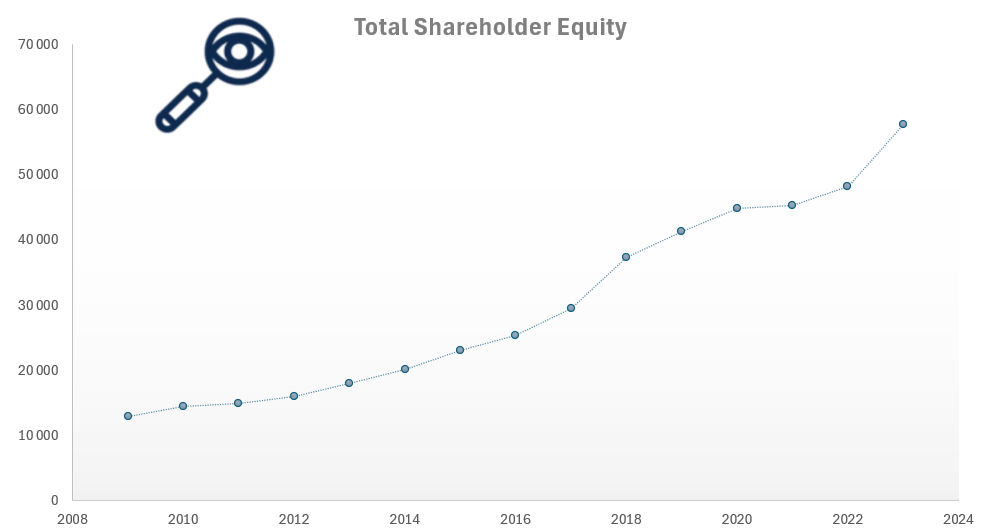
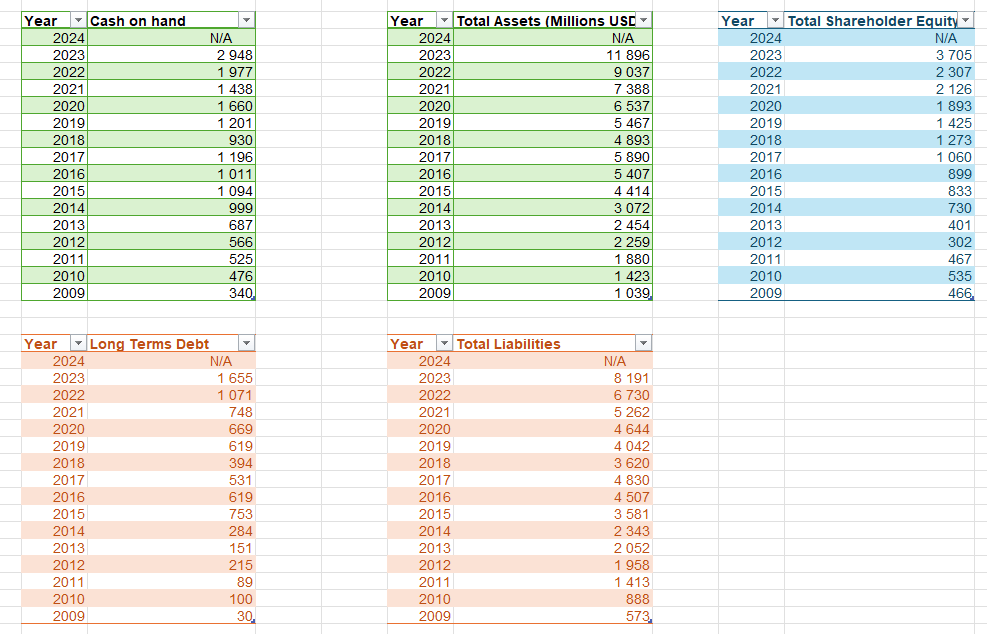
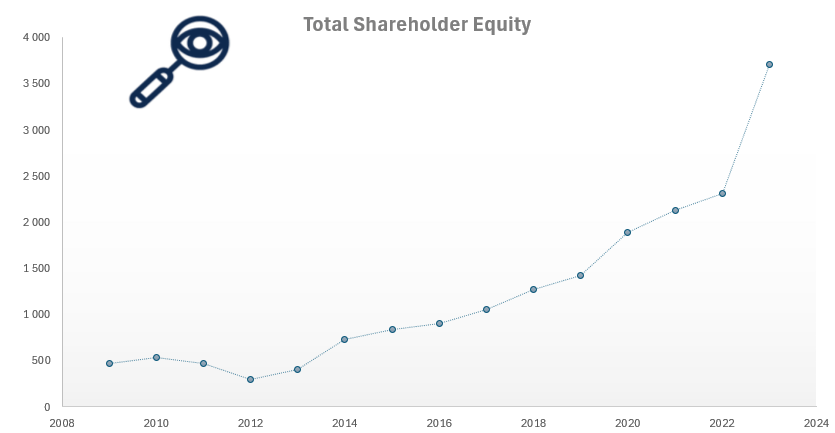
Illustration 15 and 16: Assets and Liabilities for UnitedHealth Group from 2009 to 2024

When sizing up UnitedHealth Group as an investment, it’s like checking under the hood before buying a car, you want to know what’s powering the engine and how well it’s maintained. UnitedHealth has been steadily growing its assets over the years, showing that its motor is strong. The total asstes have gone up from USD 59 million USD in 2009 to nearly 300 in 2024.

But here’s a twist: its cash on hand is surprisingly low compared to its debts. That’s a bit of a red flag because having limited cash means less wiggle room to handle unexpected costs or jump on new opportunities quickly. It’s like having a powerful engine but a nearly empty fuel tank, something investors need to watch closely. Its cash on hand is also significantly below its long term debt which is a red flag for potential investors. That is total liabilities has grown over time is also a red flag that should be closely monitored.

Now for the good news. UnitedHealth’s shareholder equity. the real measure of what the company owns outright, has been climbing steadily. This means it’s building solid value and managing its financial foundation well. Growing equity signals strength and stability, which is a green flag for anyone looking for a company that can weather storms and keep growing.

In short, while the tight cash situation raises some caution, the impressive rise in shareholder equity shows UnitedHealth is on a strong, responsible path. Investors should keep an eye on how it balances these factors because how UnitedHealth handles its cash and debt will shape its ability to keep leading in the fast-evolving healthcare world.

Debt to Equity Ratio

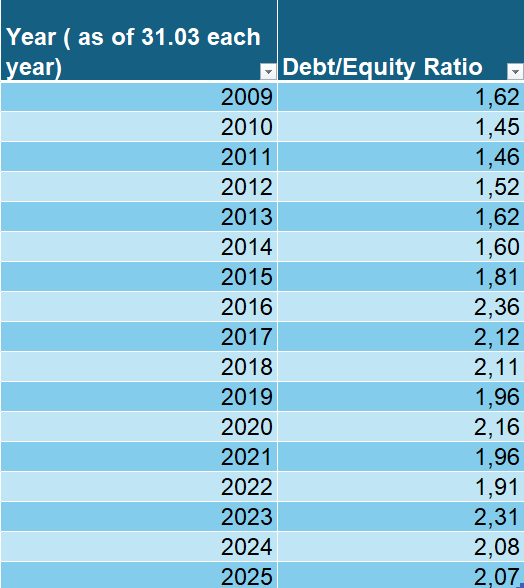
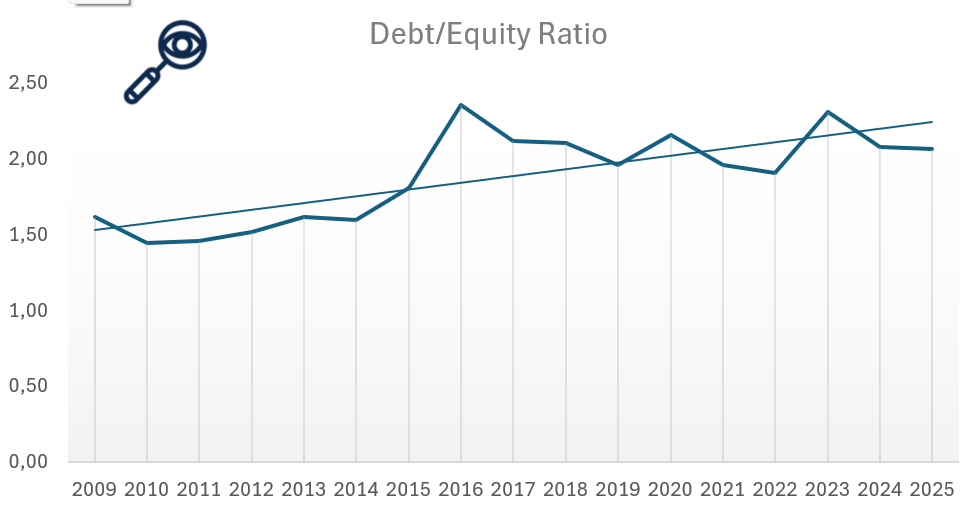
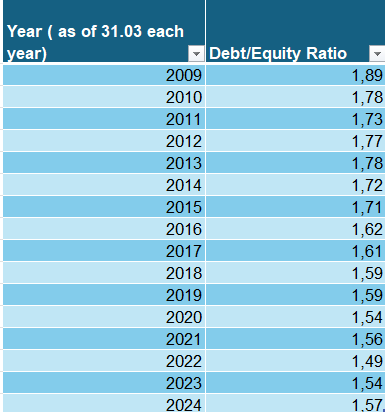
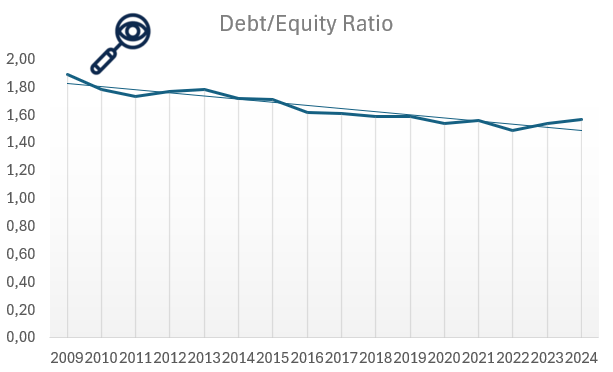
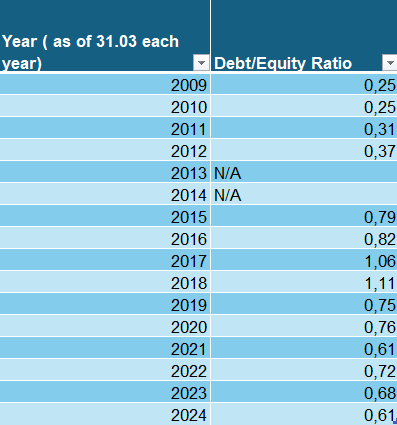
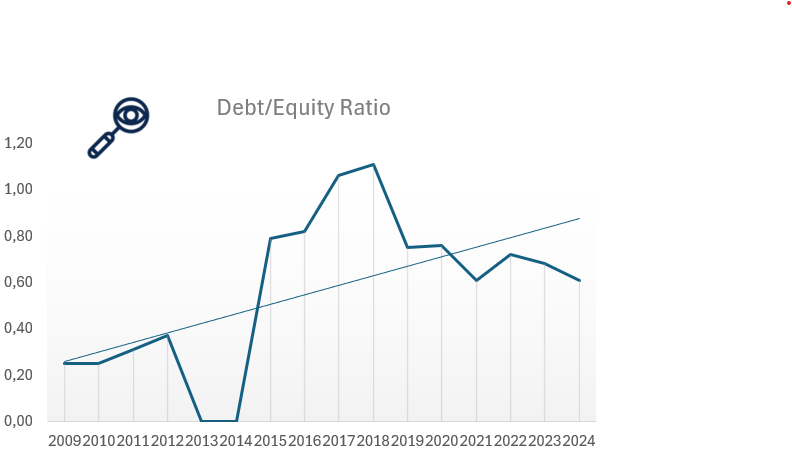
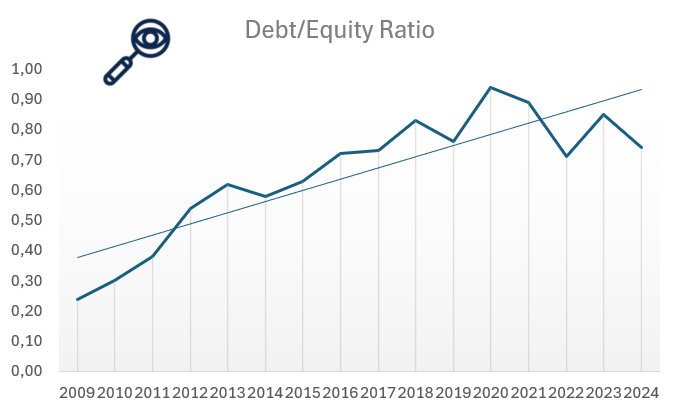
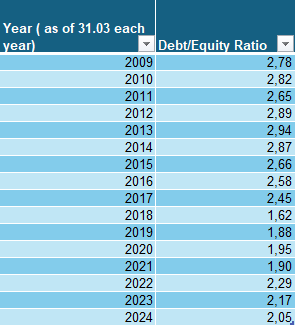
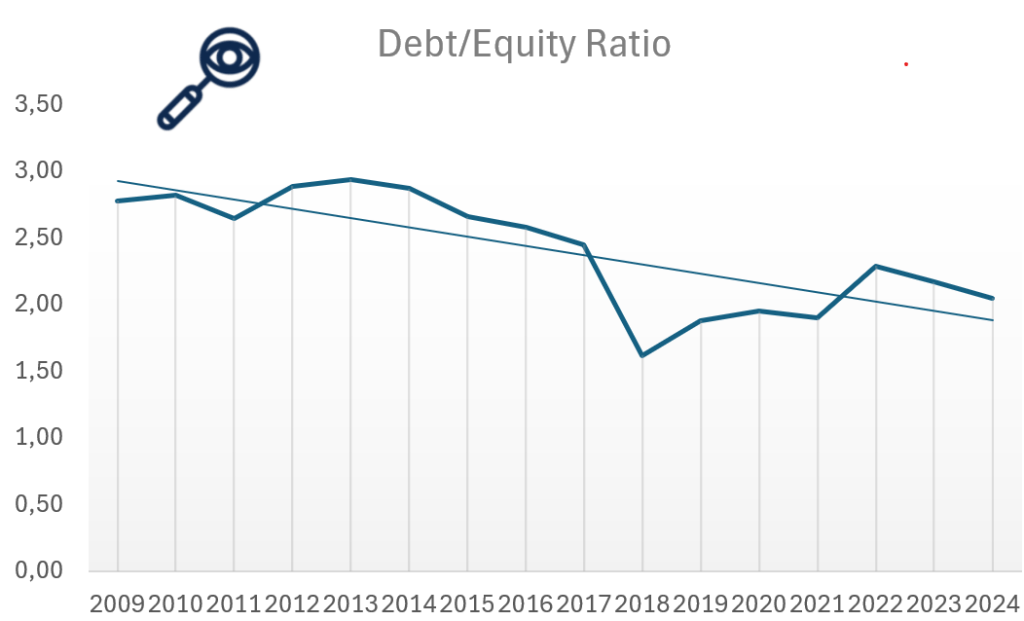
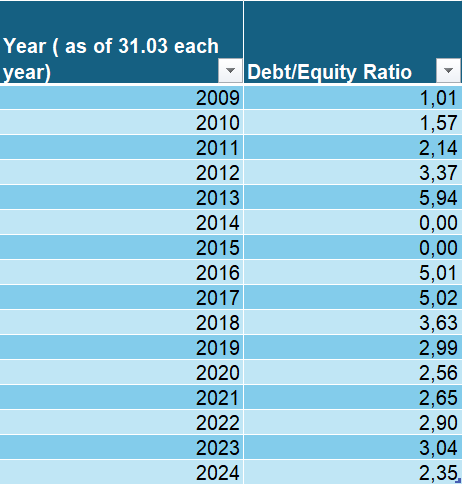
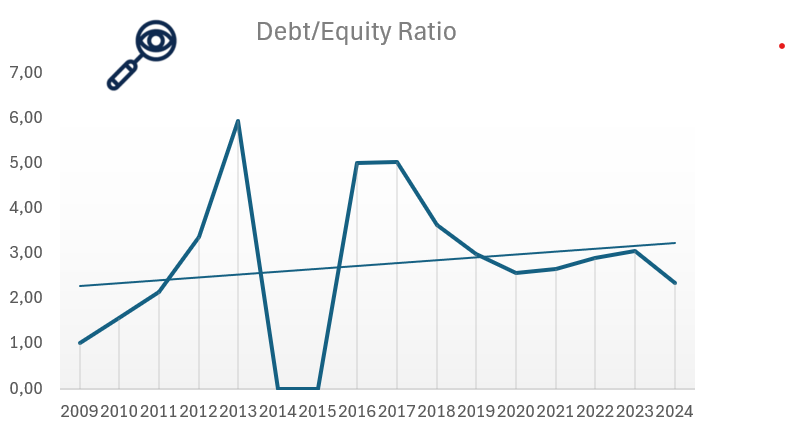
Illustration 17 and 18: Debt to equity ratio for UnitedHealth Group from 2009 to 2024

The Debt-to-Equity (D/E) ratio is an important financial metric for assessing a company’s financial leverage and risk. It compares the amount of debt the company uses to finance its operations relative to its shareholder equity. A high D/E ratio suggests that the company relies more heavily on debt to fuel growth, which could increase financial risk, especially during economic downturns when managing debt obligations becomes more challenging. In contrast, a lower D/E ratio indicates that the company is primarily financed through equity, reducing financial risk but potentially limiting its ability to rapidly expand.

Warren Buffett, a legendary value investor, typically prefers a debt-to-equity (D/E) ratio below 0.5 as a sign of conservative financial management. UnitedHealth Group’s D/E ratio was notably higher at around 2 in 2024 which is a potential red flag. In addition it’s D/E ratio has increased steadily from 2009 to 2024. This elevated level reflects the company’s significant use of debt to finance its large-scale investments in expanding healthcare services, technology, and pharmacy benefit that are areas driving its growth. While a rising D/E ratio can be a red flag signaling increased financial risk and greater leverage, it’s important to consider that UnitedHealth is strategically deploying this debt to support long-term growth. Investors should watch the trend closely, it is not neccessairly a red flag if it is using the debt to finance its growth but it should be closely monitored.

Price to earnings ratio (P/E)

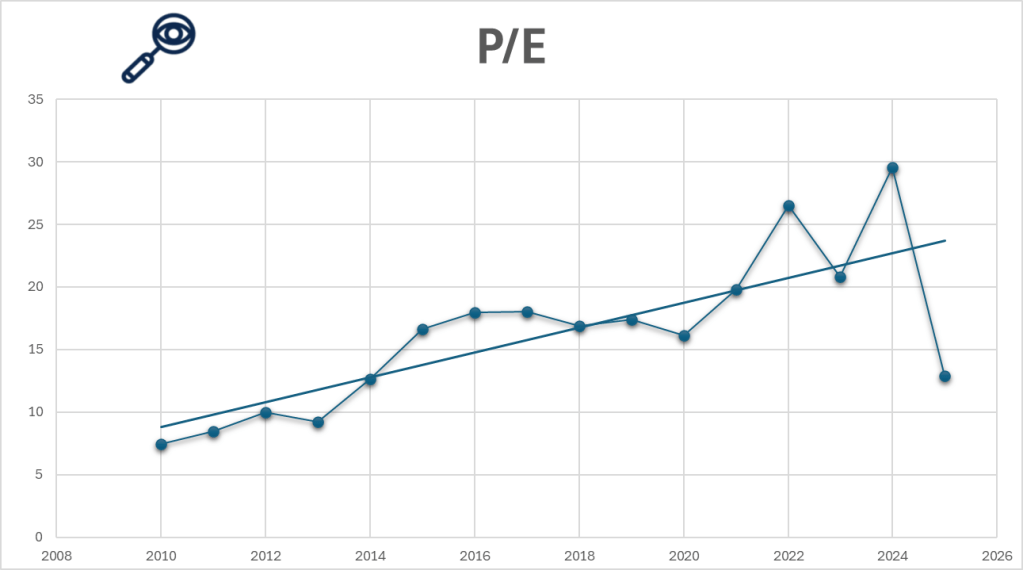
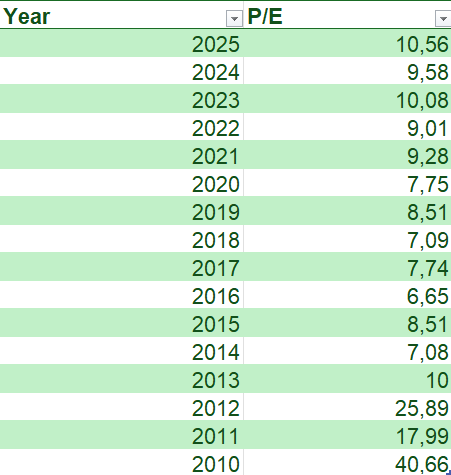
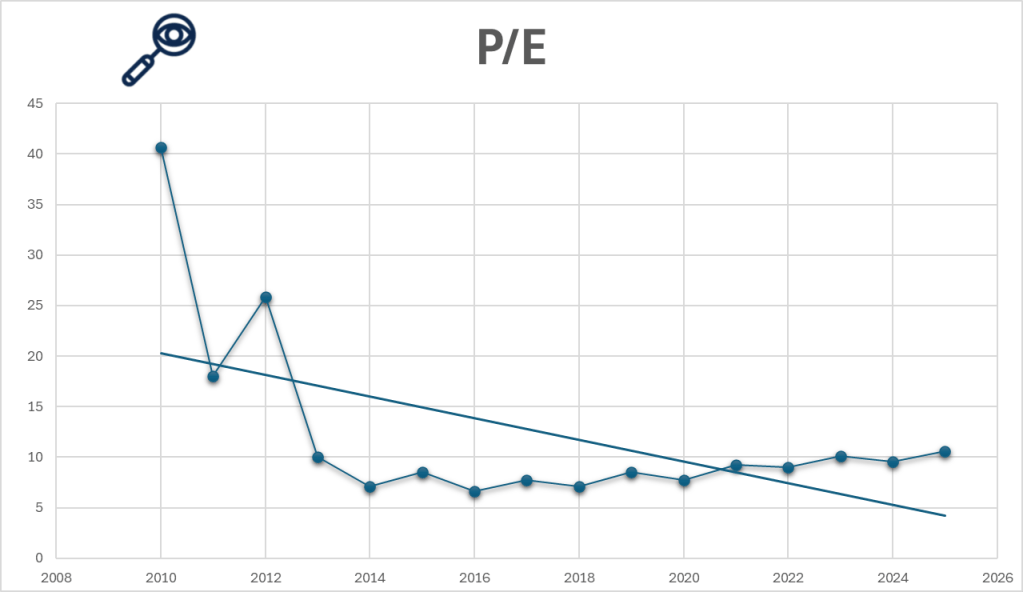
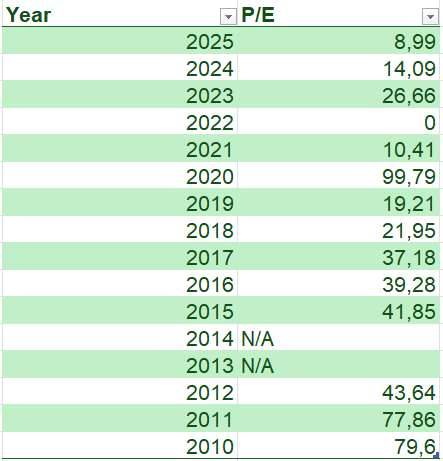
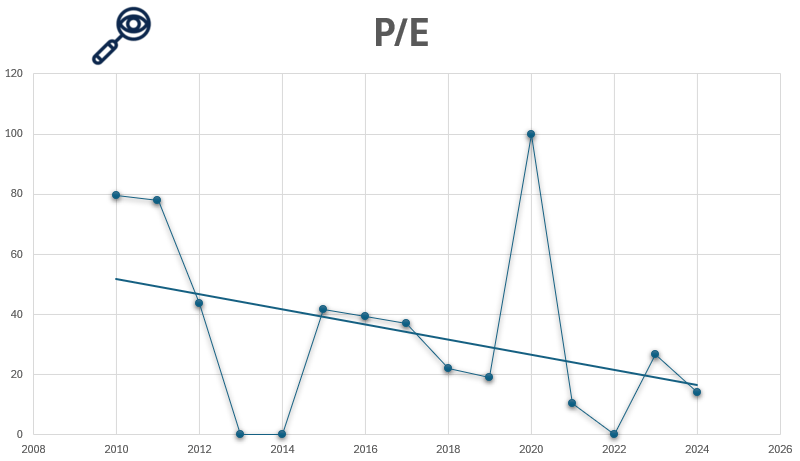
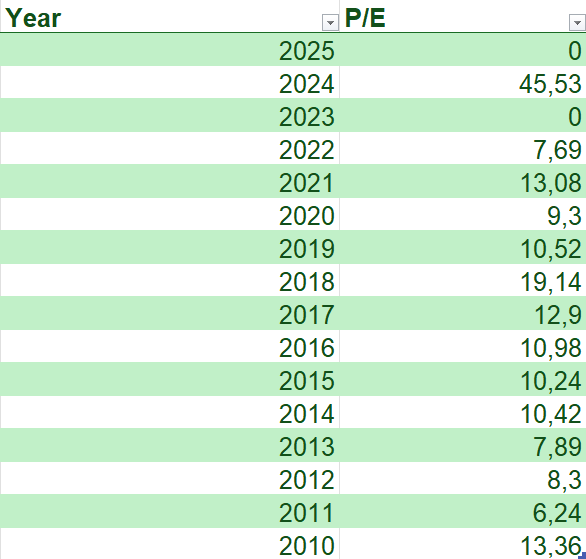
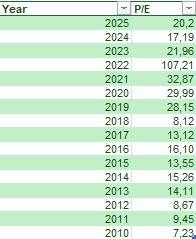
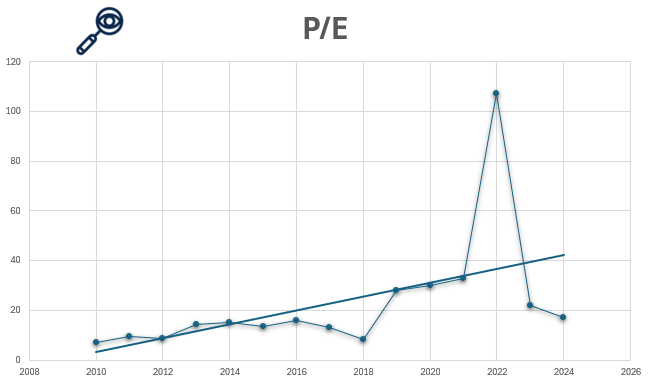
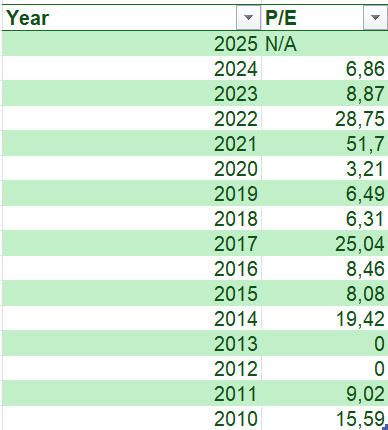
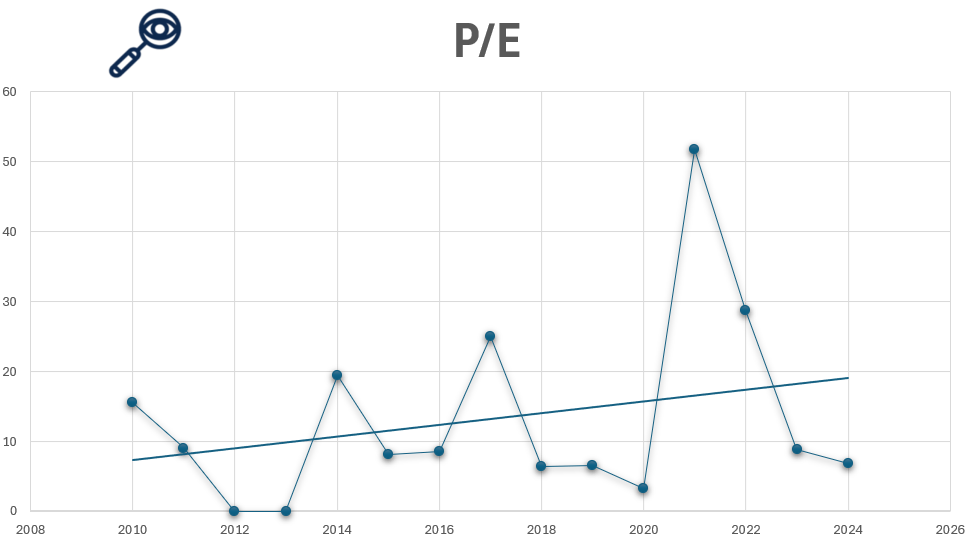
Illustration 19 and 20: Price to earnings ratio for UnitedHealth Group from 2009 to 2025

For value investors, one of the first numbers worth checking when evaluating a stock like UnitedHealth Group is the price-to-earnings (P/E) ratio. It’s like the price tag on a business and just like in real life, paying too much, even for something great, can ruin the deal. Think of it this way: imagine a business that reliably earns $1 million per year. If you could buy the whole thing for just $1, you’d jump at the opportunity. But what if the owner wanted $1 trillion for it? Suddenly, the exact same business looks like a terrible investment. The stock market is no different. Companies go in and out of favor, and sometimes great businesses get temporarily mispriced. That’s when value investors pay attention.

Warren Buffett, the oracle of Omaha himself, has famously looked for companies trading at 15 times earnings or less, calling them “bargains.” Historically, UnitedHealth Group (UNH) , America’s largest health insurer , has traded well above that range, often with a P/E between 17 and 24, reflecting its strong growth, dependable cash flow, and dominant market position in a sector that rarely slows down. But here’s where things get interesting: after recent political noise surrounding Medicare Advantage and changes to reimbursement rates, UnitedHealth’s P/E ratio has dropped to around 13.

For long-term investors focused on value, this drop could be a golden opportunity. The core business remains intact. UnitedHealth continues to post strong revenue and earnings, and demand for managed care isn’t going anywhere. If anything, the recent dip looks more like a market overreaction than a true reflection of the company’s future prospects. This suggest that it is a good time for investors to buy this stock.

Price to Book Ratio (P/B)

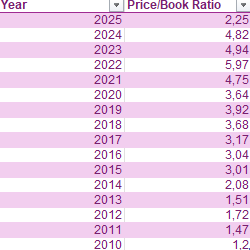
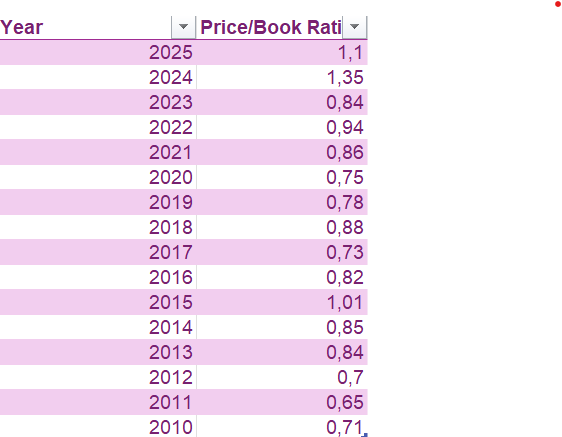
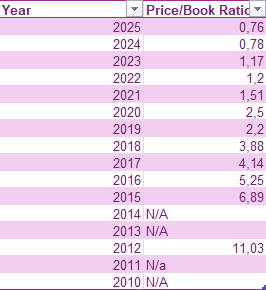
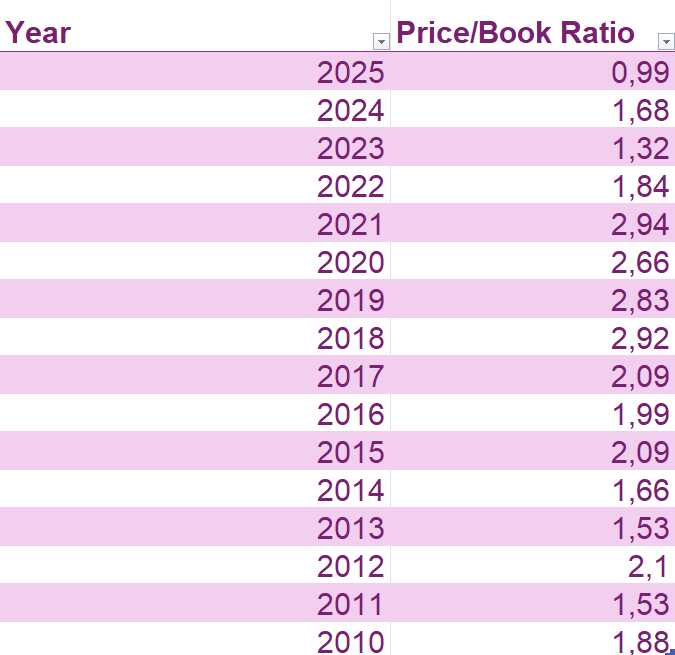
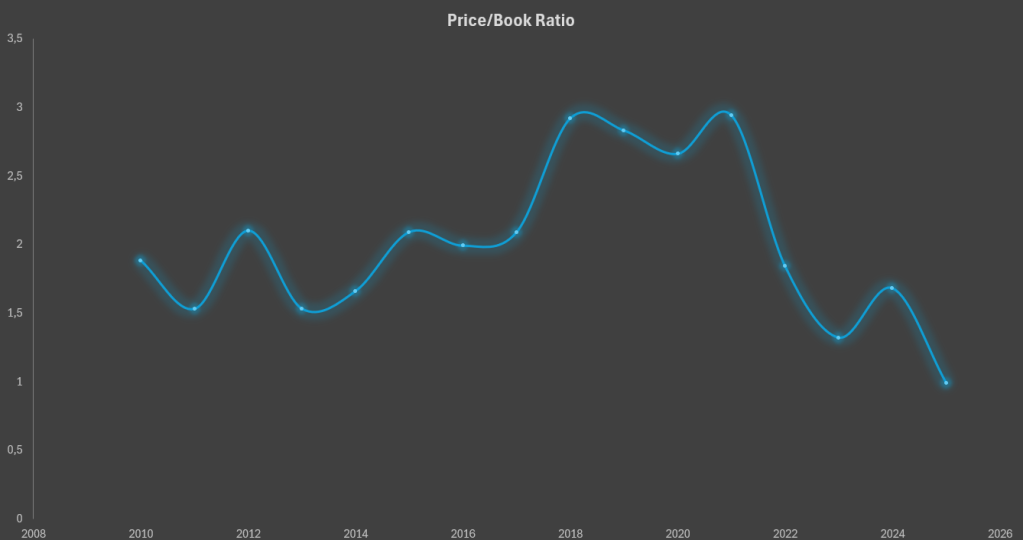
Illustration 21 and 22: Price to book ratio for UnitedHealth Group from 2009 to 2025

When it comes to spotting value, the price-to-book (P/B) ratio is a favorite tool of seasoned investors, especially those following in Warren Buffett’s footsteps. This ratio compares a company’s stock price to the net value of its assets (book value). A P/B below 1.5 is often seen as the sweet spot, with Buffett himself known to buy in around 1.3 or lower when quality meets value. UnitedHealth Group, a dominant force in American healthcare, isn’t usually seen as a “deep value” stock — but recent events have changed the narrative. Historically trading at a P/B between 4 and 6, UnitedHealth’s valuation took a noticeable hit between late 2024 and mid-2025, driven by political pressure around Medicare Advantage, reimbursement rate shifts, and broader volatility in the healthcare sector. As a result, its P/B ratio dropped to the 3.2–3.4 range which is the lowest in years.

Now, that may not scream “cheap” compared to old-school industrials or banks. But for a healthcare juggernaut with massive scale, strong free cash flow, and a fortress balance sheet, this pullback could represent an overlooked opportunity. A lower P/B in this context suggests that the market is undervaluing the company’s underlying assets and future cash flows, not because the fundamentals are weak, but because of short-term fear .For value-oriented investors, this shift in valuation might be exactly what they wait for: a blue-chip compounder trading at a tangible discount. If UnitedHealth’s earnings power holds steady, and all signs suggest it will, this could be one of those rare windows where Wall Street’s caution creates Main Street’s opportunity.

Return on Investment (ROI)

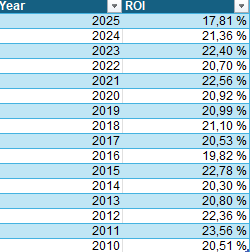
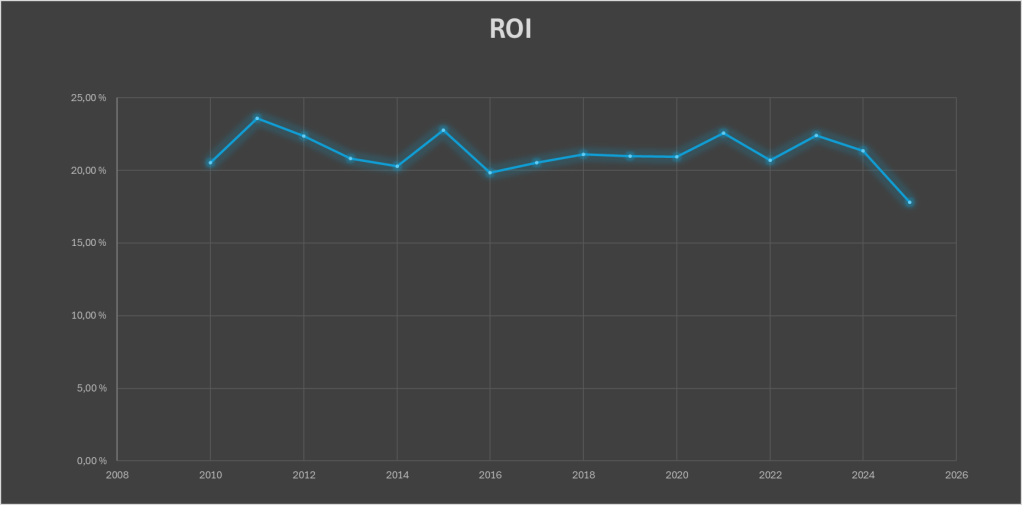
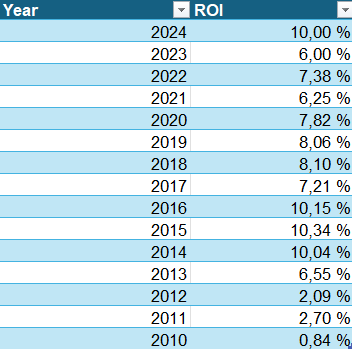
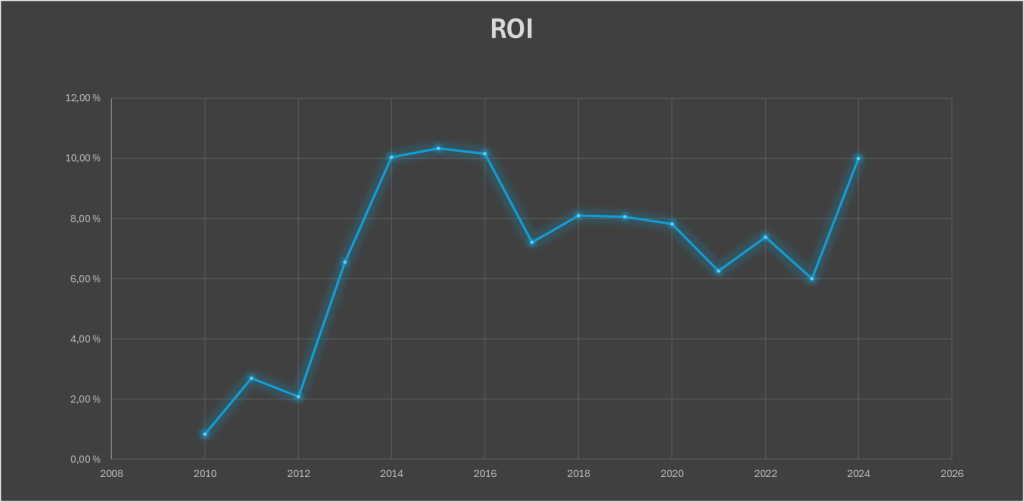
Illustration 23 and 24: Return on investment for UnitedHealth Group from 2009 to 2025

For value investors, Return on Investment (ROI) is another vital lens for evaluating a company like UnitedHealth Group. It tells you how effectively a business turns capital into profits, not just how much it earns, but how efficiently it earns it. You wouldn’t want to invest in a company that needs $10 billion to squeeze out mediocre returns when another business can produce similar profits with half the capital. That’s where ROI comes in. It separates the capital-efficient winners from the bloated operations. A company generating high profits on lean capital is usually doing something right, and investors like Warren Buffett are always on the lookout for those with strong, sustainable returns on capital. While Buffett rarely quotes ROI directly, his investment philosophy centers around the same idea: he seeks companies that can generate 15% or more annually over time through smart capital deployment.

Historically, UnitedHealth Group has been a capital-efficiency machine, delivering ROI in the 20% range, well above most healthcare peers and more in line with what Buffett looks for. Its diversified structure, spanning insurance, pharmacy benefits, and healthcare services via Optum, has allowed it to generate strong returns with less volatility than other insurers. But in late 2024 through mid-2025, ROI slipped, dropping below 20%, a noticeable decline tied to political uncertainty, slower-than-expected growth in Medicare Advantage, and rising costs in care delivery. Some investors took it as a red flag.

But here’s the twist: even with that drop, UnitedHealth’s ROI remains competitive, especially for a highly regulated, capital-heavy industry like healthcare. And if margins normalize, which seems likely once short-term headwinds ease, returns could rebound toward historical averages. For investors focused on long-term capital efficiency, this dip may be more opportunity than concern. UnitedHealth’s track record shows disciplined spending, intelligent reinvestment, and the ability to weather policy shocks. A temporarily lower ROI doesn’t erase a decade of strong returns, but it might give value-minded investors a rare opening to buy a world-class compounder at a discount.

Dividend

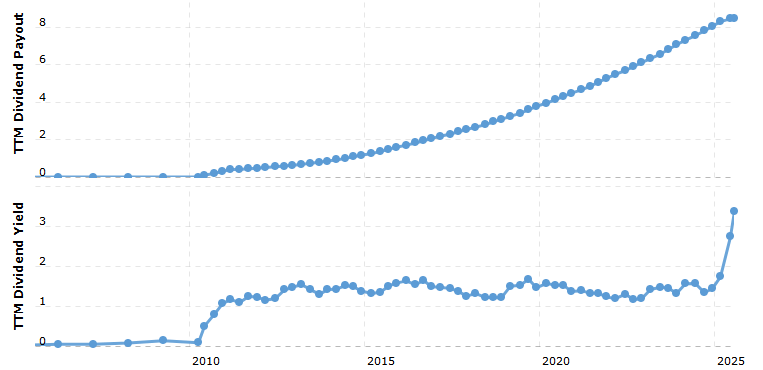
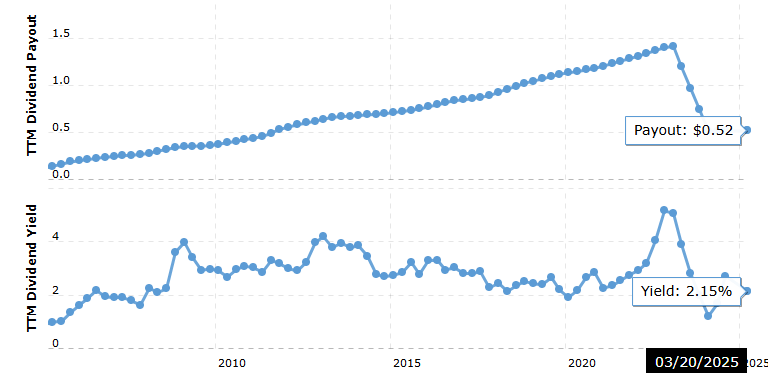
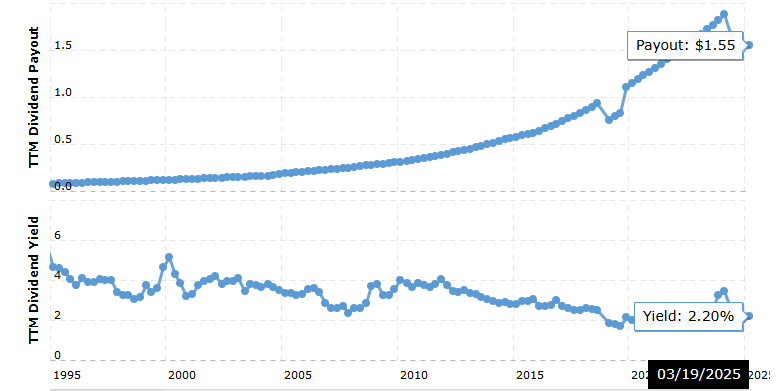
Illustration 25: Dividend Payout and Yield of UNH from 2005 to 2025

UnitedHealth Group has established itself as a dependable dividend payer in the healthcare sector, offering consistent and impressive annual dividend increases over the past decade. As of 2025, the company pays a quarterly dividend of $2.10 per share, amounting to an annual payout of $8.40. This marks a significant rise from the $0.28 per share quarterly dividend paid in 2015, reflecting a more than sevenfold increase in just 10 years. Such growth underscores UnitedHealth’s commitment to delivering shareholder value while maintaining strong financial performance and disciplined capital allocation. The company’s ability to consistently raise dividends, even during times of macroeconomic stress, highlights its robust cash flow and long-term business resilience, making it particularly appealing to income-oriented investors.

That said, investors should consider UnitedHealth’s dividend yield, which typically ranges between 1% and 1.5%. While the company continues to raise its dividend annually, its relatively low yield reflects a high stock price and a strategy centered on long-term expansion. Substantial capital is still being directed toward strategic acquisitions, digital health initiatives, and expanding healthcare services through its fast-growing Optum segment. These growth priorities may moderate the pace of future dividend hikes, particularly if rising healthcare costs, regulatory scrutiny, or margin pressures begin to affect earnings growth. Nonetheless, UnitedHealth’s strong track record suggests it is well-positioned to continue delivering growing dividend payouts over the long term.

Insider Trading

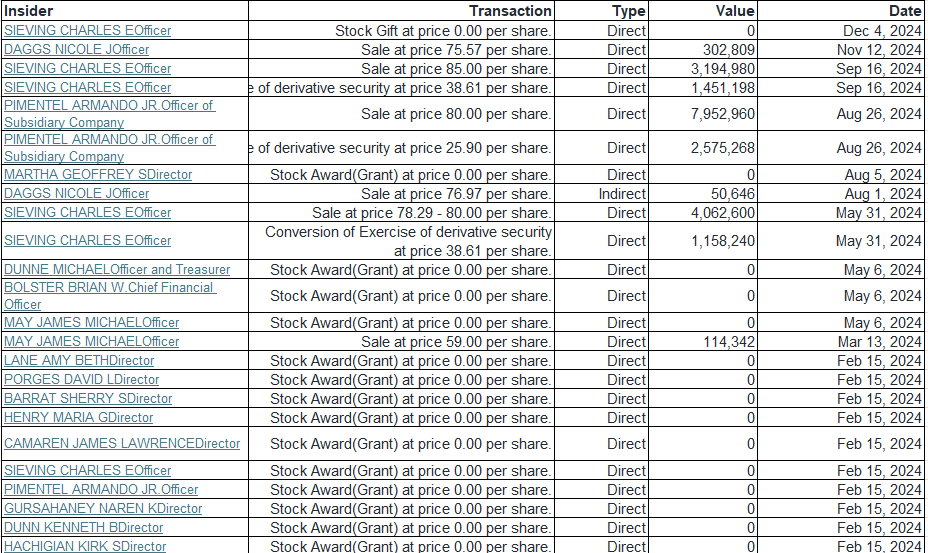
In late 2023 and early 2024, several UnitedHealth Group executives, including then-CEO Andrew Witty and CFO John Rex, sold large amounts of stock, much of it through pre-planned 10b5-1 programs. However, the timing raised concerns, as these sales occurred shortly before news broke of a Department of Justice antitrust investigation. The sales triggered political and regulatory scrutiny, with lawmakers requesting an SEC investigation. This pattern raised red flags around governance, timing, and transparency.

In contrast, 2025 saw a sharp reversal. After UnitedHealth’s stock plunged nearly 50%, a wave of insider buying signaled renewed confidence. CEO Stephen Hemsley purchased $25 million worth of stock, joined by the CFO and several board members in a coordinated buying spree exceeding $30 million. These open-market purchases, some of the largest in company history, send a strong green signal, suggesting insiders see long-term value and are committed to the company’s recovery.

Other Company Info

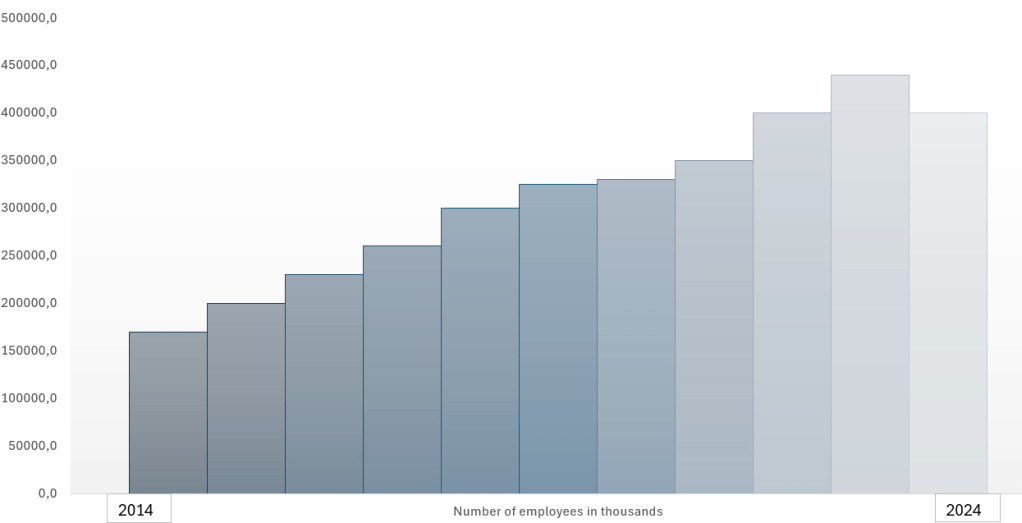
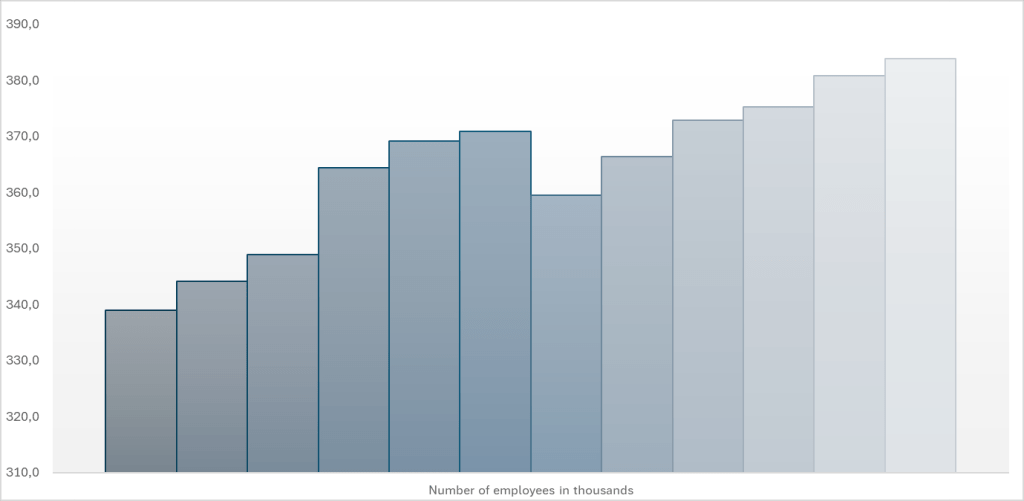
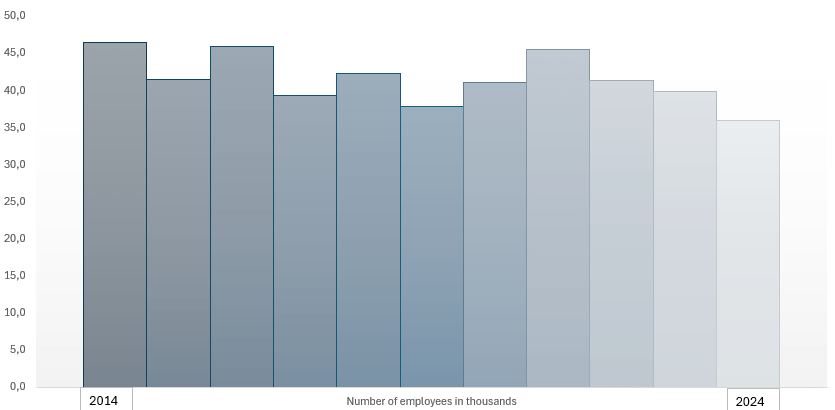
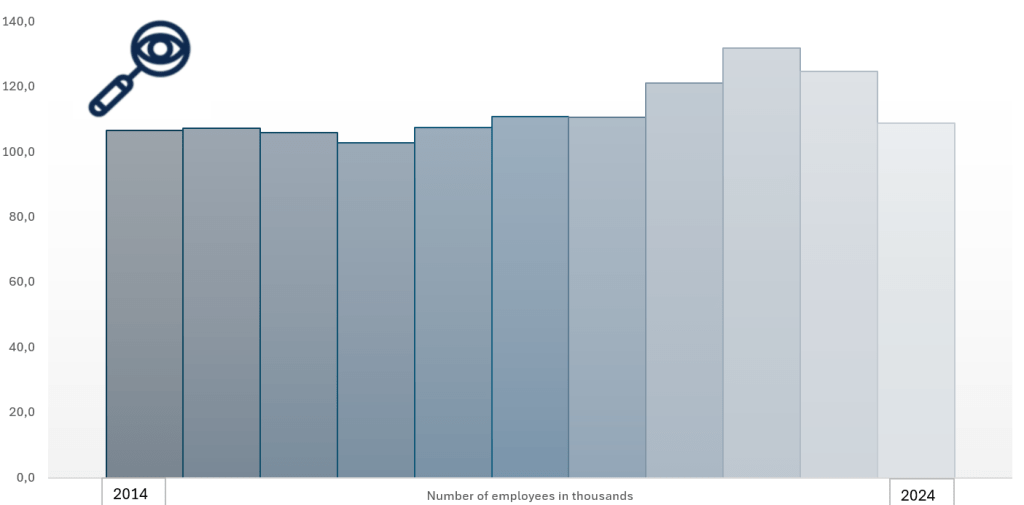
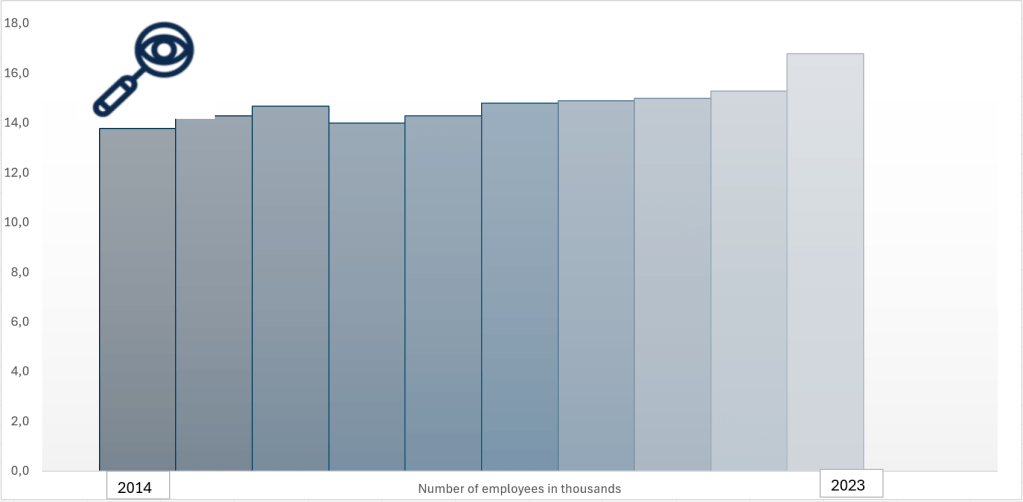
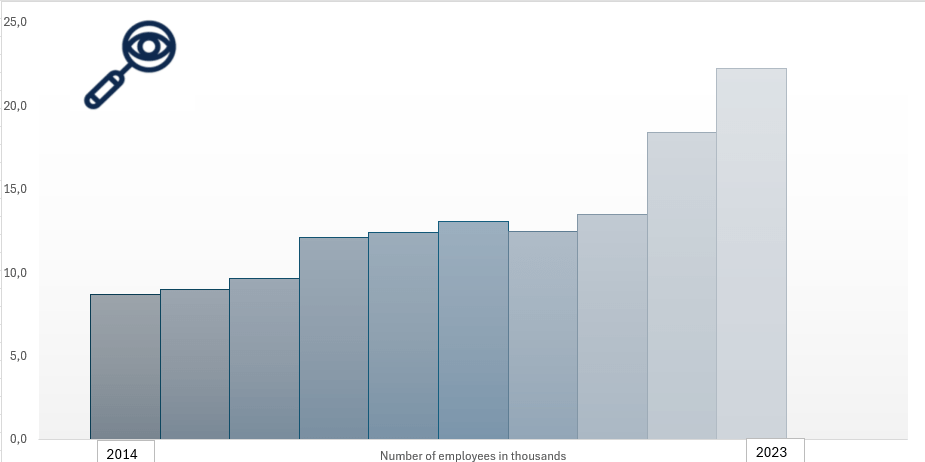
Founded in 1977, UnitedHealth Group is one of the world’s largest and most influential healthcare companies, known for its integrated approach to health benefits and services. As of 2025, UnitedHealth employs over 400,000 people globally through its two main business segments: UnitedHealthcare (health insurance) and Optum (health services, data, and technology). The company is publicly traded on the New York Stock Exchange under the ticker symbol UNH and operates within the Health Care sector, specifically in the Managed Health Care industry.

UnitedHealth Group is headquartered at 9900 Bren Road East, Minnetonka, Minnesota, USA. As of 2025, the company has approximately 920 million shares outstanding, with a market capitalization exceeding $400 billion USD. For more information, visit UnitedHealth Group’s official website: https://www.unitedhealthgroup.com.

Illustration 27-28: Number of employees and location of UnitedHealth Group

Final Verdict

UnitedHealth Group stands out as a strong long-term investment, particularly for growth and income-oriented investors. While its debt and liabilities has grown and its cash on hand is on the lower side, the company’s consistent earnings growth, strong cash flow, and dominant position in the healthcare sector can make it a good play. Its steadily rising dividend, conservative payout ratio, and robust balance sheet make it a reliable income-generating stock. In addition, it’s fallen P/E ratio and P/B ratio for 2025 can make it seem undervalued.

The company’s dual-engine model, combining UnitedHealthcare’s insurance business with Optum’s data-driven health services, provides diversification and resilience. UnitedHealth continues to invest heavily in technology, analytics, and value-based care models, positioning itself at the forefront of healthcare transformation.

Overall, UnitedHealth Group remains an attractive option for long-term investors seeking a mix of stability, innovation, and steady returns. Its strong fundamentals, leadership in a defensive sector, and long track record of performance make it a compelling addition to a diversified portfolio. It could potentially be a very good option for investors looking for undervalued companies after the stock has fallen by 50% in 2025.

Compound Interest: The Magic Formula Behind Investing that turn time into wealth

Let’s begin with a riddle that has baffled more than a few bright minds. Suppose I offer you a choice: either I hand you $1 million right now, or I give you a single penny today that doubles in value every day for 30 days. Which would you take?

24,100+ Us Dollar Drawing Stock Photos, Pictures & Royalty-Free Images -  iStock

Illustration 1: 100 USD, the highest USD note

Most people instinctively jump at the million-dollar offer. A million bucks in hand feels like a dream come true. That’s life-changing money, after all. But if you run the math on that humble penny, something astounding happens. On day five, it’s just 16 cents. On day ten, it’s still under $6. But by day twenty, it explodes past $5,000. And on day thirty? That penny is worth over ten million dollars.

That, in a nutshell, is the sheer power of compounding, the secret sauce behind many of the world’s wealthiest investors. And yet, it remains one of the most misunderstood, underestimated, and underused concepts in personal finance and trading alike. While others chase quick profits and high-risk trades, the smartest players in the game let time do the heavy lifting.

Compound investing is the financial equivalent of planting an apple tree and waiting patiently until you’re sitting in an orchard. At its heart, compounding means that your investments don’t just earn returns, they also earn returns on those returns. It’s a cycle of reinvestment, where growth builds upon growth, snowballing over time into something far greater than you started with.

Imagine putting $1,000 into an investment that earns 10% per year. After one year, you have $1,100. If you leave that full amount invested, the next 10% applies not just to your original $1,000, but to the $1,100 total which gives you $1,210. Then it grows to $1,331, then $1,464, and so on. Eventually, what started as a small seed becomes a forest of wealth.

How to Draw a Summer Vacation - Really Easy Drawing Tutorial

Illustration 2: You don’t need to do anything, you can be on hammock in Indonesia and just relax if you want to


And the best part? You don’t have to do anything fancy. You don’t need a degree in finance or a crystal ball to time the market. You just need the discipline to start, the patience to wait, and the wisdom to let compounding do its thing.

Let’s be blunt: most people want to get rich fast. We are hardwired to crave instant results. That’s why trading apps, meme stocks, and crypto roller coasters are so addictive. They feed the dopamine circuits in our brains. But in the long run, these fast strategies tend to burn more than they build.

We put AMC, GameStop and other meme stocks' numbers to the test — here's  which ones came out on top - MarketWatch

Illustration 3: A lot of people such as those at the r/wallstreetbets subreddit focus on getting rich quick.

Compound investing, by contrast, doesn’t try to outsmart the market on a daily basis. It bets on consistency, not cleverness. Over long periods, compounding will often outperform flashy trading simply because it never stops working. Your capital keeps growing while you sleep, while you’re on vacation, while you’re living life. You don’t have to hustle, your money does it for you.

The real beauty of compound investing is that its effect accelerates over time. The longer you leave your investment untouched, the more explosive its growth becomes. This is why starting early is often more powerful than starting big.

The numbers behind compounding are not just impressive, they’re mind-blowing. Let’s take a simple scenario: you invest $10,000 at an 8% annual return, compounded once a year. In 30 years, that $10,000 becomes over $100,000. You didn’t lift a finger, yet your money grew tenfold.

Now, add a monthly contribution of just $300. That same investment explodes to nearly half a million dollars over the same timeframe. The math is straightforward, but the implications are profound. With time and consistency, even modest investments can turn into serious wealth.

Wolf of Wall Street illustration #1 - Jordan Belfort Leonardo Dicaprio  Money Pop Art Print Home Decor Poster Print (11x17 inches) : Amazon.com.au:  Home

Illustration 4: Over time compound interest can lead to serious wealth

There’s even a trick to estimate how long it takes for your investment to double: the Rule of 72. Just divide 72 by your annual return rate. At 8%, your money doubles in 9 years. That’s two doublings in 18 years, four in 36. It sneaks up on you, and suddenly, you’re looking at a portfolio that dwarfs what you ever imagined possible.


Trading is sexy. It makes for great movies, exciting YouTube channels, and nail-biting nights staring at candlestick charts. But here’s the dirty little secret: most traders lose money. Not just some — most.

Marine trip of friends, wealthy or rich people enjoying summer vacations  cruising on yacht. personage jumping in water and sunbathing on boat or  luxurious ship. swimming vector in flat style | Premium

Illustration 5: Trading will eat up most of your capital that you could have used to become wealthy

The reasons are many. Transaction fees eat into profits. Emotions lead to poor decisions. Taxes hammer short-term gains. And worst of all, one bad trade can erase dozens of good ones. Trading rewards sharpness, but penalizes mistakes with brutal efficiency.

Compound investing plays a different game entirely. It’s slow, steady, and boring , in the best possible way. It rewards discipline, not luck. It minimizes fees, avoids taxes through long-term holding, and removes emotional triggers. While traders swing for the fences, compound investors jog steadily around the bases. And nine times out of ten, it’s the jogger who wins.

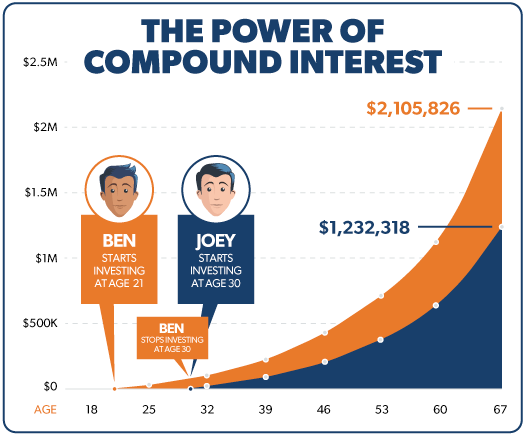
Illustration 6: An illustration showing the power of compound interest

Even in the trading world, the best players understand the power of compounding. They don’t gamble on every tick. They develop strategies that can grow capital sustainably. They think in terms of systems and longevity. In short, they let their skills and their capital compound over time.

If compounding is the vehicle, time is the fuel. Nothing supercharges compound investing like giving it time to work. And the earlier you start, the more time you have, the bigger your outcome.

There’s a famous story in finance circles about two hypothetical investors. One starts investing $200 a month at age 22 and stops at 30. The other waits until 30 and invests $200 monthly until retirement at 65. Guess who ends up with more money?


Illustration 7: Time is the fuel that powers it all

Surprisingly, the early starter wins, even though she contributed far less overall. That’s the power of compounding in action. The early years are the most valuable, because they multiply over the longest time. The longer your money compounds, the less you have to contribute later. The system does the heavy lifting.

Now, what if you’re reading this at 35, 40, or even 50 and feeling regret bubble up? Here’s the good news: it’s never too late to harness compounding. Yes, you’ll need to save more aggressively, and you may not have quite as much time. But compound investing still works.

Leonardo Dicaprio Cheers Blank Meme Template - Imgflip

Illustration 8: There is never to late to start compounding which is cause for celebtation

You can boost the effects by increasing contributions, reducing fees, reinvesting dividends, and choosing slightly higher-yielding (but still prudent) investments. The most important thing is to begin, not perfectly, but immediately.

Warren Buffett, arguably the greatest investor of all time, built 99% of his wealth after the age of 50. He began investing at age 11 and never stopped. His wealth isn’t due to extraordinary returns, it’s due to extraordinary time. His investing returns have been great, sure — but it’s the decades of compounding that turned great into godlike.

Warren Buffett Painting by MotionAge Designs - Pixels

Illustration 9; Legendary Investor Warren Buffet is someone that have built his wealth on compounding

Then there’s Ronald Read, a Vermont janitor who quietly amassed over $8 million through steady investing and compounding. Or Anne Scheiber, a retired IRS agent who left behind $22 million after years of investing modestly in dividend stocks. These weren’t hedge fund managers. They were regular people who simply understood compounding and never gave up on it.


You don’t need a Wall Street advisor or a six-figure salary to begin. Open a brokerage account or a retirement fund. Automate monthly contributions, even if they’re small. Choose index funds or dividend-paying stocks with a history of stability and growth. Reinvest every dollar you earn. Then walk away. Let it grow.

Wall Street Banker Print No Frame / Small

Illustration 10: You don’t need to be a Wall Street investor to benefit from compound investing, a normal index fund like VOO or SPY will do.

The hardest part is resisting the temptation to tinker. When markets dip, and they will, don’t panic. Compounding doesn’t care about temporary downturns. It thrives over the long haul. The more hands-off you are, the better it works.

There are a few landmines that destroy compounding’s magic. The biggest is pulling out money too early. Every time you interrupt compounding, you reset the process. Another killer is chasing hot trends and high-risk stocks that can wipe out gains. High fees are another silent thief, quietly siphoning away your future wealth. And perhaps worst of all is waiting too long to start.

It’s easy to dismiss compound investing as “too slow” or “too dull.” But those who stick with it know the truth: it’s anything but boring. Watching your money grow, slowly at first, then exponentially, is one of the most thrilling experiences in finance. It feels like cheating — only it’s not.

Compound investing is the rare strategy that doesn’t just build wealth. It builds freedom. It buys you time, security, and peace of mind. It works when you sleep. It grows when you’re busy living. It’s not a sprint — it’s a quiet revolution, unfolding silently in the background.

In the fable of the tortoise and the hare, it’s the slow, steady, unshakable turtle who wins the race. Compound investing is your turtle. It doesn’t promise instant riches. It doesn’t thrill with daily highs. But over time, it builds something far more valuable: lasting wealth.

Di00061 Turtle Rabbit race – Frits Ahlefeldt – My Art and Stories

Illustration 11: Be the turtle not the rabbit


In the fable of the tortoise and the hare, it’s the slow, steady, unshakable turtle who wins the race. Compound investing is your turtle. It doesn’t promise instant riches. It doesn’t thrill with daily highs. But over time, it builds something far more valuable: lasting wealth.

So stop chasing hot tips. Ignore the noise. Start investing, early if you can, consistently no matter what, and with patience above all. Let your money work harder than you ever could. Let compounding carry you toward the life you dream of.

Because once you understand compound investing, you’ll realize something extraordinary: you don’t have to get rich quick… when you can get rich for sure.

A Stock Analysis of Boeing Company: Navigating Headwinds and Opportunities

Introduction

The Boeing Company is one of the world’s largest aerospace and defense corporations, renowned for its cutting-edge innovations in commercial aviation, space exploration, and military systems. Headquartered in Arlington, Virginia, Boeing plays a pivotal role in global mobility and national defense, supplying aircraft, satellites, and defense systems to customers across more than 150 countries.

Illustration1 : The Boeing logo, a global symbol of aviation excellence and aerospace innovation.

Boeing operates across several major sectors including commercial airplanes, defense, space, and security systems, as well as global services. It is best known for its iconic aircraft such as the 737, 777, and 787 Dreamliner, which have helped connect the world’s cities and economies. Beyond aviation, Boeing leads ambitious projects in space travel, advanced robotics, and autonomous flight technologies.

Unlike many traditional manufacturing companies, Boeing evolved from the pioneering age of aviation and has remained a dominant force throughout the 20th and 21st centuries. Its legacy of innovation, high-performance engineering, and large-scale systems integration makes it a cornerstone of the global aerospace and defense industry.

History

Boeing was founded in 1916 by aviation pioneer William E. Boeing in Seattle, Washington. Originally a small manufacturer of seaplanes, the company played a significant role in both World Wars, supplying military aircraft that proved decisive in combat. Post-World War II, Boeing helped usher in the Jet Age with the launch of the 707, the first successful commercial jetliner.

Illustration 2: Boeing 707, was the first successful commercial jetliner.

Boeing’s commercial success soared with aircraft like the 737, 747, and 777, revolutionizing long-distance air travel. The 747, in particular, became a global icon and the world’s first wide-body “jumbo jet,” transforming air travel in the 1970s.

In 1997, Boeing merged with McDonnell Douglas, strengthening its position in the defense sector. The company also expanded into space systems, becoming a key contractor for NASA, including work on the International Space Station, Space Launch System, and Starliner crew capsule.

Despite facing challenges such as the 737 MAX crisis, global supply chain issues, and geopolitical headwinds, Boeing continues to be a vital force in aerospace innovation and global defense capabilities.


Operations and Production

  • Portfolio

Boeing is one of the world’s leading aerospace companies, with core operations centered around the design, manufacture, and support of commercial airplanes, defense systems, satellites, and space exploration technologies.

Its flagship commercial aircraft include the 737, 747, 767, 777, and 787 Dreamliner families. With operations in over 65 countries and customers in more than 150, Boeing is one of the largest exporters in the United States.

Its operations are divided into three primary business units:

Illustration 3: A Boeing commercial plane landing.

Boeing Commercial Airplanes (BCA), which designs, assembles, and delivers aircraft to airlines and leasing companies. Boeing’s commercial aircraft families include 737 (The best-selling jetliner in history, primarily used for short- to medium-haul routes) and 787 Dreamliner (A long-haul, fuel-efficient wide-body aircraft made with composite materials).

Furthermore, it includes 777 and 777x ( Known for long-range and high-capacity, with the 777X featuring folding wingtips and the world’s most powerful jet engines), and 767 and 747-8 (used for both passenger and cargo operations, with the 747 being the iconic “Queen of the Skies).

Boeing Defense, Space & Security | Military Wiki | Fandom

Illustration 4: A Boeing Spy plane

The second division of Boeing is Boeing Defense, Space & Security (BDS) which delivers products and services to government customers worldwide. This includes: Combat aircraft such as the F/A-18 Super Hornet and F-15EX Eagle II. Furthermore it also includes Rotary-wing platforms like the AH-64 Apache and CH-47 Chinook helicopters.

Missile defense systems, satellites, and space launch systems including the Space Launch System (SLS), the most powerful rocket NASA has ever built, is also part of the BDS division of Boeing.

The third division is Boeing Global Services (BGS) which offers logistics, maintenance, training, parts, and digital aviation services. BGS supports both commercial and defense customers with end-to-end lifecycle services


Boeing Stock Is Not A High-Flyer, But Its Recovery Could Pay Off | Seeking  Alpha

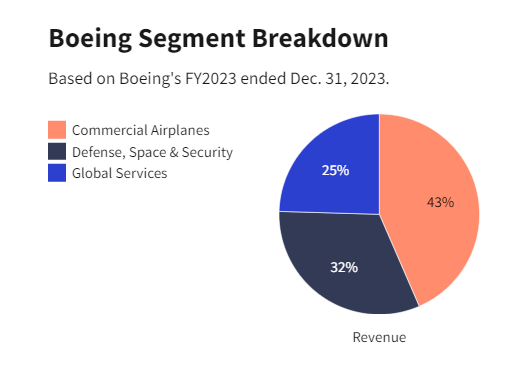
Illustration 5: Boeing revenue by segment

As can be seen from illustration 4, the largest segment for Boeing is commercial Airplanes at 43%. However, Defense, Space & Security also makes up a very big segment at 32% and Global Services at 25 %.

Boeing’s global manufacturing network includes major facilities in the U.S. (notably Everett and Renton, Washington; Charleston, South Carolina; and St. Louis, Missouri), along with significant operations in Australia, the U.K., Canada, and the Middle East.

  • Technology and Space

Boeing plays a key role in space exploration and defense innovation. Through its work with NASA, Boeing helped develop the International Space Station (ISS) and is now working on the Starliner spacecraft, designed to transport astronauts to low Earth orbit.

In defense, Boeing is investing in autonomous systems such as the MQ-25 Stingray (an unmanned aerial refueling aircraft), loyal wingman drones, and space-based missile defense technologies. Boeing is also a key player in hypersonic weapons development and satellite constellations for secure communications and Earth observation


In the AI and digital space, Boeing uses advanced analytics, machine learning, and digital twins to optimize manufacturing, maintenance, and flight operations. he company’s “AnalytX” suite supports real-time fleet health monitoring, and its digital solutions are integrated into flight operations globally.

Boeing MQ-28 Ghost Bat - Wikipedia

Illustration 6: Loyal Wingman, an AI-enabled drone developed in Australia, designed to operate alongside manned fighter jets.

Key Competitors

Boeing competes across various aerospace and defense sectors. Its competitors differ depending on whether the focus is on commercial aviation, defense contracts, or space exploration.

1. Commercial Aviation

Airbus SE is Boeing’s primary global competitor in commercial aircraft. Airbus’s A220, A320neo, and A350 families compete head-to-head with Boeing’s 737 MAX, 787, and 777 series.

COMAC is backed by the Chinese government, COMAC aims to reduce reliance on Western aircraft through its C919 and ARJ21 models.

Embraer is a leading manufacturer of regional jets, Embraer was once part of a failed merger with Boeing but remains a strong player in the 70–150 seat market.


2. Defense and Military Systems

Lockheed Martin, dominates in fighter aircraft and space systems with platforms like the F-35 and Orion.

Northrop Grumman is a competitor in autonomous aircraft, strategic bombers (B-21 Raider), and satellite systems.

Raytheon Technologies, provides engines (via Pratt & Whitney), avionics, and missile systems used in both commercial and military platforms.

3. Space and Emerging Tecg

SpaceX, Elon Musk’s company is a disruptive force in spaceflight, reusable rockets, and low Earth orbit (LEO) satellite networks (Starlink).

Blue Origin is competing with Boeing for lunar landers and suborbital space tourism.

Palantir, Anduril is tech firms, entering defense with AI-powered battlefield intelligence and surveillance systems.

Competitive Advantage

Boeing’s competitive advantage is rooted in its scale, technical expertise, and diverse operations across commercial aviation, defense, and space.

As one of the oldest and most recognized names in aerospace, Boeing benefits from a strong brand reputation built on decades of delivering reliable, high-performance aircraft and systems. This reputation fosters long-term trust and loyalty among airlines, governments, and space agencies worldwide.

Boeing secures 777 order from Lufthansa Cargo and Swiss - Puget Sound  Business Journal

Illustration 7: A Boeing Aircraft flying over the Alps

The company’s vertically integrated operations and vast global supply chain give it the ability to manufacture complex systems at scale, while also adapting to local markets and geopolitical shifts. Boeing’s Global Services division adds further value by offering lifecycle support, digital solutions, and predictive maintenance, deepening customer relationships beyond the point of sale.

Boeing’s broad product portfolio, from narrow-body jets and wide-body aircraft to fighter jets, satellites, and launch vehicles, allows it to spread risk and capture opportunities in multiple markets. During commercial downturns, its defense and space segments provide financial stability and continuity.


Innovation is another core strength. Boeing continuously invests in advanced manufacturing, autonomous systems, artificial intelligence, and sustainable technologies. Programs like the ecoDemonstrator test platform and partnerships in urban air mobility demonstrate its commitment to shaping the future of flight.

Boeing Sees Big Airline Fleet Growth From Middle East | Aviation  International News

Illustration 8: A Boeing 777

Combined with its global presence and government partnerships, Boeing’s ability to integrate technology, scale, and service gives it a clear edge in a highly competitive industry.

Future Outlook

Boeing is entering a new growth phase as the aviation industry rebounds and global demand for commercial aircraft returns. The company is ramping up production of its 737 MAX and 787 models, while its defense and space divisions continue to secure major contracts, especially in the U.S. and Asia-Pacific.

Sustainability is at the core of Boeing’s future strategy, with investments in sustainable aviation fuels, electric and hydrogen propulsion, and next-generation aircraft. Its space ventures, including the Starliner and Space Launch System, position Boeing to play a major role in future space exploration. With a strong order backlog and focus on innovation, Boeing is well placed to lead the aerospace industry into the next era.


Stock Analysis

In this section we will analyze Toyota’s stock to see if it is a good stock to buy or not. Our philosophy is value investing meaning that we try to find good quality companies that are undervalued. However, we will give a holistic overview so all kind of investors with different philosophies can judge the stock for themselves.

Revenue and Profits
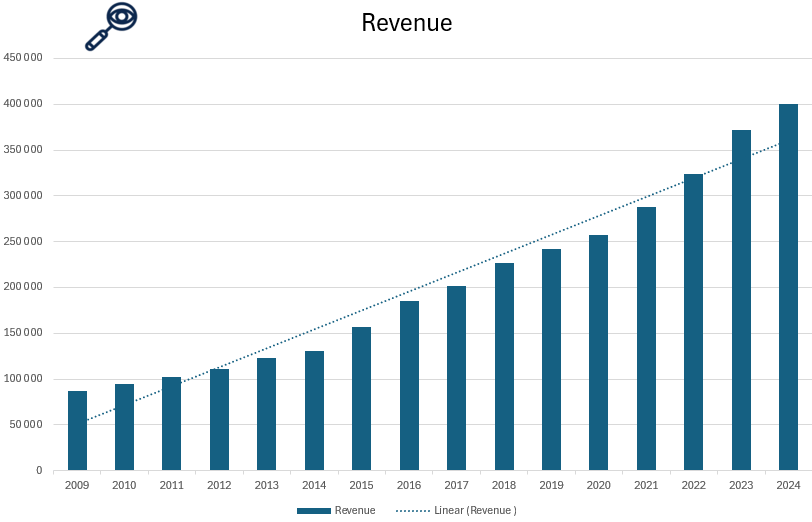
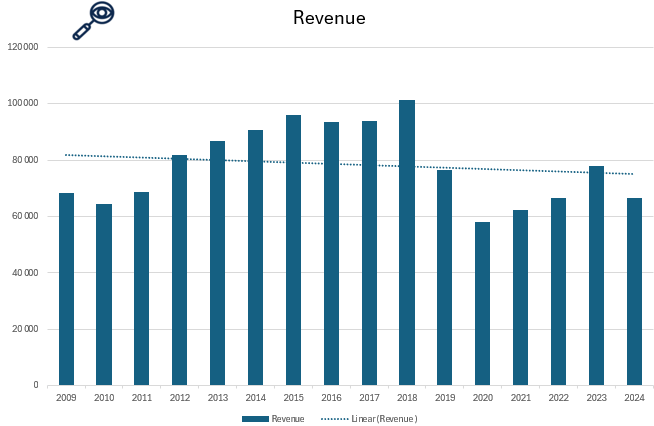
Illustration 9 and 10: Revenue of Boeing from 2009 to 2024

As shown in Illustrations 9 and 10, Boeing’s revenue trajectory has had sharp fluctuations rather than steady growth, with a particularly severe decline between 2018 and 2020. After peaking at around USD 101 billion in 2018, revenues plunged to approximately USD 58 billion by 2020, a staggering drop of over 40% in just two years. This steep decline, triggered by the grounding of the 737 MAX and compounded by the COVID-19 pandemic’s impact on global air travel, raising red flags for investors about Boeing’s operational resilience and crisis management.

While Boeing has made progress in recovering since then, revenues have not yet returned to pre-2018 levels as of 2024. The pace of recovery has been gradual, reflecting ongoing efforts to stabilize production, resolve supply chain issues, and rebuild customer confidence. Boeing’s focus on both commercial and defense segments provides some diversification, but its performance remains sensitive to the global aerospace market and regulatory developments.

Overall, Boeing’s financial performance over the past several years reflects a company navigating a complex recovery phase. The revenue volatility underscores the challenges faced during a turbulent period, but also highlights the potential for future growth as commercial aviation rebounds and new aircraft programs come online. For investors, this mixed picture calls for careful monitoring rather than a clear red or green flag.

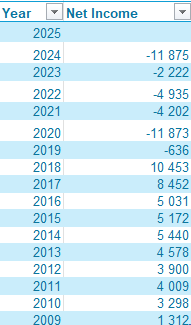
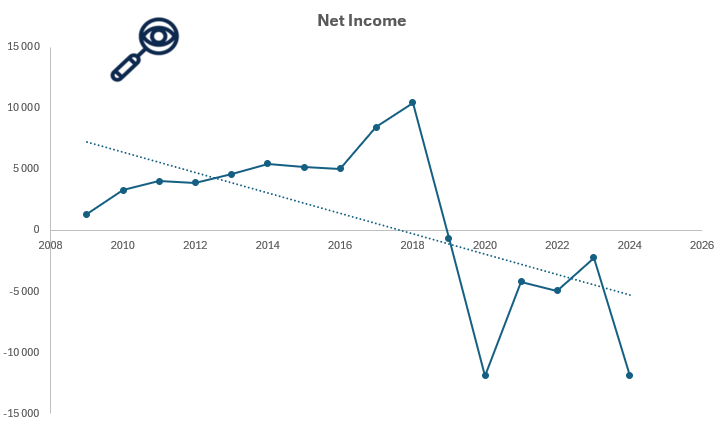
Illustration 11 and 12: Net Income of Boeing from 2009 to 2024

Net income is a crucial metric to evaluate when determining whether a company is a worthwhile investment. It represents a company’s net profit or loss after accounting for all revenues, income items, and expenses, calculated as Net Income = Revenue – Expenses.

As seen in Illustrations 10 and 11, Boeing’s net income has shown significant volatility, with a sharp decline into negative territory from 2018 to 2020. This drop, driven by the 737 MAX crisis and the pandemic’s impact on air travel, marks a clear red flag, as profits fell even more steeply than revenues.

Although Boeing has made efforts to recover, net income remains inconsistent, reflecting ongoing challenges in production, regulation, and market demand. Unlike companies with steady profit growth, Boeing’s recent earnings instability signals elevated risk for investors focused on financial reliability.

Revenue Breakdown

Is Boeing Co (BA) Fairly Valued? A Comprehensive Analysis

Illustration 13: Revenue breakdown of Boeing Co,

As shown in Illustration 13, Boeing’s core Commercial Airplanes segment remains its largest revenue contributor, typically accounting for around 40% of total revenue. This includes sales of aircraft such as the 737, 787, and 777 models to global airline customers and leasing firms. While historically a strong growth engine, this segment has experienced significant disruption since 2019 due to the 737 MAX grounding, COVID-19, and ongoing supply chain issues, resulting in elevated costs and production delays.

The Defense, Space & Security division, contributing around 35% of revenue, provides more consistent performance through multi-year government contracts for military aircraft, satellites, and surveillance systems. Boeing Global Services, making up roughly 26% of revenue, generates recurring income from maintenance, spare parts, pilot training, and digital analytics—supporting airline customers through fleet lifecycle services.

Boeing’s main costs that eats up most of it’s revenue is cost of goods sold (COGS) which remains very high, typically representing around 94.7% of revenue, reflecting the capital-intensive nature of aircraft production and frequent cost overruns related to rework and supply constraints. SG&A expenses covers global operations, customer support, and corporate functions while R&D expenses focuses on fuel efficiency, autonomous systems, digital engineering, and sustainable aviation, though these initiatives are still early in commercial impact. Emerging technologies such as space-based systems, electric propulsion, and advanced air mobility are strategically important but currently represent a small share of revenue. These areas are gradually expanding through joint ventures and government partnerships.

Overall, Boeing’s revenue structure reflects both high operating complexity and long-term diversification. While its defense and services businesses offer some financial stability, elevated costs and pressures in the commercial segment pose near-term challenges. The company’s ongoing investment in innovation underscores its long-term vision, but achieving margin recovery will depend on execution, supply chain normalization, and restoring commercial delivery volumes.

Earnings per Share

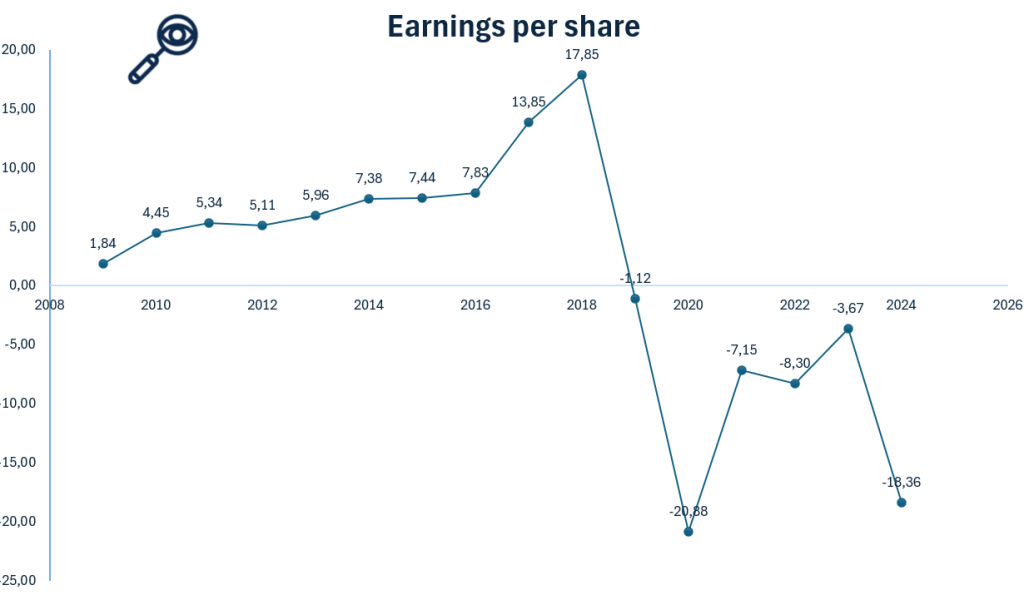
Illustration 14: Earnings per share for Boeing from 2009 to 2024

Earnings Per Share (EPS) is a key financial metric that measures a company’s profitability on a per-share basis. It indicates how much profit a company generates for each outstanding share of its stock, and is used to assess a company’s financial health, profitability, and potential for growth. In other words this metric can tell us how profitable the business is.

The EPS figure itself isn’t the primary focus for value investors, it can be 0.2 or 10, but what truly matters is the company’s ability to generate consistent earnings growth. A steadily increasing EPS over time signals strong financial health, profitability, and long-term value creation.

Boeing’s earnings per share from 2009 to 2025 shows a sharp decline from 17.85 in 2018 to -20.88 in 2020, marking a significant red flag. This drop was driven by the 737 MAX grounding and the pandemic’s impact on global aviation. While EPS has recovered somewhat in recent years, it remains below pre-crisis levels, reflecting continued cost pressures, supply chain issues, and production delays. The volatility in earnings highlights Boeing’s financial vulnerability during industry shocks and signals ongoing risk. For investors, this uneven trend raises concerns about near-term stability despite the company’s long-term strategic efforts. Furthermore, it had another significant drop from 2023 to 2024. These developments should be closely monitored by potential investors and are clear red flags.

Assets and Liabilities

Illustration 15 and 16: Assets and Liabilities for Boeing from 2009 to 2024

When evaluating a company as a potential investment, understanding its assets and liabilities is crucial. If a local business owner offered to sell their shop to you, one of the first questions. after determining its profitability, would be about its equity and assets. The same principle applies when assessing publicly traded companies like Boeing.

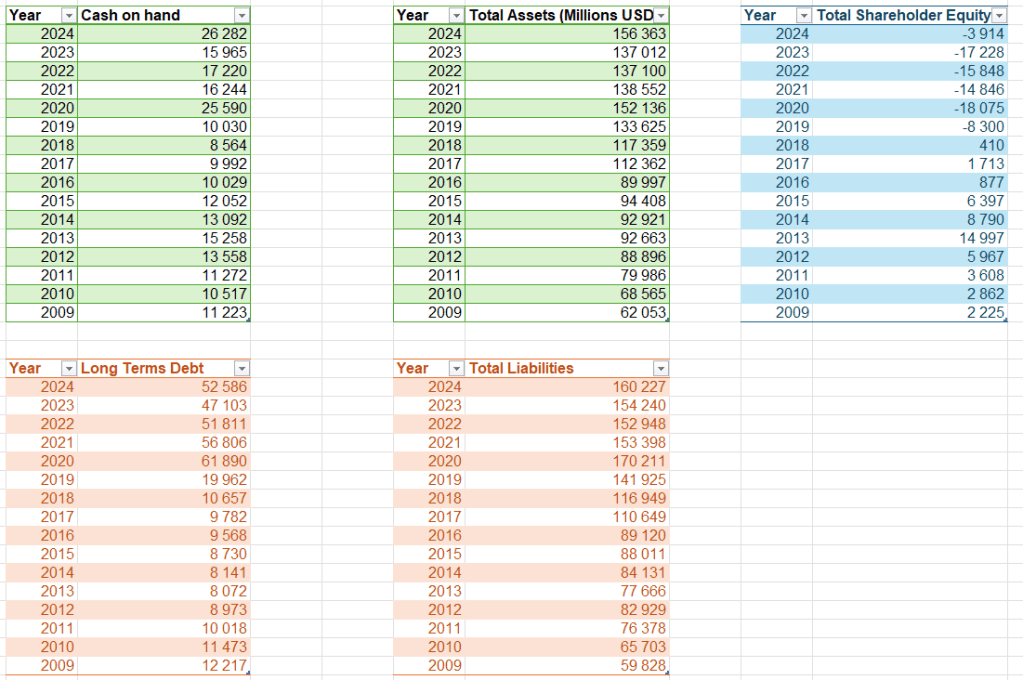
As shown in Illustrations 14 and 15, Boeing’s total assets reached approximately $156 billion in 2024, a figure that reflects the scale of its global operations. However, unlike the steady asset growth seen in some peers, Boeing’s asset base has fluctuated over the past decade due to write-downs, delivery delays, and program-related adjustments. While recent investments in next-generation aircraft and digital systems signal a forward-looking strategy, overall asset growth has been modest and uneven.

At the same time, Boeing’s total liabilities have increased substantially, rising to over $160 billion in 2024. Much of this is tied to debt issued during the pandemic to maintain liquidity and stabilize operations. While some leverage is expected in capital-intensive industries, Boeing’s high debt load combined with continued cash flow pressures raises concerns and big red flags about long-term financial flexibility and resilience. Investors should closely monitor Boeing’s ability to reduce debt and restore balance sheet strength in the coming years.

The critical issue for investors is whether Boeing can return to sustained profitability while managing its obligations. With thin margins and ongoing production costs, the company faces the challenge of generating sufficient free cash flow to reduce its liabilities without sacrificing investment in innovation and quality control. Failure to improve operating efficiency or deliver aircraft at scale could intensify financial strain.

Boeing’s cash on hand in 2024 remains relatively low compared to its long-term debt, which presents a red flag for liquidity. This imbalance could make it more difficult to weather unexpected disruptions or fund strategic initiatives without additional borrowing or asset sales. Investors should keep a close watch on Boeing’s cash generation and working capital management to assess its ability to support operations and repay obligations in the near term.

As seen in Illustration 15, Boeing’s total shareholder equity has turned negative in recent years, meaning its liabilities exceed its assets. This trend is a serious concern, as it indicates erosion of the company’s financial foundation and limited cushion against further losses. Negative equity can restrict financial flexibility and undermine investor confidence, especially if cash flow does not improve. While Boeing retains strong long-term potential in aerospace and defense, rebuilding equity will be essential to restoring investor trust and ensuring long-term financial stability.

Debt to Equity Ratio

Illustration 17 and 18: Debt to Equity ratio for Boeing from 2009 to 2024

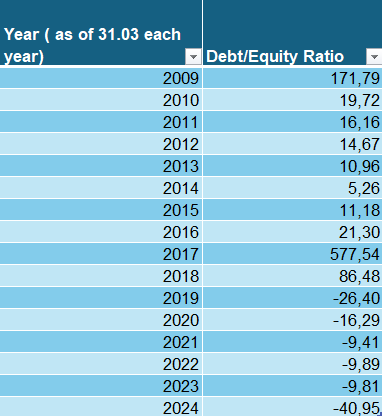
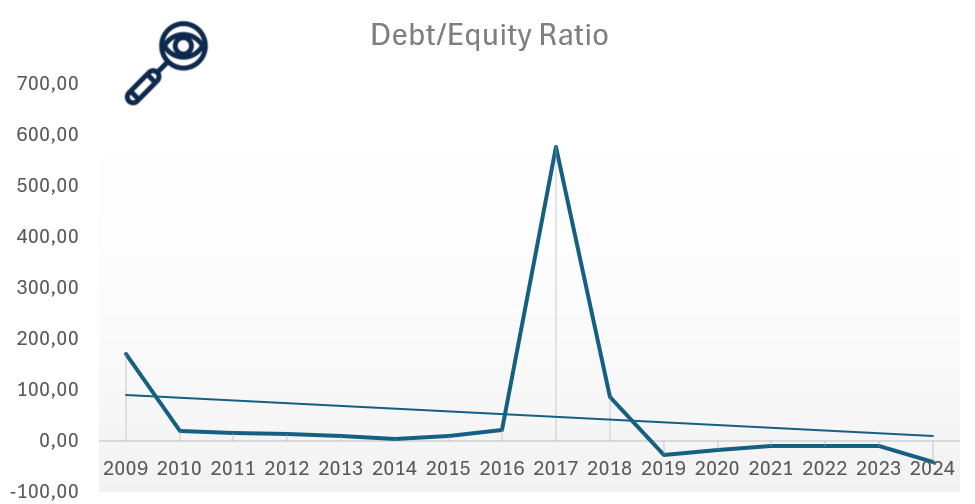
The Debt-to-Equity (D/E) ratio is an important financial metric for assessing a company’s financial leverage and risk. It compares the amount of debt a company uses to finance its operations relative to its shareholder equity. A high D/E ratio suggests the company relies more heavily on debt, increasing financial risk, especially during periods of economic stress. In contrast, a lower D/E ratio implies more conservative financing through equity, offering greater financial stability but possibly slower expansion.

Legendary value investor Warren Buffett generally prefers a D/E ratio below 0.5. However, Boeing’s total shareholder equity turned negative in recent years, meaning its liabilities now exceed its assets. As a result, the D/E ratio is no longer a meaningful metric in the traditional sense, it is effectively undefined or extremely high. This situation signals a red flag, as it reflects the long-term financial strain caused by the 737 MAX crisis, pandemic-era losses, and the need for heavy borrowing to sustain operations. Restoring equity and reducing debt will be critical to improving financial health. Until then, the absence of a meaningful D/E ratio highlights the company’s reliance on debt financing and underscores the importance of disciplined cash flow management and margin recovery in the years ahead.

Price to earning ratio (P/E)

Illustration 19 and 20: Price to Earnings ratio for Boeing from 2009 to 2024

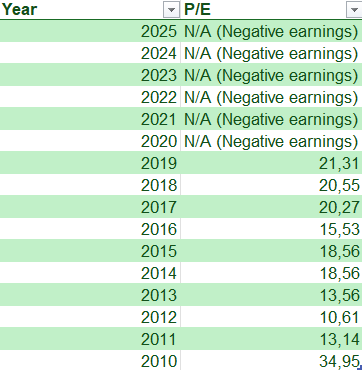
For value investors, one of the most critical metrics when evaluating Boeing’s stock is the price-to-earnings (P/E) ratio, as it helps assess whether the company is undervalued or overvalued. Even if a company has a strong brand and global footprint, paying too much for its stock can still result in poor returns. For example, imagine a business that earns $1 million annually, if offered to you for $1, it’s a steal. But if the owner asks $1 trillion, the profitability becomes irrelevant, the price is simply too high. The stock market works the same way: even good companies can be bad investments if bought at inflated prices.

Warren Buffett, a legendary value investor, generally prefers companies with a P/E ratio below 15, viewing them as attractively priced relative to earnings. In Boeing’s case, the situation is more complex. Due to multi-year losses from 2019 to 2021, Boeing’s P/E ratio has either been undefined or exceptionally high during those periods. As earnings have begun to recover, the P/E ratio remains volatile, sensitive to quarterly swings and investor sentiment. As of 2024, Boeing trades at a forward P/E ratio above 40, reflecting high expectations for recovery rather than current earnings strength.

For value investors, this elevated P/E signals caution. While Boeing’s long-term aerospace and defense prospects remain strong, the current valuation suggests that much of the recovery optimism is already priced in. Unless earnings normalize quickly and sustainably, the stock may offer limited margin of safety at current levels.

Price to Book ratio (P/B)

Illustration 21 and 22: Price to book ratio for Boeing from 2009 to 2024

Price-to-book value (P/B ratio) compares a company’s market value to its book value, calculated as total assets minus total liabilities. A low P/B ratio may indicate undervaluation, while a high ratio can signal overvaluation or strong growth expectations. Value investors, including Warren Buffett, often prefer P/B ratios under 1.5, ideally closer to 1.3, when seeking companies trading below their intrinsic asset value.

For Boeing, however, the P/B ratio is no longer meaningful, as the company’s shareholder equity has turned negative in recent years due to accumulated losses and rising liabilities. This means the book value per share is also negative, making the traditional P/B metric undefined.

Rather than suggesting undervaluation, this situation is a red flag, highlighting the weakened state of Boeing’s balance sheet. While Boeing continues to hold strategic value in commercial and defense aerospace, value investors are likely to remain cautious until equity becomes positive again and financial fundamentals stabilize.

Return on Investment (ROI)

Illustration 23 and 24: Return on Investment for Boeing from 2009 to 2024

For value investors, another essential metric when evaluating Boeing’s stock is Return on Investment (ROI), as it shows how efficiently the company uses its capital to generate profits. In simple terms, ROI measures the return earned relative to the capital required to operate the business. A company may have strong revenue, but if it requires heavy capital to generate modest profits, it may not be an efficient investment. For example, if two firms earn the same profit, but one uses half the capital to do so, it’s clearly more efficient. ROI helps investors identify companies that convert capital into returns effectively—a key consideration in capital-intensive industries like aerospace.

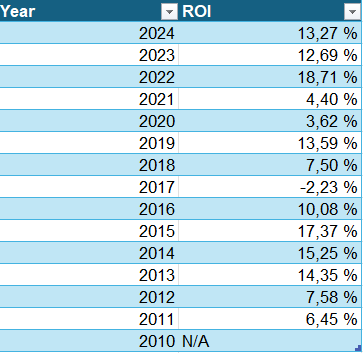
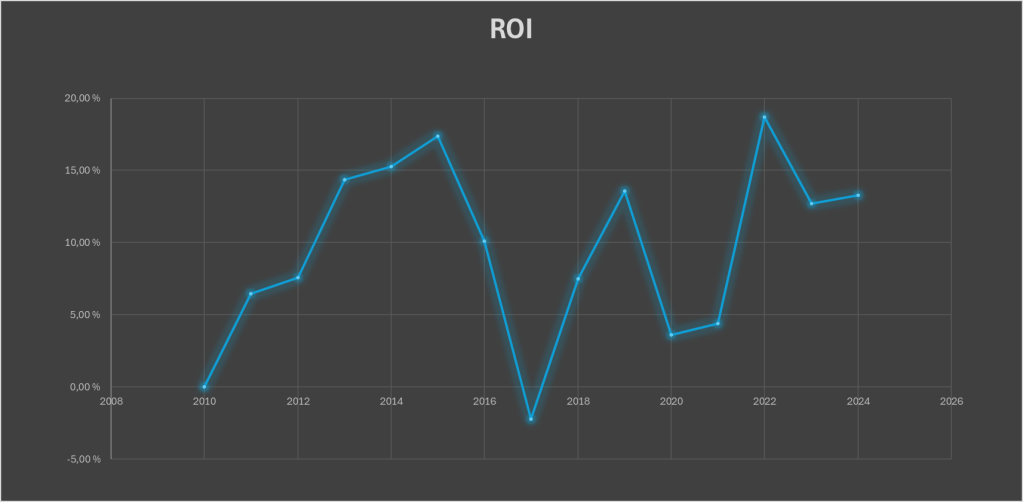
Boeing’s ROI has been highly volatile in recent years, and negative during 2017. While ROI has improved as earnings begin to recover, it still lags behind industry expectations. Boeing’s returns have been erratic, raising questions about capital efficiency and long-term value creation. As shown in Illustration 23 and 24, this inconsistent performance reflects the ongoing challenges Boeing faces in restoring operational stability, managing debt, and navigating cost overruns. For long-term investors, this is a cautionary signal, as it suggests that the company has yet to regain full control over its capital deployment. While Boeing remains a leader in aerospace innovation, meaningful improvement in ROI will be key to signaling that the company is delivering sustainable value from its significant investments. A 13% ROI for Boeing in 2024 is a good sign, especially considering its turbulent past few years. It suggests Boeing is becoming more efficient with its capital again. However, it should be assessed alongside other metrics, like cash flow, equity, debt levels, and order backlog, to judge whether the improvement is sustainable and investable.

Dividend

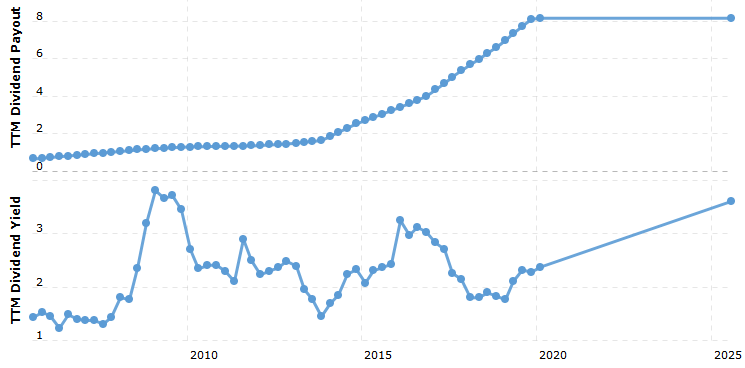
Illustration 25:  Dividend Yield and dividend payout ratio from 2005 to 2025 for Boeing

Boeing has historically been a reliable dividend payer, with its annual dividend reaching as high as $2.06 per share in early 2020 and an average dividend yield around 2.5% over the past five years. However, Boeing suspended dividend payments in March 2020 amid financial challenges from the 737 MAX crisis and the COVID-19 pandemic. Since then, no dividends have been issued.

In 2024, Boeing reported a negative earnings per share (EPS) of approximately -$18.36, and while its dividend payout ratio would have been around 48% based on prior earnings patterns, the suspension means the actual payout ratio is effectively zero. This pause in dividends is a red flag for income-focused investors who value steady cash returns. That it has suspended dividends is a big red flag for investors.

Insider Trading

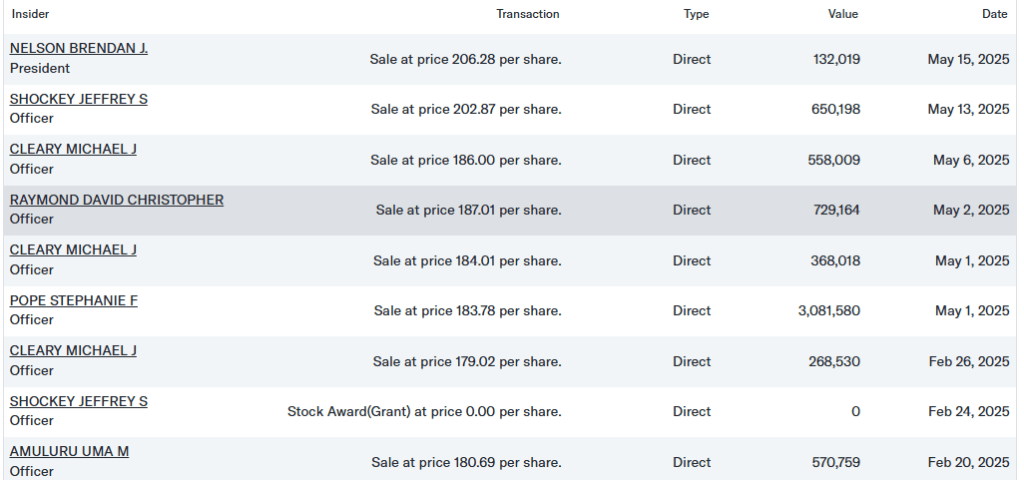
Illustration 26: Recent insider trading at yahoo, gathered from yahoo finance

Recent insider trading activity at Boeing has shown a significant increase in insider selling, which may raise concerns for investors. Between early and mid-May 2025, multiple senior executives, including Boeing’s Executive Vice Presidents and Presidents of major divisions sold substantial amounts of company stock, collectively worth several million dollars. While insider selling can be part of routine financial planning or diversification, the concentrated timing and volume of these sales are noteworthy.

Insider selling at this level can be interpreted as a potential red flag, as it may suggest that insiders have less confidence in the company’s near-term prospects or are taking advantage of current stock prices before possible declines. For value investors, such activity warrants closer scrutiny and signals the importance of monitoring Boeing’s forthcoming earnings results, operational updates, and market conditions.

Other Company Info

Founded in 1916, The Boeing Company is one of the world’s largest and most respected aerospace manufacturers, known for its commercial aircraft, defense systems, and space technologies. As of 2024, Boeing employs approximately 140,000 people globally, reflecting its extensive operations in manufacturing, engineering, research, and services. The company is publicly traded on the New York Stock Exchange (NYSE) under the ticker symbol BA and operates within the Industrials sector, specifically in the Aerospace & Defense industry.

Boeing is headquartered at 100 North Riverside Plaza, Chicago, Illinois, USA. As of 2024, the company has approximately 560 million shares outstanding, with a market capitalization of around $140 billion USD. For more information, visit Boeing’s official website: https://www.boeing.com.

Illustration 17: Number of employees and location of Boeing.

Final Verdict

The Boeing Company currently faces significant challenges that make it a risky investment, especially for value and income investors seeking stability. Despite being a major player in aerospace, Boeing’s financials reveal several red flags: the company has negative shareholder equity, high debt levels, and low cash reserves, which limit its financial flexibility and increase risk during downturns.

Boeing’s earnings have been volatile, and recent dividend cuts have diminished its appeal to income-focused investors. Ongoing production issues, delays, and market uncertainties further cloud the company’s near-term prospects. While Boeing is investing in innovation and defense contracts, these efforts have yet to translate into consistent profitability or a stronger balance sheet.

Overall, Boeing’s current financial health and operational risks suggest caution. It may not be suitable for conservative investors, and those considering it should be prepared for potential volatility and a prolonged recovery period. This makes Boeing a less attractive choice compared to more stable industry peers.

Toyota Motor Corp. – A Stock Analysis of one of the leading automakers of the world

Introduction

Toyota Motor Corporation is a globally renowned Japanese multinational automotive manufacturer, widely regarded as one of the world’s leading innovators in mobility, automotive engineering, and sustainable transportation.

The Toyota logo has an ingenious hidden message | Creative Bloq

Illustration 1: he Toyota logo, a symbol of trust, innovation, and global mobility.

Headquartered in Toyota City, Japan, the company is best known for its high-quality vehicles and pioneering work in hybrid technology, but its operations span a broad spectrum including robotics, AI, autonomous driving, and hydrogen fuel cell systems.

Unlike many Western automakers that evolved in tandem with the American and European car industries, Toyota carved a unique path grounded in the principles of Kaizen (continuous improvement) and Just-In-Time manufacturing, revolutionizing global automotive production with the Toyota Production System (TPS). Its reputation for reliability, efficiency, and innovation has made it a household name in markets around the world.

Toyota is consistently ranked among the top global automakers by volume and market capitalization. It has spearheaded the automotive industry’s shift toward sustainability through its leadership in hybrid technology (beginning with the Prius) and its bold push into hydrogen-powered and battery electric vehicles. With a growing focus on AI, connected vehicles, and mobility-as-a-service, Toyota continues to shape the future of transportation.

History

Toyota was founded in 1937 by Kiichiro Toyoda, evolving from Toyoda Automatic Loom Works. Initially focused on producing passenger cars for the Japanese market, the company quickly established itself with models like the Toyota AA and developed a reputation for durable vehicles in the post-war period.

How Toyota's first car vanished, re-emerging years later in Russia

Illustration 2: The first Toyota passenger car was the Toyoda Model AA

The real global breakthrough came during the 1970s and 1980s, when Toyota expanded aggressively into North America and Europe. Its compact, fuel-efficient cars, such as the Corolla and Camry, gained popularity during the oil crisis, helping it gain a foothold in key international markets.


Toyota became a global icon of manufacturing excellence with the development of the Toyota Production System (TPS) which is a manufacturing philosophy that transformed supply chains worldwide. In 1997, it launched the Prius, the world’s first mass-produced hybrid electric vehicle, cementing Toyota’s role as an environmental pioneer in the auto industry.

In the 2010s, Toyota expanded into next-generation mobility, investing in AI research, autonomous driving (under its subsidiary Woven by Toyota), and alternative energy sources such as hydrogen fuel cells (Mirai). The company has continued to build its brand as not just an automaker but a mobility solutions provider.

Today, Toyota operates over 50 manufacturing facilities worldwide and sells vehicles in more than 170 countries. It remains the world’s largest automaker by units sold, combining innovation with a deep commitment to quality and sustainability. Its reputation is that their cars will last for ever due to their quality.

Operations and Production

  • Portfolio

Toyota is a car company and it’s core operations center around the development, manufacturing, and sale of automobiles, including sedans, SUVs, trucks, and commercial vehicles. Its flagship models include the Corolla (the world’s best-selling car), Camry, Land Cruiser, Hilux, RAV4 and Prius hybrid.

Toyota Land Cruiser Price in Pakistan 2025

Illustration 3: Toyota Land Cruiser is one of the most famous Toyota cars

The Toyota Motor Corporation owns several key brands:

  • Toyota (mainstream brand)
  • Lexus (luxury vehicles)
  • Daihatsu (compact cars and mini-vehicles)
  • Hino (commercial trucks and buses)

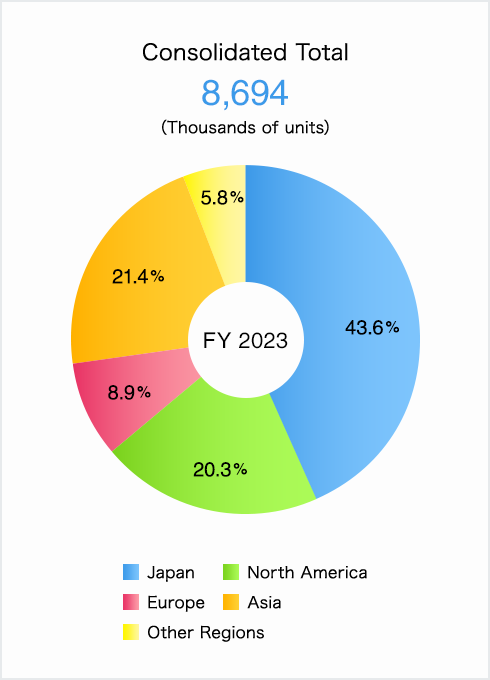
Toyota sells cars in all countries, but its biggest markets are asia and Japan.

Financial Highlights & Financial Performance | Shareholders & Investors  News | Toyota Motor Corporation Official Global Website

Illustration 4: Illustration of the biggest markets of Toyota


  • Electric and Hybrid Cars

Toyota has been a pioneer in hybrid technology since the launch of the Prius in 1997, the world’s first mass-produced hybrid electric vehicle. This bold move not only positioned Toyota as a technological leader but also sparked a global movement toward cleaner and more fuel-efficient vehicles. As of today, Toyota has sold over 20 million hybrid vehicles worldwide, contributing significantly to global CO₂ emissions reduction in the transportation sector.

Toyota’s hybrid portfolio is among the most comprehensive in the industry, spanning sedans, SUVs, and even commercial vehicles. Models like the RAV4 Hybrid, Corolla Hybrid, and Camry Hybrid continue to perform strongly in markets across Asia, North America, and Europe. Toyota is known for it’s longevity, quality and sustainability and it has proved that it can produce hybrid cars that are as solid as its gasoline cars.

Toyota teases slick electric sports cars in major EV preview - CNET

Illustration 5: Prototype of a new Toyota car that is to come out by 2026

In addition to hybrids, Toyota is expanding its presence in battery electric vehicles (BEVs). Under its new “bZ” (beyond zero) sub-brand, Toyota has launched the bZ4X, a fully electric crossover SUV, and plans to introduce over 10 new BEV models by 2026.

Toyota also produces hydrogen-powered cars as it intorduced Toyota Mirai, one of the few hydrogen-powered cars available to the public, in 2014. Toyota is also investing heavily in solid-state battery research. These next-generation batteries promise higher energy density, faster charging times and greater thermal stability, which could solve many of the limitations of current lithium-ion technology. Toyota aims to begin commercial production of solid-state batteries as early as 2027–2028, potentially reshaping the EV landscape.

  • Autonomous Driving, Robotics and AI

Under its innovation hub Woven by Toyota, the company is developing technologies for autonomous vehicles, smart cities, and connected mobility. Toyota’s Guardian system enhances driver safety through AI-driven assistive features, while its Chauffeur system aims for full autonomy in the future.

Toyota is also building Woven City, a fully connected smart city near Mt. Fuji to test smart infrastructure, robotics, and autonomous vehicles in real-life settings.

Beyond cars, Toyota is developing robotics for elderly care, manufacturing automation, and personal assistance. It has also invested in AI research, including partnerships with Stanford and MIT, and launched the Toyota Research Institute (TRI) to explore machine learning, robotics, and materials science.


Key Competitors

Toyota operates in one of the most competitive and rapidly evolving industries, facing rivals across traditional automaking, electric mobility, autonomous driving, and smart mobility ecosystems. Its competitors can be grouped into three main categories:

1. Traditional Global Automakers

  • Volkswagen Group: Toyota’s closest global rival by sales volume. Volkswagen has committed heavily to electrification, launching the ID. series of EVs and investing over €180 billion in digital and sustainable technologies. Its scale and global manufacturing footprint mirror Toyota’s, making the two firms frequent contenders in both developed and emerging markets.
  • General Motors (GM): Strong in North America and China, GM is transitioning aggressively to EVs under its Ultium battery platform and brands like Chevrolet, GMC, and Cadillac. GM’s Cruise division is also a key player in autonomous mobility.
  • Ford Motor Company: Ford competes in global markets, particularly in trucks, SUVs, and commercial vehicles. Its F-150 Lightning electric pickup and investment in self-driving (via Argo AI, now winding down) reflect its growing focus on innovation.
  • Honda: Fellow Japanese automaker and frequent rival in efficiency, reliability, and innovation.

2. Electrification and Mobility Disruptors

  • Tesla: As the world’s leading electric vehicle manufacturer, Tesla has redefined customer expectations in EV range, software, and direct-to-consumer sales. While Toyota is far ahead in hybrids and hydrogen, Tesla currently leads in BEV market share and autonomous software development.
  • BYD: China’s largest EV maker, BYD has quickly become a dominant force in battery-electric and plug-in hybrid vehicles. With vertical integration of battery and semiconductor manufacturing, BYD poses a strong challenge to Toyota’s market position in Asia and Latin America.
  • Hyundai-Kia: Rapidly growing with vehicles like the Ioniq 5 and EV6, the Hyundai Motor Group also invests heavily in hydrogen fuel cells, autonomous driving (via Motional), and design innovation. Hyundai’s ambition and product breadth increasingly rival Toyota’s.
Toyota reveals global sales in the first half increased 5.1% to 4.9 million  vehicles - Money & Banking Magazine

Illustration 6: A Toyota dealership


3. Tech Giants and AI Innovators

  • Apple and Google (Alphabet): Though not automakers per se, both companies are developing autonomous driving software and in-vehicle infotainment platforms. Google’s Waymo and Apple’s rumored “Apple Car” project symbolize the convergence of automotive and digital ecosystems.
  • NIO, XPeng, and Li Auto: Chinese EV startups are innovating rapidly in autonomous driving, digital UX, and direct sales models, supported by China’s strong EV policies.

Competitive Advantage

Toyota’s most defining advantage lies in its lean manufacturing and Kaizen culture. This system allows Toyota to produce high-quality vehicles with minimal waste and exceptional efficiency—offering a competitive edge in both cost control and scalability.

Its early leadership in hybrid technology has given Toyota unmatched experience in powertrain integration and fuel efficiency. Toyota’s scale, supply chain mastery, and reputation for reliability allow it to produce high-quality vehicles at competitive prices.

Rather than focusing solely on battery electric vehicles, Toyota has embraced a diverse electrification roadmap: hybrids, plug-in hybrids, BEVs, and hydrogen fuel cell vehicles. This approach gives Toyota flexibility across different markets and infrastructures, particularly in countries where charging infrastructure is underdeveloped.

Toyota is consistently ranked among the top brands for quality, safety, and long-term dependability. Its vehicles often command premium resale value and customer loyalty, helping sustain market share in competitive regions. Toyota invests heavily in R&D (over ¥1.2 trillion annually), with a focus on AI, robotics, connected mobility, and next-generation batteries. Its internal ventures like the Toyota Research Institute (TRI) and Woven by Toyota exemplify its commitment to transforming from a carmaker into a mobility technology company

2010 Toyota Prius Pricing, Photos & Specs

Illustration 7: Toyota Prius is a pioneer when it comes to hybrid cars

Future Outlook

Toyota is at a pivotal moment as the global auto industry transitions to electrification, autonomy and digital mobility. The company aims to sell 3.5 million battery electric vehicles annually by 2030, alongside continued leadership in hybrids and hydrogen.

Its investments in solid-state batteries, next-gen EV platforms and smart cities indicate a long-term strategy rooted in technological leadership and environmental responsibility.

As governments tighten emissions regulations and consumers demand cleaner, smarter mobility solutions, Toyota’s hybrid legacy, global reach, and evolving tech ecosystem position it as a mobility leader for the 21st century.


Stock Analaysis

In this section we will analyze Toyota’s stock to see if it is a good stock to buy or not. Our philosophy is value investing meaning that we try to find good quality companies that are undervalued. However, we will give a holistic overview so all kind of investors with different philosophies can judge the stock for themselves.

Revenue and Profits

Illustration 8 and 9: Revenue of Toyota Motor Corporation from 2009 to 2025

As shown in Illustrations 6 and 7, Toyota has maintained steady and consistent revenue growth from around USD 209 billion in 2009 to around 317 billion in 2025, without major spikes or declines. This smooth upward trajectory is a strong green flag, reflecting Toyota’s disciplined operations, global market balance, and long-term strategy.

Even through global disruptions like COVID-19 and supply chain challenges, Toyota’s lean manufacturing and diversified product mix helped it maintain growth. Its cautious but forward-looking investments in hybrids, EVs, hydrogen, and smart mobility have supported revenue expansion without volatility.

Overall, Toyota’s financial performance is a green flag for value investors as it shows a company that is stable, has increased its revenue steadily over time and been able to grow and handle crisis.

Illustration 10 and 11: Net Income of Toyota Motor Corporation from 2009 to 2025

Net income is a crucial metric to evaluate when determining whether a company is a worthwhile investment. It represents a company’s net profit or loss after accounting for all revenues, income items, and expenses, calculated as Net Income = Revenue – Expenses.

As seen in Illustrations 10 and 11, Toyota’s net income has followed a stable and upward trend from 2009 to 2025, closely mirroring its consistent revenue growth. Unlike many global automakers or tech firms, Toyota has avoided major profit volatility, thanks to its efficient cost structure, strong global demand, and disciplined investment strategy. This alignment between revenue and net income is a strong green flag, reflecting Toyota’s ability to innovate while maintaining healthy margins and financial stability.

Revenue Breakdown

Unveiling Toyota Motor (TM)'s Value: Is It Really Priced Right? A  Comprehensive Guide

Illustration 12: Revenue breakdown for Toyota Motor Corp. made by guru focus

As shown in Illustration 12, Toyota’s core automotive operations remain its largest revenue driver, consistently contributing over 90% of total revenue. This includes sales of passenger vehicles, commercial trucks, and parts across global markets. Toyota’s diverse portfolio, from the Toyota Corolla and RAV4 to Lexus luxury models and Hilux pickups, provides broad appeal across customer segments and regions. Its leadership in hybrid technology has been a key factor in sustaining strong vehicle demand and repeat sales.

In addition to vehicle sales, Toyota’s financial services segment, offering leasing, loans, and insurance, accounts for approximately 7.5% of total revenue. This arm supports the company’s retail strategy by providing in-house financing for customers and dealers in major markets like the U.S., Europe, and Japan. It also generates stable recurring income, even during periods of lower vehicle sales.

Emerging technologies and mobility initiatives, including hydrogen fuel cell systems, battery electric vehicles (BEVs), autonomous driving (via Woven by Toyota), and AI-powered mobility platforms, contribute a small but growing portion of revenue, currently estimated at 1.6%. While not yet significant in financial terms, these areas are central to Toyota’s long-term transformation strategy and have seen growing R&D allocation.

Toyota’s heavy investment in R&D, consistently around 8–9% of revenue, supports innovation in electrification, AI, robotics, and autonomous driving. While these initiatives contribute to short-term cost pressure, they are considered essential for maintaining technological leadership and complying with future regulatory standards.

In terms of profitability, Toyota maintains strong gross margins across its core business due to operational efficiency, economies of scale, and its renowned Toyota Production System (TPS). However, newer segments like BEVs and hydrogen mobility currently have higher development and production costs, which modestly impact overall margins as they scale.

Overall, Toyota’s revenue structure reflects both stability and forward-looking diversification. Its core business provides predictable cash flow, while its investments in next-generation mobility position the company for leadership in a rapidly evolving automotive landscape.

Earnings per Share

Illustration 13: Earnings per share for Toyota Motor Corp. from 2009 to 2025

Earnings Per Share (EPS) is a key financial metric that measures a company’s profitability on a per-share basis. It indicates how much profit a company generates for each outstanding share of its stock, and is used to assess a company’s financial health, profitability, and potential for growth. In other words this metric can tell us how profitable the business is.

The EPS figure itself isn’t the primary focus for value investors, it can be 0.2 or 10, but what truly matters is the company’s ability to generate consistent earnings growth. A steadily increasing EPS over time signals strong financial health, profitability, and long-term value creation.

Toyota’s earnings per share from 2009 to 2025 shows an increase over time from -2.88 in 2009 to 23.73 in 2025. This reflects a remarkable turnaround and long-term financial strength, driven by consistent global demand, operational efficiency through the Toyota Production System, and strategic investments in hybrid and next-generation mobility technologies. The steady growth in EPS highlights Toyota’s ability to generate sustainable profits even amid industry disruptions, regulatory changes, and rising R&D spending, positioning it as one of the most resilient and reliable companies in the global automotive sector and is a green flag for investors.
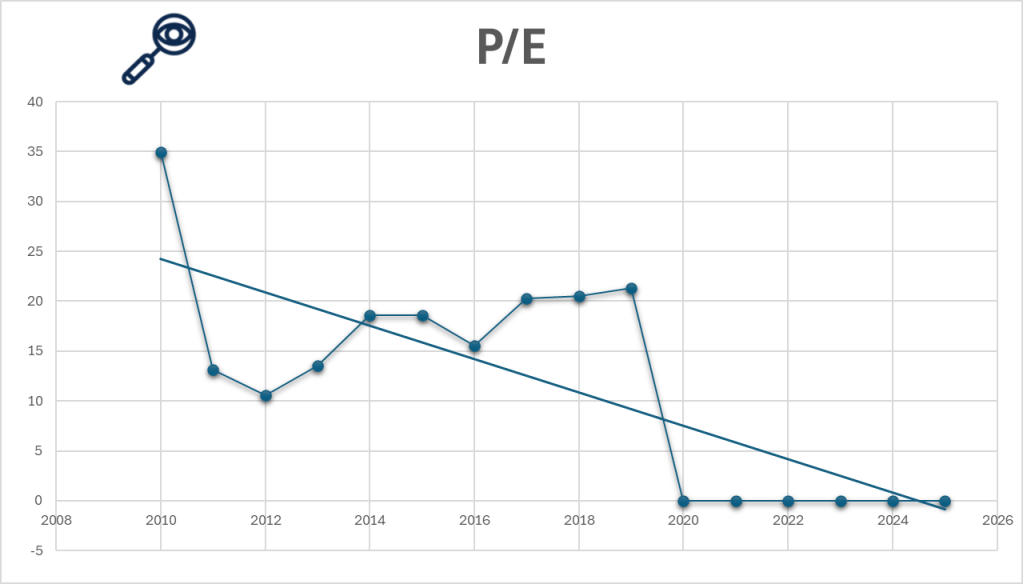
Assets and Liabilities

Illustration 14 and 15: Assets and Liabilities for Toyota from 2009 to 2025

When evaluating a company as a potential investment, understanding its assets and liabilities is crucial. If a local business owner offered to sell their shop to you, one of the first questions. after determining its profitability, would be about its equity and assets. The same principle applies when assessing publicly traded companies like Toyota.

As shown in Illustrations 14 and 15, Toyota has built a substantial asset base, totaling approximately $621 billion in 2024. This steady asset growth from 2009 to 2024 is a strong positive indicator, reflecting the company’s ongoing expansion, long-term investments in electrification, autonomous technology, and manufacturing infrastructure.

At the same time, Toyota’s total liabilities have also increased over the years, rising from approximately $193 billion in 2009 to over $378 billion in 2024. While this rise in liabilities may raise concerns for some investors, it is not necessarily a red flag, as much of it is tied to Toyota’s financial services arm and ongoing investments in electrification, autonomous driving, and next-generation mobility infrastructure. These capital-intensive areas are critical for maintaining Toyota’s global competitiveness and future readiness. Historically, Toyota has maintained a strong balance between investment and financial discipline, supported by robust cash flows and consistent profitability. Nevertheless, the scale of its liabilities warrants continued observation. Investors should monitor Toyota’s ability to manage debt responsibly, ensuring that it does not limit strategic flexibility or affect long-term financial stability as the automotive industry continues to evolve.

The key factor for investors is whether Toyota can effectively manage its debt while maintaining strong revenue and profitability. If the company can generate consistent cash flow and sustain high demand for its products and services, its rising liabilities may not be a major issue. However, if debt levels continue to grow faster than revenue or profits, it could indicate financial strain, making it important for investors to monitor the company’s ability to service its obligations while maintaining profitability.

Toyota’s cash on hand in 2024 is notably less than its long-term debt, which raises some concerns about its liquidity position. Holding less readily available cash compared to its debt obligations may indicate potential challenges in meeting short-term financial commitments without relying on additional financing or asset sales. This imbalance could limit Toyota’s flexibility to fund strategic investments or navigate unexpected market downturns, and investors should monitor the company’s cash flow management closely to assess any risks related to its financial stability. This should be monitored closely by all investors.

As seen in Illustration 15, Total Shareholder Equity, calculated as total assets minus total liabilities, has consistently grown over the past 14 years. This is a positive indicator for potential investors, as it suggests that Toyota is building value over time rather than eroding its financial foundation. A steadily increasing shareholder equity indicates that the company’s assets are growing at a faster rate than its liabilities, which is a green flag for financial health. This trend suggests that Toyota is successfully expanding its operations while maintaining a solid balance sheet. Additionally, rising equity provides a buffer against financial downturns, making the company more resilient in times of economic uncertainty. However, investors should also consider how this growth is achieved, whether through profitable operations or increased debt financing, to fully assess the sustainability of this trend.

Debt to Equity Ratio

Illustration 16 and 17: Debt to Equity ratio for Toyota Motor Corp. from 2009 to 2024

The Debt-to-Equity (D/E) ratio is an important financial metric for assessing a company’s financial leverage and risk. It compares the amount of debt the company uses to finance its operations relative to its shareholder equity. A high D/E ratio suggests that the company relies more heavily on debt to fuel growth, which could increase financial risk, especially during economic downturns when managing debt obligations becomes more challenging. In contrast, a lower D/E ratio indicates that the company is primarily financed through equity, reducing financial risk but potentially limiting its ability to rapidly expand.

Legendary value investor Warren Buffett generally prefers a debt-to-equity (D/E) ratio below 0.5. Toyota’s D/E ratio, however, stood at approximately 1.57 in 2024. TWhile this could raise concerns about Toyota’s financial leverage and its capacity to manage debt—especially amid industry shifts and economic uncertainties, it is not necessarily a red flag. Toyota has been strategically using debt to fund key investments in electrification, hydrogen technology, and autonomous systems, supporting its long-term growth ambitions. The downwards trend in D/E ratio is also a positive sign for investors as it indicates less reliance on debt financing over the years.

Price to earning ratio (P/E)

Illustration 18 and 19: Price to earnings ratio of Toyota Motor Corp. from 2010 to 2025

For value investors, one of the most critical metrics when evaluating Toyota’s stock is the price-to-earnings (P/E) ratio, as it helps assess whether the company is undervalued or overvalued. Even if a company has strong financials, purchasing its stock at a high price can lead to poor returns. For example, imagine a business generating solid profits of $1 million per year. If the owner offers to sell you the business for just $1, it would be an incredible deal. But if the owner asks for $1 trillion, even though the business is profitable, the price would be absurdly overvalued. The stock market works similarly, companies can be priced cheaply on some days and excessively expensive on others.

Warren Buffett, a legendary value investor, typically considers stocks with a P/E ratio of 15 or lower as “bargains.” A high P/E ratio suggests that investors are paying a premium for the company’s earnings, expecting significant growth. Toyota Motor Corporation has consistently maintained a relatively low P/E ratio over the years, hovering around 10 across multiple periods, as can be seen in illustration 18. This consistent valuation suggests a cautious but stable investor outlook, reflecting Toyota’s mature industry position and steady earnings performance. The current P/E ratio of 10.2 may signal that Toyota remains undervalued relative to the broader market. For value investors, this steady undervaluation could present an appealing entry point, especially if Toyota continues to perform reliably while transitioning to electric and autonomous vehicle technologies.

Price to Book ratio (P/B)

Illustration 20 and 21: Price to book ratio for Toyota Motor Corp. from 2009 to 2024

Price-to-book value (P/B ratio) is a financial metric used to compare a company’s market value (its stock price) to its book value (the net asset value of the company, calculated as total assets minus total liabilities). The P/B ratio is calculated by dividing the current share price by the book value per share. A lower P/B ratio suggests that the stock may be undervalued, as investors are paying less for the company’s assets than their actual worth. Conversely, a high P/B ratiomay indicate that the stock is overvalued, or that investors expect high growth in the company’s future earnings. The P/B ratio is often used by value investors to assess whether a stock is trading at a fair price based on its underlying assets. Legendary Investor Warren Buffet prefers company’s with P/B lower than 1.5 and often buys around 1.3 or lower.

The price-to-book (P/B) ratio of Toyota Motor Corporation is a green flag for value-oriented investors, as it has remained consistently low compared to industry peers and well within the range Warren Buffett often considers attractive. With a P/B ratio typically hovering around 1.0 or lower in recent years, Toyota appears undervalued relative to the net worth of its assets. This suggests that investors are paying a modest price for ownership in a company with strong tangible asset backing, healthy cash flows, and a proven global presence. Unlike tech companies with inflated P/B ratios driven by future growth speculation, Toyota’s low P/B reflects its stable earnings, conservative balance sheet, and disciplined capital allocation. For value investors, this consistency signals a potentially underappreciated opportunity, especially as Toyota ramps up its transition to electric and hydrogen vehicles, which could unlock new growth while maintaining financial resilience. Rather than indicating market pessimism, Toyota’s low valuation may simply reflect a longstanding investor tendency to undervalue traditional automakers, offering a chance for upside if the market re-rates its future prospects.

Return on Investment (ROI)

Illustration 22 and 23: Return on Investment for Toyota Motor Corp. from 2010 to 2015

For value investors, another essential metric when evaluating Toyota’s stock is Return on Investment (ROI), as it reveals how efficiently the company is using its capital to generate profits. In simple terms, ROI measures how much return a business earns relative to the capital invested to run it. Even if a company shows strong revenues, if it needs massive amounts of capital to produce modest profits, it may not be an attractive investment. For example, if one company generates a $100,000 return on a $1 million investment, while another earns the same return on just $500,000, the latter is clearly more efficient and potentially more valuable. ROI helps investors identify these distinctions and avoid companies that consume capital without delivering proportional returns. The higher the ROI, the better but it is also very industry dependent as some industries need a lot more capital than others. Legendary investor Warren Buffett has often stated that he seeks returns of at least 15% annually on his investments over time. While he doesn’t quote ROI specifically, this is effectively what he aims for in terms of return on invested capital and intrinsic value growth.

Toyota Motor Corporation has historically delivered a low but stable ROI, often ranging between 5% and 10%, which is considered healthy for a capital-intensive industry like automotive manufacturing. Even though, this is under Buffet’s expectations this is a normal ROI in the automaker industry which is very capital intensive. This consistent performance indicates that Toyota is effectively deploying its resources to generate returns, especially in comparison to peers in the same sector who may struggle with slimmer margins or capital inefficiency. As shown in illustration 21, Toyota’s ability to maintain solid ROI over time. despite economic cycles, supply chain disruptions, and shifts in consumer demand, demonstrates sound management and operational resilience. For long-term investors, this level of capital efficiency is a green flag, suggesting that Toyota is not just a stable company but one that continues to deliver meaningful returns without reckless spending, even as it invests in the future of mobility through electrification and automation.

Dividend

Illustration 24: Dividend Yield and dividend payout ratio from 2005 to 2025.

Toyota Motor Corporation has established itself as a reliable dividend payer in the global automotive industry, offering an annual dividend of approximately ¥60–¥70 per share in recent years. This reflects the company’s commitment to rewarding shareholders while maintaining financial discipline. Toyota’s steady dividend history—even through economic downturns—underscores its reputation as a financially stable, conservative company, making it a favorable choice for income-seeking investors.

However, there are considerations regarding Toyota’s dividend yield, which typically ranges between 2% and 3%. While the company continues to return capital to shareholders, growing demands for investment in electrification, autonomous driving, and sustainability initiatives could limit the pace of future dividend increases. As Toyota ramps up R&D and capital expenditures to stay competitive in a rapidly evolving industry, sustained dividend growth may face some headwinds if earnings growth slows.

Insider Trading

As a Foreign Private Issuer (FPI), Toyota is not required to file insider trading reports with the U.S. Securities and Exchange Commission (SEC). However, the company provides detailed disclosures in its annual reports and Form 20-F filings, which include information on executive compensation, shareholdings, and related party transactions.

Over the past years, Toyota Motor Corporation has not reported direct insider transactions involving its own shares. According to publicly available data and insider-tracking sources, the most recent direct insider transactions involving Toyota Motor Corporation’s own stock (NYSE: TM) date back to 2004.

This can be seen as both a red and a green flag for potential investors. It is a green flag as The absence of insider sales may suggest that Toyota’s executives have long-term confidence in the company and see no reason to cash out. Unlike many public firms where executives frequently sell stock, Toyota’s leadership appears more focused on stewardship than on short-term financial gains. Furthermore, In Japan, corporate culture traditionally emphasizes stability, loyalty, and modest compensation. Executives are less incentivized through stock grants compared to U.S. firms. This can reflect a conservative, shareholder-friendly philosophy where management is aligned with long-term success rather than short-term speculation.

However, The absence of insider purchases—even during market dips—may raise eyebrows. If executives truly believed the stock was undervalued at any point, why didn’t they buy? In the U.S., insider buying is often considered a strong bullish signal. Toyota is a Japanese company listed as an ADR (American Depositary Receipt) in the U.S., and insider trading disclosures aren’t held to the same real-time standards as in the U.S. This can lead to lower visibility and slower access to critical insider activity data, which some investors view as a governance downside. Toyota’s executive compensation is less tied to equity than U.S. firms, meaning insiders may not have “skin in the game” to the same extent. For some investors, this reduces alignment between management and shareholders.

Other Company Info

Founded in 1937, Toyota Motor Corporation is one of the world’s largest and most respected automotive manufacturers, known for its high quality and sustainable vehicles. As of 2024, Toyota employs approximately 375,000 people globally, reflecting its extensive operations in manufacturing, R&D, and mobility solutions. The company is publicly traded on the Tokyo Stock Exchange (TSE) under the ticker symbol 7203 which is its main listing, but it is also cross -listed on the New York Stock Exchange under the ticker symbol TM and operates within the Consumer Discretionary sector, specifically in the Automobiles industry.

Toyota is headquartered at 1 Toyota-cho, Toyota City, Aichi Prefecture, Japan. As of 2024, the company has approximately 3.2 billion shares outstanding, with a market capitalization of over $300 billion USD. For more information, visit Toyota’s official website: https://global.toyota.

Final Verdict

Toyota Motor Corporation is a solid long-term investment, especially for value and income investors. With consistently low P/E and P/B ratios, the stock appears undervalued compared to its history and peers. Toyota has a strong balance sheet, steady dividends, and a conservative payout ratio, making it reliable for income seekers.

The company is investing in hybrids, electric vehicles, hydrogen fuel cells, and autonomous driving, maintaining its global leadership with operations in over 170 countries. Although Toyota’s EV transition is slower than some competitors, its diversified approach could offer stability.

Overall, Toyota looks like a great opportunity for value investors. It seems undervalued, has solid financials and offers steady growth nad reliable dividends, making it an attractive choice for long-term investors focused on stability rather than rapid growth.

Bruce Kovner: From Cab Driver to Billionaire

“In markets, you need a blend of arrogance and humility.” — Bruce Kovner

Bruce Kovner’s life reads like a movie script: a young man with intellectual gifts but no clear direction, hustling as a New York City cab driver who eventually becomes a billionaire hedge fund manager, shaping one of the most successful macro hedge funds in history, Caxton Associates. As of April 2024, his net worth was estimated at US$7.7 billion.

Bruce Kovner

Illustration 1: Bruce Kovner

But his story is more than just rags to riches. It’s a masterclass in entrepreneurial resilience, risk-taking, and strategic thinking, offering a blueprint for ambitious investors and dreamers alike. This article will go the entrepreneurial journey of Bruce Kovner in order to determine the lessons future investors and entrepreneurs can learn from him.

Harvard University: Admissions 2025, Fees, Rankings, Scholarships, and  Courses

Illustration 2: Bruce Kovner studied at Harvard, but dropped out of his PhD program.


In 1977, at the age of 32, Kovner made his first trade, a decision that would change his life forever. He borrowed $3,000 against his MasterCard and bought soybean futures, which rose dramatically in value. The position grew to $40,000, but in a gut-wrenching twist, he held on too long and exited with just $23,000 in profits. That first experience taught him a core principle of trading which is risk management. “I almost lost it all… I learned how important it is to preserve capital. That lesson has never left me.” It also showed a trait common in great entrepreneurs that they all learn fast from mistakes.

Soybeans | Organic, Non-GMO and Identity-Preserved Options

Illustration 3: Trading soybean futures was where Kovner’s turnaround started.

Shortly after his first trade, Kovner joined Commodities Corporation, a trading firm that also nurtured legends like Paul Tudor Jones and Michael Marcus.

It was here that Kovner honed his macro trading skills, using fundamental analysis, global economic indicators, and market psychology to anticipate major price movements in commodities, currencies, bonds, and equities. His performance at Commodities Corp was nothing short of phenomenal, regularly generating double- and triple-digit returns.

The following lessons can be learned from this which is to seek mentorship and elite environments. By surrounding yourself with skilled, like-minded professionals you accelerate your growth. You have to study the game deeply, Kovner dove into global macroeconomic trends understanding, the “why” behind market moves. Lastly, Kovner was known for balancing intuition and data. He trusted his gut, but only after intense analysis and scenario planning.

In 1983, Kovner struck out on his own, founding Caxton Associates, a global macro hedge fund that would become one of the most respected and consistently profitable funds in history.

Caxton Associates Gets a Boost From ESG | Institutional Investor

Illustration 4: Caxton Associates was founded by Bruce Kovner

Kovner invested his own capital, managed risk obsessively, and recruited top talent, establishing a culture of intellectual rigor and emotional discipline. His entrepreneurial leap was bold, he wasn’t just trading anymore but he was building a business, with a vision and a team.

Under his leadership, Caxton never had a losing year while he was at the helm, achieving average annual returns of around 21% for nearly two decades. At its peak, Caxton managed over $14 billion in assets.


Kovner was well known for his relentless curiosity. Kovner wasn’t formally trained in finance. Yet he devoured books on markets, economics, psychology, and political history. He knew that to trade globally, you must think globally. An important lesson from this is to never stop learning. The market rewards deep understanding, not surface-level trends.

He was willing to take bold positions, betting billions on global events, but always maintained tight risk controls, rarely risking more than 1–2% of capital on any trade. The lesson from this is that big rewards come from long-term survival, not reckless gambles.

Kovner invested heavily in building teams of researchers, analysts, and traders. He believed in empowering talent and sharing knowledge, a trait that many great entrepreneurial leaders share.

Markets change, and Kovner’s flexibility, switching strategies, asset classes, and regions, allowed Caxton to thrive in both bull and bear markets. One of the hallmarks of Bruce Kovner’s career is that he never had a losing year while running Caxton Associates, even during periods of extreme volatility, financial crises, and bear markets. That’s not just rare, it’s almost unheard of in the hedge fund world. Kovner wasn’t a long-only equity investor.

How I Learned to Stop Worrying and Love the Bear Market - WSJ

Illustration 5: Kovner had a successfull track record even during bear markets.

He ran a global macro strategy, which meant he could go long or short virtually any asset class: currencies, commodities, bonds, equities, anywhere in the world.

This gave him a powerful edge in bear markets. While most investors were losing money on falling stocks, Kovner could bet on rising volatility or dislocations in foreign exchange markets, short equities or sectors likely to collapse, Go long on safe-haven assets like U.S. Treasuries or gold, bet on rising volatility or dislocations in foreign exchange markets. Flexibility is one of the greatest defenses against a bear market.

Kovner wasn’t reacting to headlines, he was anticipating them. His deep understanding of macroeconomics and policy allowed him to foresee: Central bank decisions, Currency devaluations, Sovereign debt risks and Structural imbalances in economies. During the Asian Crisis, for instance, he positioned his fund to profit from collapsing currencies in Thailand and Indonesia, shorting those currencies while others were still bullish.


Kovner retired from Caxton in 2011, worth an estimated $5.3 billion, according to Forbes. But he didn’t disappear.

Juilliard Acceptance Rate, Alumni, and How to Get In (2024)

Illustration 6: Kovner became a significant donor to the Julliard School

He became one of New York’s leading philanthropists, funding education, culture, and conservative causes. He founded the Julliard School’s Kovner Fellowship, supporting gifted musicians and continues to be active in politics, think tanks, and the arts. His success inspired a generation of macro traders, and his approach is still studied in financial circles today.

Bruce Kovner is a beacon for those who feel stuck, uncertain, or “too late” to start something great. He wasn’t a teenage prodigy, nor a Silicon Valley founder. He was a cab driver in his 30s who studied obsessively, took a bold leap, and built a financial empire.

NYC's Last Crown Vic Taxis: A Final Farewell | Diehl Ford of Sharon

Illustration 7: A NYC taxi cab. Kovner worked as a taxi driver before becoming a CEO Fund manager.

In an age where people chase fast money and viral fame, Kovner’s story is a reminder that discipline, depth, and daring are the timeless keys to success.


Baidu Inc. – A Stock Analysis of One of China’s Leading Tech Giants

Introduction

Baidu Inc. is a prominent Chinese multinational technology company, widely recognized as one of the world’s leading artificial intelligence (AI) and internet services providers. Headquartered in Beijing, Baidu is best known for operating China’s largest search engine, but its portfolio spans a broad range of sectors, including cloud computing, autonomous driving, language processing, and smart devices.

Illustration 1: The Baidu logo, featuring its distinctive pawprint symbol, representing its digital footprint and innovation.

Unlike many global tech giants that emerged from the West, Baidu has played a foundational role in shaping the Chinese internet landscape. Its search engine dominates the domestic market, while its ongoing investment in AI and machine learning has positioned the company as a key innovator in emerging technologies such as autonomous vehicles and natural language understanding.

As a member of China’s “BAT” trio (Baidu, Alibaba, Tencent), Baidu is one of the most influential tech companies in Asia. Its technological infrastructure powers a wide array of services, including Baidu Maps, Baidu Cloud, and DuerOS—a voice assistant platform integrated into various smart devices. With a strong focus on AI research, a deep data ecosystem, and strategic partnerships, Baidu continues to be a driving force in the global tech landscape, particularly in AI and intelligent mobility.

History

Baidu was founded in 2000 by Robin Li and Eric Xu, emerging at a time when China’s internet ecosystem was still in its infancy. Robin Li’s development of the RankDex site-scoring algorithm in the late 1990s laid the foundation for Baidu’s core search technology—a precursor to modern search engine optimization and ranking systems.

Baidu’s breakthrough came in the early 2000s as it rapidly became China’s dominant search engine, offering results tailored to Chinese-language users with superior indexing of Chinese websites. The company’s innovative pay-for-placement advertising model helped generate significant early revenue, setting the stage for rapid growth and public listing on the NASDAQ in 2005.

Throughout the 2010s, Baidu evolved from a search engine company into a diversified tech powerhouse. It expanded into cloud services, digital maps, mobile applications, and AI-powered products. A major turning point was its strategic pivot toward artificial intelligence—investing heavily in autonomous driving (Apollo), smart voice assistants (DuerOS), and deep learning platforms (PaddlePaddle), making AI central to its long-term vision.

By the 2020s, Baidu had positioned itself as a global leader in AI and autonomous technology. Its Apollo platform became one of the most advanced autonomous driving systems in the world, and Baidu began operating robotaxi services in several Chinese cities. The company also deepened its AI capabilities through Baidu Brain, a large-scale AI system integrating vision, speech, knowledge, and language technologies.


Today, Baidu remains one of China’s most influential technology companies. With a strong emphasis on innovation, research, and ethical AI development, Baidu continues to drive advancements across industries. In the stock market, Baidu is seen as a bellwether for the Chinese tech sector, reflecting broader trends in AI, cloud computing, and digital infrastructure.

Operations and Products

  • Search, Cloud, and AI-Driven Ecosystem

Baidu operates one of the world’s largest and most advanced AI-powered ecosystems, built on a foundation of search, cloud computing, and intelligent services. While the company began as China’s premier internet search engine, it has transformed into a diversified technology enterprise focused on artificial intelligence, autonomous driving, cloud services, and smart devices.

Baidu’s core products still include its flagship Baidu Search, which dominates the Chinese-language internet search market. Over time, this platform has evolved with advanced AI features such as voice search, natural language processing (NLP), and personalized results based on big data analytics.

Baidu launches search engine in Thailand, Brazil, and Egypt

Illustration 2: Baidu Search is the product Baidu is most famous for.

Beyond search, Baidu Cloud delivers enterprise-grade infrastructure and intelligent services, including AI-powered data analytics, intelligent speech and image recognition, and machine learning platforms. This cloud ecosystem serves sectors like finance, healthcare, manufacturing, and smart cities.

  • Autonomous Driving and Smart Transportation

One of Baidu’s most prominent innovations is Apollo, its open-source autonomous driving platform. Apollo provides a comprehensive solution for autonomous vehicle development, including software stacks, cloud-based simulation tools, and in-vehicle operating systems. The platform is used by global automakers and has powered the launch of robotaxi services in cities like Beijing, Wuhan, and Chongqing.

Illustration 3: One of Baidu’s Apollo robotaxies

In addition to Apollo, Baidu has introduced RT6, a fully autonomous electric vehicle designed for urban ride-hailing, marking a step forward in reducing operational costs and scaling autonomous mobility.

  • Voice Assistants and Smart Devices

Baidu’s AI assistant DuerOS powers a growing range of smart devices, from smart speakers and in-car infotainment systems to household appliances. Through natural language processing and conversational AI, DuerOS enables hands-free interaction and integration with Baidu’s services.

The company has also developed AI chips, such as Kunlun, to support high-performance AI processing for applications in data centers and on edge devices. These chips are used for deep learning, image and speech recognition, and autonomous driving computation.


  • Emerging Technologies and Future Focus

Baidu is investing heavily in generative AI, foundation models, and language-based applications. Its ERNIE (Enhanced Representation through Knowledge Integration) model is China’s counterpart to GPT-like large language models, enabling everything from AI writing and coding to intelligent customer service and enterprise automation.

Looking ahead, Baidu is positioning itself as a global AI leader, with a focus on AI cloud integration, smart transportation infrastructure, and intelligent edge computing. Its commitment to ethical AI, energy efficiency, and open-source collaboration ensures its relevance in both China’s tech ecosystem and the broader international market.

Key Competitors

Baidu operates in several fast-evolving and highly competitive sectors, including internet services, artificial intelligence, cloud computing, and autonomous driving. Its major competitors vary by product category and technological focus:

Alibaba Group – As one of China’s largest tech conglomerates, Alibaba competes with Baidu primarily in cloud computing and AI services. Alibaba Cloud is a top rival to Baidu Cloud, offering a wide range of infrastructure and machine learning tools to enterprise clients. Alibaba also invests heavily in smart city and AI-driven business applications.

Tencent – Known for WeChat and its expansive digital ecosystem, Tencent competes with Baidu in the realms of online advertising, content distribution, and AI-powered applications. Tencent’s investments in cloud computing, search, and smart services overlap with Baidu’s broader AI ecosystem.

ByteDance – While originally known for its short-form video platforms like TikTok (Douyin in China), ByteDance has become a formidable competitor in AI and online search. Its Toutiao news aggregation platform and growing ambitions in AI research present a challenge to Baidu’s dominance in content discovery and recommendation systems.

Huawei – Huawei competes with Baidu in AI chips, cloud services, and smart infrastructure. The company’s Ascend AI processors and Huawei Cloud offerings rival Baidu’s Kunlun chips and cloud-based AI solutions. Huawei is also a major player in intelligent transportation, overlapping with Baidu’s Apollo platform.

Illustration 4: Baidu Headquarters in Beijing China

Google (Alphabet Inc.) – On the international stage, Google is Baidu’s most direct analogue, especially in search, cloud, and AI research. While Google does not operate in mainland China due to regulatory constraints, both companies compete globally in areas such as large language models, autonomous driving, and AI-powered cloud services.


Competitive Advantage

Baidu’s most significant competitive advantage lies in its deep expertise and long-standing investment in artificial intelligence (AI). As one of the first Chinese tech companies to prioritize AI as a core strategy, Baidu has built a vertically integrated AI ecosystem that spans foundational research, infrastructure, and practical applications. Its proprietary ERNIE large language model and AI framework PaddlePaddle give Baidu full-stack control over its AI pipeline, from model training to deployment—similar to how a vertically integrated chipmaker controls the semiconductor process. This in-house AI capability enables Baidu to quickly adapt and deploy solutions across sectors such as search, cloud computing, autonomous driving, and smart devices, giving it a strong edge over companies that rely on third-party models or external development frameworks.

Another competitive strength is Baidu’s autonomous driving platform, Apollo, which is widely regarded as one of the world’s most advanced open-source ecosystems for intelligent mobility. With partnerships across the automotive industry and active robotaxi deployments in multiple Chinese cities, Baidu has a first-mover advantage in the smart transportation space.

Baidu also benefits from its dominance in Chinese-language search and knowledge-based services. Its search engine remains the market leader in China, supported by AI-enhanced features and deep content integration through platforms like Baidu Baike (an online encyclopedia) and Baidu Tieba (a discussion forum network). These platforms give Baidu access to vast amounts of first-party data, enabling superior personalization, ad targeting, and machine learning performance.

Additionally, Baidu’s emphasis on data security, localization, and regulatory alignment gives it an operational advantage in China’s tightly regulated digital environment. The company’s strong government relations and commitment to compliance enable it to operate at scale in areas where foreign tech giants face barriers.

Finally, Baidu’s strong R&D culture, with continuous investment in AI chips (e.g., Kunlun) and next-gen computing, ensures its long-term competitiveness. Combined with a robust cloud infrastructure, a growing enterprise customer base, and integrated smart services, Baidu is uniquely positioned to lead China’s digital transformation and compete globally in AI-driven technologies.

Illustration 5: A Baidu AI robot

Future Outlook

Baidu is expected to see steady growth as demand rises for smart mobility, cloud services, and intelligent digital tools in China. Sectors like autonomous driving, enterprise cloud solutions, and digital infrastructure are projected to expand, creating new opportunities for the company.

With ongoing investment in self-driving technology (Apollo), custom chips (Kunlun), and industry-focused cloud services, Baidu is well-placed to benefit from China’s push toward automation and digitalization. As these trends continue, demand for Baidu’s core services is likely to increase in the years ahead.


Stock Analysis

In this section we will analyze Baidu’s stock to see if it is a good stock to buy or not. Our philosophy is value investing meaning that we try to find good quality companies that are undervalued. However, we will give a holistic overview so all kind of investors with different philosophies can judge the stock for themselves.

Revenue and Profits

Illustration 6 and 7: Revenue of Baidu from 2009 to 2024

As shown in Illustration 6 and 7, Baidu has experienced a dynamic long-term revenue trajectory, particularly from 2009 to 2021, when it established itself as China’s dominant search engine and a major player in online advertising. The company’s early lead in China’s digital economy, supported by rapid internet adoption and growing advertiser demand, helped drive consistent gains throughout much of this period. Baidu also began investing in emerging technologies during these years, including artificial intelligence, autonomous driving, and cloud services, laying the groundwork for future diversification.

However, despite these early advantages, Baidu encountered periods of slower growth and revenue pressure, notably between 2021 and 2024. This downturn was driven by intensifying competition from platforms like Tencent and Bytedance, shifts in user behavior toward mobile super apps and short-form video, and internal restructuring. In response, Baidu expanded its R&D spending and began repositioning itself as a technology-driven company beyond search, focusing on AI cloud computing, Apollo (autonomous driving), and smart devices. The role of coid-19 on the very strong revenue increase is also worth taking in to consideration.

Baidu’s revenue is overall a green flag as it shows a steady increase in income over time and also reflects the company’s ability to adapt through diversification into AI, cloud, and autonomous driving, positioning it well for future growth despite short-term volatility.

Illustration 8 and 9: Net Income for Baidu from 2009 to 2024

Net income is a crucial metric to evaluate when determining whether a company is a worthwhile investment. It represents a company’s net profit or loss after accounting for all revenues, income items, and expenses, calculated as Net Income = Revenue – Expenses.

As can be seen from Illustration 8 and 9, the net income for Baidu rose steadily from 2009 to 2015 due to strong performance in its core search and online advertising business. However, from 2015 to 2025, net income has been highly volatile despite steadily increasing revenue. This disconnect is largely due to rising operating costs, heavy R&D investments in AI, autonomous driving, and cloud services, as well as regulatory headwinds and economic uncertainty in China. While revenue growth indicates strong top-line performance, the inconsistency in net income is a red flag, suggesting pressure on margins and highlighting the financial risks tied to Baidu’s aggressive long-term innovation strategy.

Revenue Breakdown

Illustration 10: Revenue Breakdown for Baidu gathered from gurufocus

The Online Marketing segment is Baidu’s largest revenue driver, contributing approximately 60–70% of total revenue. This segment primarily consists of pay-per-click (PPC) advertising services through Baidu’s core search engine platform, as well as display ads across its ecosystem of products and content partners. Despite growing competition from platforms like Tencent and ByteDance, Baidu maintains a strong presence in China’s search-based ad market. However, ad revenue has faced pressure in recent years due to regulatory crackdowns on internet companies, weakening macroeconomic conditions, and advertisers shifting budgets toward e-commerce and short video platforms.

Baidu’s non-advertising revenue—mainly from AI Cloud and intelligent driving—now accounts for approximately 25–30% of total revenue. This segment includes Baidu AI Cloud services, Apollo autonomous driving, Xiaodu smart devices, and intelligent transportation systems. AI Cloud has seen significant growth from government and enterprise demand for digital transformation, while Apollo remains a long-term bet on the future of mobility. These areas have required heavy investment and contributed to margin pressure, but they represent key pillars of Baidu’s strategic pivot beyond advertising. The cloud segment, in particular, has shown strong momentum, with revenue growing over 20% year-over-year in several recent quarters.

The remaining 5–10% of Baidu’s revenue comes from other sources, including content subscriptions, licensing, and miscellaneous services tied to the company’s broader AI ecosystem. While not core drivers of growth, these smaller streams add diversification and support Baidu’s broader goal of becoming a comprehensive AI and technology platform.

Despite this diversification, Baidu has faced financial pressure in recent years. While revenue has continued to rise, net income has been volatile due to high R&D costs, regulatory expenses, and ongoing losses in emerging business units like autonomous driving. For example, Baidu’s net income dropped from RMB 10.2 billion in 2021 to RMB 7.6 billion in 2023, with fluctuations expected to continue as the company scales its next-gen technologies.

As seen in Illustration 13, a significant portion of Baidu’s revenue is allocated to cost of goods sold (COGS), particularly within its cloud and AI-related businesses. Unlike the higher-margin search advertising segment, Baidu’s non-advertising services—such as AI Cloud and smart devices—tend to carry higher operational costs, resulting in a larger share of revenue consumed by COGS. This has put pressure on overall gross margins, especially as these segments expand. Additionally, Baidu consistently allocates over 15% of its revenue to research and development (R&D), reflecting its strategic focus on long-term innovation in AI and autonomous technologies. While these investments are vital for future growth, they contribute to current margin compression and earnings volatility.

Overall, Baidu’s revenue breakdown reflects both stability and transformation. Its dominance in online advertising ensures steady cash flow, while emerging segments in AI and autonomous driving offer promising growth opportunities. However, investors should be aware of the execution risks and earnings volatility that come with this strategic shift.

Earnings per Share (EPS)

Illustration 11: Earnings per share for Baidu from 2009 to 2024

Earnings Per Share (EPS) is a key financial metric that measures a company’s profitability on a per-share basis. It indicates how much profit a company generates for each outstanding share of its stock, and is used to assess a company’s financial health, profitability, and potential for growth. In other words this metric can tell us how profitable the business is.

The EPS figure itself isn’t the primary focus for value investors—it can be 0.2 or 10, but what truly matters is the company’s ability to generate consistent earnings growth. A steadily increasing EPS over time signals strong financial health, profitability, and long-term value creation.

Baidu’ earnings per share (EPS) performance from 2009 to 2015 reflects a generally strong long-term trend, but recent years have shown a concerning volatility as shown in illustration 11. From 2009 to 2015, Baidy consistently grew its EPS, reaching a peak of $16.69 per share in 2015. However, from 2015 onwards, Baidu’s EPS has shown pronounced fluctuations. This volatility has been driven by several factors: intensifying competition from other tech giants, heavy investments in AI and autonomous driving, regulatory pressures within China’s tech sector, and broader macroeconomic uncertainties. While there were periods of recovery and innovation-led growth, the company has struggled to maintain stable profit expansion year-over-year.

This volatility is a red flag for investors, as it indicates that Baidu is struggling to maintain steady profit growth despite its historically strong revenue performance. However, in recent years from 2022 its EPS has been steadily increasing which is a positive sign and shows an ability to grow a profit. Potential Investors should in all case monitor the EPS of Baidu closely for sudden changes.

Assets and Liabilities

Illustration 12 and 13: Assets and Liabilities for Baidu from 2009 to 2024.

When evaluating a company as a potential investment, understanding its assets and liabilities is crucial. If a local business owner offered to sell their shop to you, one of the first questions—after determining its profitability—would be about its equity and assets. The same principle applies when assessing publicly traded companies like Baidu.’

As shown in Illustrations 11 and 12, Texas Instruments has a substantial asset base, totaling $58.6 billion in 2024. This steady asset growth over time from 2009 to 2024 is a positive sign, indicating that the company is expanding its operations, investing in new technologies, and strengthening its market position. A growing asset base often reflects a company’s ability to scale its business, acquire new projects, and improve its production capacity, which is particularly important in the competitive industry Baidu is in.

At the same time, Baidu’s total liabilities have also increased significantly, rising from $0.2 billion in 2009 to $21.1 billion in 2024. While such a sharp rise in debt might raise concerns for some investors, it is not necessarily a red flag given Baidu’s ongoing investments in artificial intelligence, cloud computing, and autonomous driving. These capital-intensive initiatives are essential for maintaining technological leadership in a rapidly evolving landscape. Baidu has historically balanced its investments with a strong focus on innovation and long-term growth, but the rising debt levels warrant careful observation. Investors should closely monitor Baidu’s ability to manage its liabilities effectively, especially amid recent earnings volatility. Ensuring that debt remains manageable and does not hinder future financial stability will be crucial for the company’s long-term success.

The key factor for investors is whether Baidu can effectively manage its debt while maintaining strong revenue and profitability. If the company can generate consistent cash flow and sustain high demand for its products and services, its rising liabilities may not be a major issue. However, if debt levels continue to grow faster than revenue or profits, it could indicate financial strain, making it important for investors to monitor the company’s ability to service its obligations while maintaining profitability.

The cash on hand for Baidu is a green flag for potential investors, as the company has $19 billion in readily available cash as of 2024. This is significantly higher than its long-term debt of $7.1 billion, which indicates a strong liquidity position. This suggests that Baidu is well-equipped to meet its financial obligations, fund strategic investments, and weather short-term market uncertainties without relying heavily on external financing.

As seen in Illustration 13, Total Shareholder Equity—calculated as total assets minus total liabilities—has consistently grown over the past 14 years. This is a positive indicator for potential investors, as it suggests that Baidu is building value over time rather than eroding its financial foundation. A steadily increasing shareholder equity indicates that the company’s assets are growing at a faster rate than its liabilities, which is a green flag for financial health. This trend suggests that Baidu is successfully expanding its operations while maintaining a solid balance sheet. Additionally, rising equity provides a buffer against financial downturns, making the company more resilient in times of economic uncertainty. However, investors should also consider how this growth is achieved—whether through profitable operations or increased debt financing—to fully assess the sustainability of this trend.

Debt to Equity Ratio

Illustration 14 and 15: Debt tp Equity ratio of Baidu from 2009 to 2024

The Debt-to-Equity (D/E) ratio is an important financial metric for assessing a company’s financial leverage and risk. It compares the amount of debt the company uses to finance its operations relative to its shareholder equity. A high D/E ratio suggests that the company relies more heavily on debt to fuel growth, which could increase financial risk, especially during economic downturns when managing debt obligations becomes more challenging. In contrast, a lower D/E ratio indicates that the company is primarily financed through equity, reducing financial risk but potentially limiting its ability to rapidly expand.

Legendary value investor Warren Buffett generally prefers a ratio below 0.5. Baidu’s D/E ratio is currently above that, standing at approximately 0.61 as of 2024 which is not much especially considering all the new AI projects Baidu has started in recent years. The D/E has steadily increased from 2009 where it was just 0.25. This indicates a growing reliance on debt financing over the past decade. This rising trend could raise concerns about Baidu’s financial leverage and its ability to manage debt effectively, especially in a volatile regulatory and competitive environment. However, this is not necessarily a red flag as Baidu has been investing in more AI projects during this time span that are financed through debt financing.

Since peaking around 2018, Baidu’s D/E ratio has shown signs of moderation, indicating a possible shift toward a more balanced capital structure. This decline may reflect efforts to deleverage and improve financial stability, which could be appealing to long-term investors focused on risk management. Baidu’s D/E ratio has also shown some volatility, suggesting that while the company generally maintains a cautious approach to debt, there are periods where leverage increases—potentially due to large-scale investments in AI, cloud, and autonomous driving. This isn’t necessarily a red flag, as long as Baidu avoids becoming overly dependent on debt. Still, the combination of rising debt and inconsistent profitability should be monitored closely, as it could pose risks to financial flexibility if not managed prudently.

Price to earnings ratio (P/E)

Illustration 16 and 17: P/E ratio of Baidu from 2010 to 2024

For value investors, one of the most critical metrics when evaluating Baidu’s stock is the price-to-earnings (P/E) ratio, as it helps assess whether the company is undervalued or overvalued. Even if a company has strong financials, purchasing its stock at a high price can lead to poor returns. For example, imagine a business generating solid profits of $1 million per year. If the owner offers to sell you the business for just $1, it would be an incredible deal. But if the owner asks for $1 trillion, even though the business is profitable, the price would be absurdly overvalued. The stock market works similarly—companies can be priced cheaply on some days and excessively expensive on others.

Warren Buffett, a legendary value investor, typically considers stocks with a P/E ratio of 15 or lower as “bargains.” A high P/E ratio suggests that investors are paying a premium for the company’s earnings, expecting significant growth. The P/E ratio of Baidu has fluctuated widely, ranging from 79.6 in 2010, to 19.21 in 2019, spiking to 99.79 in 2020, and dropping significantly to 12.5 in 2025. These sharp fluctuations are a red flag for potential investors, as they indicate market uncertainty and inconsistent investor confidence in Baidu’s earnings potential. However, the current P/E ratio of 12.5 suggests that Baidu may be undervalued, especially when compared to its historical valuation levels. For value investors, this could represent a potential buying opportunity—provided that the company can stabilize earnings and deliver on future growth prospects.
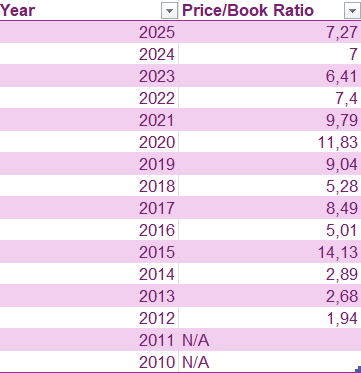
Price to book value (P/B ratio)

Illustration 18 and 19: Price to book ratio of Baidu from 2010 to 2025.

Price-to-book value (P/B ratio) is a financial metric used to compare a company’s market value (its stock price) to its book value (the net asset value of the company, calculated as total assets minus total liabilities). The P/B ratio is calculated by dividing the current share price by the book value per share. A lower P/B ratio suggests that the stock may be undervalued, as investors are paying less for the company’s assets than their actual worth. Conversely, a high P/B ratiomay indicate that the stock is overvalued, or that investors expect high growth in the company’s future earnings. The P/B ratio is often used by value investors to assess whether a stock is trading at a fair price based on its underlying assets. Legendary Investor Warren Buffet prefers company’s with P/B lower than 1.5 and often buys around 1.3 or lower.

The price-to-book (P/B) ratio of Baidu is a green flag, as it is significantly lower than that of many competitors in the tech sector and falls below the levels Warren Buffett typically considers undervalued. This suggests that the company may be undervalued relative to its book value, meaning investors are paying less for its assets compared to peers. Furthermore, the overall downward trend in Baidu’s P/B ratio in recent years indicates weakening investor sentiment, even as revenues have continued to grow. This could reflect under-optimism about Baidu’s future growth or a disconnect between its stock price and its underlying fundamentals. If profitability continues to decline while the P/B ratio remains low, it could signal a risk of value traps—where a stock appears cheap but lacks the catalyst for recovery. Investors should carefully assess whether the company’s financial performance can support future growth or if the current low valuation reflects deeper structural concerns.

Dividend

As of 2025, Baidu does not pay a regular dividend to shareholders. Baidu has historically reinvested its earnings into research and development, artificial intelligence, autonomous driving, and other growth initiatives rather than returning capital to shareholders through dividends. This strategy is typical for many tech companies, especially those still focused on expansion and innovation. If you’re looking for dividend-paying Chinese tech companies, you might want to look at others like Tencent or Alibaba, which have initiated or considered dividend payments in recent years.

Insider Trading

Over the past few years, insider trading activity at Baidu has been relatively limited, which is generally a neutral to green flag for investors, as it suggests stability and confidence in the company’s long-term prospects. However, there have been some notable planned transactions. For instance, in October 2024, insider Melissa Dongmin Ma filed a Form 144 to sell approximately 395,000 shares valued at around $41.6 million, following a similar filing in July 2024 for 260,000 shares worth about $22.4 million. While such large proposed sales might raise eyebrows, they are not necessarily a red flag, especially if they are part of routine portfolio diversification or personal financial planning. The absence of widespread or frequent insider selling supports a cautiously positive view, but investors should still monitor any emerging trends that may reflect shifting internal sentiment.

Other Company Info

Founded in 2000, Baidu Inc. is a leading Chinese technology company specializing in internet-related services, artificial intelligence, and autonomous driving technologies. As of 2024, Baidu employs approximately 35,900 people, reflecting its continued investment in research and development across AI, cloud computing, and smart mobility. The company is publicly traded on the NASDAQ under the ticker symbol BIDU and operates within the Technology sector, specifically under the Interactive Media & Services industry.

Baidu is headquartered at No. 10 Shangdi 10th Street, Haidian District, Beijing, China. As of 2024, the company has approximately 348 million shares outstanding, with a market capitalization of around $45 billion USD. For more information, visit Baidu’s official website: https://www.baidu.com.

Illustration 20-22: Number of employees and location of Baidu Headquarters in Beijing China

Final Verdict

Investing in Baidu Inc. presents a compelling opportunity, particularly for investors seeking exposure to China’s AI and digital innovation sectors. As a pioneer in search engine technology and artificial intelligence, Baidu has positioned itself at the forefront of China’s tech evolution, with major investments in autonomous driving (Apollo), AI cloud services, and generative AI models. The company’s strong research capabilities and diversified revenue streams—from online marketing to cloud and AI solutions—underscore its long-term growth potential.

However, investors should approach with measured caution. Baidu’s earnings have shown significant volatility in recent years, and while its P/E ratio is currently low (around 12.5 as of April 2025)—suggesting undervaluation—this reflects muted investor sentiment amid regulatory uncertainty and inconsistent profitability. Additionally, Baidu does not currently pay a dividend, which may deter income-focused investors. Competition from domestic tech giants like Alibaba, Tencent, and ByteDance also remains a persistent challenge.

Overall, Baidu may be a suitable investment for long-term, growth-oriented investors who are comfortable with short-term volatility and regulatory risk in exchange for potential upside tied to China’s AI-driven future. However, Its Net Income should be monitored closely.

Intel Corporation: A Comprehensive Overview and Stock Analysis of a Semiconductor Industry Leader

Introduction

Intel Corporation is a leading American multinational technology company specializing in the design and manufacturing of semiconductor chips and computing components. Headquartered in Santa Clara, California, and incorporated in Delaware, Intel has played a pivotal role in shaping modern computing. The company is best known for its microprocessors, which power the majority of personal computers (PCs) worldwide, and its contributions to high-performance computing, AI, and data center technologies.

Intel's New Strategy Is The Right One For The Company

Illustration1: Logo of the Intel corporation which symbolizes Intel’s power in peoples mind

As one of the largest semiconductor manufacturers by revenue, Intel has been a dominant force in the industry for decades. The company has consistently ranked among the top U.S. corporations on the Fortune 500 list, demonstrating its strong financial performance and market influence. Beyond CPUs, Intel produces chipsets, network interface controllers, GPUs, FPGAs, and memory solutions, making it a key player in the computing ecosystem.

History

Intel was founded on July 18, 1968, by semiconductor pioneers Gordon Moore (famous for Moore’s Law) and Robert Noyce, along with investor Arthur Rock. Under the leadership of Andrew Grove, Intel became a driving force behind Silicon Valley’s rise as a global tech hub. Initially, the company focused on SRAM and DRAM memory chips, which were its primary revenue sources until the early 1980s.

Intel’s breakthrough came in 1971 with the release of the Intel 4004, the world’s first commercial microprocessor. However, it wasn’t until the 1990s—when the PC revolution gained momentum—that microprocessors became Intel’s core business. The strategic alliance between Microsoft Windows and Intel (“Wintel”) cemented Intel’s dominance in the industry, as its CPUs became the standard for personal and enterprise computing.

By the late 1990s and early 2000s, Intel was the undisputed leader in the microprocessor market, holding over 90% market share in PC CPUs. However, the company also faced antitrust challenges and growing competition, particularly from AMD. Despite these challenges, Intel continued to innovate, pushing the boundaries of CPU performance, efficiency, and scalability.

Since the late 2010s, Intel has faced increasing competition from AMD, NVIDIA, and ARM-based processors, leading to a decline in its market dominance. However, Intel remains the leader in the x86 CPU market, holding a 68.4% share as of 2023. Unlike many of its competitors, Intel designs and manufactures its own chips, a rare advantage in the semiconductor industry where most companies rely on third-party manufacturers like TSMC and Samsung.

With a renewed focus on AI, data centers, and advanced chip manufacturing, Intel is investing heavily in next-generation process technologies and expanding its semiconductor fabrication facilities (fabs). The company aims to regain its competitive edge and reinforce its position as a leader in the evolving semiconductor landscape.

Operations and Products

  • Microprocessor and Semiconductor Manufacturing

Intel is one of the world’s largest manufacturers of microprocessors, producing chips for personal computers (PCs), servers, data centers, and embedded systems.


The company’s flagship Intel Core and Xeon processors power a vast majority of consumer and enterprise computing devices. Intel has remained a leader in CPU development, continuously innovating with new architectures, manufacturing nodes, and efficiency improvements.

Beyond CPUs, Intel also develops chipsets, graphics processing units (GPUs), memory solutions (Optane SSDs), and field-programmable gate arrays (FPGAs). The company manufactures its own chips in Intel Foundry Services (IFS), distinguishing itself from competitors like AMD and NVIDIA, which rely on third-party fabs like TSMC. Intel is actively investing in advanced semiconductor fabrication and is working towards regaining leadership in chip manufacturing with cutting-edge process nodes like Intel 4 and Intel 3.

  • Data Centric AI Solutions

Intel has expanded beyond traditional computing into AI, cloud computing, and data center technologies. The Intel Xeon Scalable Processors dominate the server and cloud computing markets, providing businesses with high-performance computing (HPC) and enterprise-grade AI capabilities.

Additionally, Intel’s AI-focused hardware, including Intel Gaudi AI accelerators and Intel Arc GPUs, is designed to compete in the growing machine learning and artificial intelligence sectors. The company is also actively involved in networking and 5G infrastructure, offering programmable solutions for cloud service providers and telecom operators.

Intel: CPU Shortage Will Extend Into Q3 2019 | Extremetech

Illustration 2: An Intel Core CPU, which is part of its core business

  • Emerging Technologies and Future Growth Areas

Intel is making significant investments in next-generation semiconductor technologies, energy-efficient computing, and quantum computing. The company’s R&D efforts focus on improving chip performance, reducing power consumption, and enhancing cybersecurity.

As part of its strategic expansion, Intel is also developing self-driving car technologies through Mobileye, a subsidiary specializing in automotive AI and autonomous vehicle systems. With the increasing demand for AI computing and data processing, Intel is positioning itself as a key player in the evolving technology landscape.

Revenue Breakdown

Client Computing Group (CCG) – This segment accounts for 50-55% of Intel’s total revenue, making it the largest contributor. It includes the sale of Intel Core processors for laptops, desktops, and other personal computing devices. While Intel remains a dominant force in the PC processor market, it faces increasing competition from AMD and Apple’s in-house silicon.


Illustration 3: Revenue breakdown for Intel Corporation from Tipranks.

Data Center and AI Group (DCAI) – Responsible for 30-35% of Intel’s revenue, this segment focuses on Intel Xeon processors, AI accelerators, and cloud computing solutions. With the increasing adoption of AI and high-performance computing (HPC), Intel continues to expand its data center offerings. However, growing competition from NVIDIA and AMD has pressured this segment’s growth.

Network and Edge (NEX) & Foundry Services – Contributing 10-15% of Intel’s revenue, these segments include 5G network infrastructure, edge computing, and custom semiconductor manufacturing (Intel Foundry Services, or IFS). Intel is investing heavily in chip fabrication to compete with TSMC and Samsung while strengthening its position in the semiconductor supply chain.

Mobileye & Other Emerging Technologies – This is Intel’s smallest revenue segment, contributing 5-10%. Mobileye specializes in autonomous vehicle technology, providing ADAS (Advanced Driver Assistance Systems) and AI-powered automotive solutions. Intel is also making strides in quantum computing, neuromorphic chips, and AI-focused hardware.

Key Competitors

Intel operates in a highly competitive semiconductor industry, facing strong rivals across different market segments. Its key competitors include:

  • AMD (Advanced Micro Devices, Inc.) – Intel’s primary competitor in the CPU market, AMD has gained significant market share with its Ryzen and EPYC processor lines. AMD’s Zen architecture has challenged Intel’s dominance in both consumer and data center markets, particularly in multi-core performance and power efficiency.
  • NVIDIA Corporation – While historically focused on graphics processing units (GPUs), NVIDIA has expanded into AI, high-performance computing (HPC), and data centers, areas that overlap with Intel’s Xeon and AI accelerator businesses. NVIDIA’s CUDA ecosystem and AI chips (such as the H100 and upcoming Blackwell series) present a major challenge to Intel’s ambitions in AI-driven computing.
  • TSMC (Taiwan Semiconductor Manufacturing Company) – As the world’s largest contract chip manufacturer, TSMC produces cutting-edge chips for companies like Apple, AMD, and NVIDIA. Intel is attempting to compete in semiconductor manufacturing with its Intel Foundry Services (IFS), but TSMC leads in advanced process nodes (e.g., 3nm, 5nm), posing a significant challenge to Intel’s manufacturing business.

Competitive Advantage

Unlike many competitors that depend on third-party foundries like TSMC, Intel both designs and manufactures its own chips, allowing for greater control over production, innovation, and supply chain management. The company makes significant investments in R&D, focusing on advanced semiconductor technology, AI, high-performance computing (HPC), and quantum computing. Intel remains a leader in processor architecture, driving advancements in Intel Core, Xeon, and AI-powered accelerators.

Exploring the Evolution: A Brief History of Intel Corporation

Illustration 4: Outside Intel’s headquarters in Santa Clara, California.

With breakthrough technologies like Intel 3 and Intel 18A process nodes, Intel is working to regain process leadership in semiconductor manufacturing. Its vertically integrated model, which combines chip design and fabrication in-house, offers long-term cost efficiencies and technological advantages over competitors that outsource production.

Intel’s comprehensive product lineup spans PC processors (Intel Core), data center solutions (Xeon), GPUs (Intel Arc), networking hardware, AI accelerators, and foundry services, ensuring its strong presence across multiple high-growth technology sectors.

Future Outlook

Looking ahead, Intel Corporation is well-positioned to drive future growth as demand for high-performance computing, AI, and semiconductor innovation continues to rise. The company’s strong brand, cutting-edge technology, and global manufacturing footprint provide a solid foundation for long-term success.

Intel stands to benefit from government initiatives supporting domestic semiconductor production, such as the CHIPS Act, which aims to boost U.S. chip manufacturing. With increasing demand for AI accelerators, data center solutions, and advanced semiconductor nodes, Intel is expected to remain a key player in the industry.

Furthermore, Intel’s expansion into new markets, including foundry services, AI-driven computing, and emerging global tech hubs, presents significant growth opportunities in the coming years.


Stock Analysis

In this section we will analyze Intel Corporation’s stock to see if it is a good stock to buy or not. Our philosophy is value investing meaning that we try to find good quality companies that are undervalued. However, we will give a holistic overview so all kind of investors with different philosophies can judge the stock for themselves.

Revenue and Profits

To determine a company’s worth and if it is worth investing in, the company’s revenue and profits are a natural starting point to analyze. It should never bee forgotten that a stock represents a company just like the small businesses in your home town. If someone asked you if you want to buy their company, the first question would naturally be how much the company makes and the same question when trying to analyze if a company registered in the stock exchange is worth buying.

Illustration 5 and 6: Revenue for Intel Corporation from 2009 to 2024

As shown in recent financial reports, Intel Corporation has experienced steady revenue growth over the long term, particularly in recent years. In 2023, Intel’s revenue was approximately $63.1 billion, driven by rising global demand for high-performance computing, AI, data center solutions, and semiconductor innovation. Intel’s expansion into new markets, such as AI accelerators and foundry services, as well as increased demand for data center chips and consumer processors, continues to support its growth trajectory.

However, despite this general upward trend, Intel’s revenue growth has faced some volatility. As seen in recent years, Intel’s revenue declined in 2021 and 2024, largely due to increased competition in the semiconductor industry, challenges in transitioning to new process technologies, and market fluctuations. For investors, this volatility could be a concern, as it suggests that Intel’s revenue growth may not always be consistent, making it a potentially riskier investment compared to companies with more predictable financial performance. Increased competition has also eaten Intel’s market share leading to a concerning decrease in decline from 2021 to 2024. Even though Intel’s revenue before this was on an increasing trend upwards, the recent decline should be red flag as increased competition in the industry is to be expected to be a lasting problem.

Illustration 7 and 8: Net Income for Intel Corporation from 2009 to 2024

Net income is a crucial metric to evaluate when determining whether a company is a worthwhile investment. It represents a company’s net profit or loss after accounting for all revenues, income items, and expenses, calculated as Net Income = Revenue – Expenses.

The Net Income of Intel Corporation is a red flag as it has been both volatile and on a strongly negative trend in the last couple of years, as can be seen in illustration 8 from 2021 to 2024. This negative trend is due to several factors, including increased competition from companies like AMD and Nvidia, higher operational costs, delays in transitioning to new manufacturing processes, and investments in long-term projects such as AI and semiconductor R&D. The Net Income in 2024 was negative, which is a red flag for potential investors, as it signals a lack of profitability and could indicate challenges in maintaining competitive market positioning. The net income of intel should be watched very closely be any potential investors.

Revenue breakdown

Illustration 9: Revenue Breakdown of Intel Corporation

As can be seen from illustration 9, Intel Corporation has a good variety of different revenue sources in the technology sector, which is a positive sign as it shows the company’s diversification and ability to capitalize on multiple markets. COGS and operating expenses eat up a good part of the profit, which is to be expected in a capital-intensive industry. However, a very positive sign for Intel is that the majority of its operating expenses is allocated to R&D. This investment in research and development in the long term provides Intel with better technology, a competitive advantage, and the ability to stay at the forefront of innovation in areas such as AI, high-performance computing, and semiconductor manufacturing. This focus on R&D positions Intel well for future growth and resilience in the highly competitive tech sector. The revenue breakdown of intel corporation is a green flag for potential investors.

Earnings per shar (EPS)

Earnings Per Share (EPS) is a key financial metric that measures a company’s profitability on a per-share basis. It indicates how much profit a company generates for each outstanding share of its stock, and is used o assess a company’s financial health, profitability, and potential for growth. In other words this metric can tell us how profitable the business is.

Illustration 10: Earnings per share for Intel Corporation from 2009 to 2024

The EPS figure itself isn’t the primary focus for value investors—it can be 0.2 or 10, but what truly matters is the company’s ability to generate consistent earnings growth. A steadily increasing EPS over time signals strong financial health, profitability, and long-term value creation.

Intel Corporation’s earnings per share (EPS) performance from 2009 to 2023 presents a mixed picture for investors. While the company has demonstrated resilience and growth in revenue over the long term, its EPS has in recent years been falling quite dramatically and is, as of the moment, strongly negative. This is a red flag due to the company’s inability to convert revenue growth into consistent profit growth, which suggests operational or market challenges. Factors such as increasing competition in the semiconductor industry, delays in product development, and rising costs have likely contributed to the decline in EPS. For investors, the negative EPS signals potential risks in Intel’s ability to sustain profitability, making it an important indicator to monitor moving forward.

Assets and Liabilities

Illustration 11 and 12: Assets, Liabilities and Total Shareholder Equity for Intel Corporation from 2009 to 2024.

When evaluating a company as a potential investment, understanding its assets and liabilities is crucial. If a local business owner offered to sell their shop to you, one of the first questions—after determining its profitability—would be about its equity and assets. The same principle applies when assessing publicly traded companies like Dominion Energy.

As shown in Illustrations 11 and 12, Intel Corporation has a substantial asset base, totaling $196.5 billion in 2024. This steady asset growth over time is a positive sign, indicating that the company is expanding its operations, investing in new technologies, and strengthening its market position. A growing asset base often reflects a company’s ability to scale its business, acquire new projects, and improve its production capacity, which is particularly important in the highly competitive industry Intel is in.

At the same time, Intel Corporation’s total liabilities have also increased significantly, rising from $10.8 billion in 2009 to $72.1 billion in 2024. While such a sharp increase in debt might raise concerns for some investors, it is not necessarily a red flag given the nature of the semiconductor industry. Significant capital expenditures are often required for research and development, as well as for building and upgrading manufacturing facilities to remain competitive. This debt is primarily used to fuel Intel’s innovation and expansion in critical technologies like AI, high-performance computing, and next-generation chips. However, investors should closely monitor Intel’s debt levels and ability to service them, especially in light of recent profitability struggles, to ensure it doesn’t become a long-term risk to the company’s financial health.

The key factor for investors is whether Intel Corporation can effectively manage its debt while maintaining strong revenue and profitability. If the company can generate consistent cash flow and sustain high demand for its products and services, its rising liabilities may not be a major issue. However, if debt levels continue to grow faster than revenue or profits, it could indicate financial strain, making it important for investors to monitor the company’s ability to service its obligations while maintaining profitability.

The cash on hand for Intel Corporation is a red flag for potential investors, as the company has $22 billion in readily available cash as of 2024. This is lower than expected, given the company’s large-scale operations and significant capital expenditures. In addition, its cash on hand is significantly lower than its long-term debt of $46.3 billion as of 2024, which indicates a potential liquidity risk. This imbalance could limit Intel’s ability to respond to unforeseen market challenges or invest in future growth opportunities without relying heavily on additional debt.

As seen in Illustration 11, Total Shareholder Equity—calculated as total assets minus total liabilities—has consistently grown over the past 14 years. This is a positive indicator for potential investors, as it suggests that Intel Corporation is building value over time rather than eroding its financial foundation. A steadily increasing shareholder equity indicates that the company’s assets are growing at a faster rate than its liabilities, which is a green flag for financial health. This trend suggests that Intel Corporation is successfully expanding its operations while maintaining a solid balance sheet. Additionally, rising equity provides a buffer against financial downturns, making the company more resilient in times of economic uncertainty. However, investors should also consider how this growth is achieved—whether through profitable operations or increased debt financing—to fully assess the sustainability of this trend. The recent dip down in total shareholder equity from 2023 to 2024 should also be strongly monitored to make sure it is not the start of a stronger downwards trend.

Debt to Equity Ratio

Illustration 12 and 13: Debt to Equity ratio of Intel Corporation

The Debt-to-Equity (D/E) ratio is an important financial metric for assessing a company’s financial leverage and risk. It compares the amount of debt the company uses to finance its operations relative to its shareholder equity. A high D/E ratio suggests that the company relies more heavily on debt to fuel growth, which could increase financial risk, especially during economic downturns when managing debt obligations becomes more challenging. In contrast, a lower D/E ratio indicates that the company is primarily financed through equity, reducing financial risk but potentially limiting its ability to rapidly expand.

Legendary value investor Warren Buffett generally prefers a ratio below 0.5. Intel Corporation’s D/E ratio is currently above that and has been on the rise from 2009 to 2020, which indicates increasing reliance on debt financing over the past decade. This rising trend could suggest concerns about the company’s financial leverage and potential risks in managing its debt load. However, since 2020, it has had a downturn, which indicates a shift towards a more conservative approach in its capital structure. This decline could signal efforts by Intel to reduce its debt and improve financial stability, making it potentially more appealing to long-term investors concerned about excessive debt.

Price to earnings ratio (P/E)

Illustration 14 and 15: Price to earnings ratio for Intel Corporation from 2010 to 2024

For value investors, one of the most critical metrics when evaluating Intel Corporation’s stock is the price-to-earnings (P/E) ratio, as it helps assess whether the company is undervalued or overvalued. Even if a company has strong financials, purchasing its stock at a high price can lead to poor returns. For example, imagine a business generating solid profits of $1 million per year. If the owner offers to sell you the business for just $1, it would be an incredible deal. But if the owner asks for $1 trillion, even though the business is profitable, the price would be absurdly overvalued. The stock market works similarly—companies can be priced cheaply on some days and excessively expensive on others.

Warren Buffett, a legendary value investor, typically considers stocks with a P/E ratio of 15 or lower as “bargains.” A high P/E ratio suggests that investors are paying a premium for the company’s earnings, expecting significant growth. However, this also indicates that the stock is expensive relative to its earnings, which can be a red flag for value investors. Intel Corporation’s P/E has fluctuated in recent years, even being negative in 2023 and jumping to a high of 45.53 in 2023, which indicates a period of strong market expectations and speculative growth. However, this spike in the P/E ratio also raises concerns about the stock being overpriced relative to its actual earnings, making it potentially risky for investors who prefer to buy undervalued stocks. This volatility suggests uncertainty about Intel’s ability to meet the high growth expectations embedded in its valuation. As of now, Intel can be said to be overvalued as its earning are going down, buts its P/E ratio at the same time is going up reaching new hight which is not supported by the Company’s fundamentals.

Price to Book Value

Illustration 16 and 17: Price to Book ratio for Intel Corporation from 2010 to 2025.

Price-to-book value (P/B ratio) is a financial metric used to compare a company’s market value (its stock price) to its book value (the net asset value of the company, calculated as total assets minus total liabilities). The P/B ratio is calculated by dividing the current share price by the book value per share. A lower P/B ratio suggests that the stock may be undervalued, as investors are paying less for the company’s assets than their actual worth. Conversely, a high P/B ratiomay indicate that the stock is overvalued, or that investors expect high growth in the company’s future earnings. The P/B ratio is often used by value investors to assess whether a stock is trading at a fair price based on its underlying assets. Legendary Investor Warren Buffet prefers company’s with P/B lower than 1.5 and often buys around 1.3 or lower.

Intel Corporation’s price-to-book (P/B) ratio has seen notable fluctuations from 2010 to 2025, reflecting varying market perceptions and financial performance. Throughout the 2010s, Intel’s P/B ratio was typically above 2, indicating that investors were willing to pay a premium for its assets, likely due to strong market positioning and expected growth in the semiconductor industry. However, in recent years, the ratio has been more volatile, dropping below 1 in certain periods, signaling potential undervaluation or market skepticism about its future earnings growth, especially with increasing competition and declining margins. As of 2024-2025, Intel’s P/B ratio remains relatively low, suggesting that the stock may be undervalued compared to its book value, which could present a green flag for value investors looking for opportunities. Nevertheless, this could also be a red flag if the low P/B ratio reflects market concerns about Intel’s long-term competitive position, particularly amid shifts in the tech industry.

Dividend

Illustration 18: Intel Corporation Dividend from 2005 to 2025

Intel Corporation has established itself as a reliable dividend payer within the technology sector, offering an annual dividend of $0.52 per share in 2025. This reflects the company’s commitment to rewarding shareholders and maintaining financial stability. Intel has a long history of steady dividend payments, consistently delivering returns to investors, even during periods of market volatility and economic uncertainty. This has made it a favorable choice for income-seeking investors.
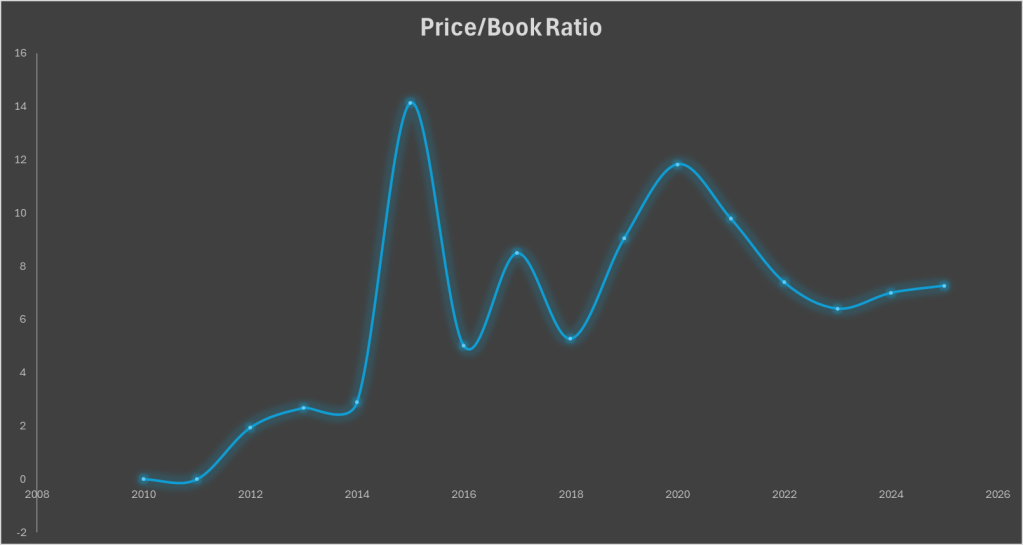
However, there are concerns regarding Intel’s dividend yield, which has recently seen a decline, now standing at 2.15%. While the company has consistently raised its dividend since 2005, the first-ever decrease in 2024-2025 to $0.52 per share in 2025 raises red flags. This marks a shift in Intel’s dividend strategy and signals potential challenges ahead, particularly given the capital-intensive nature of the business, including significant investments in research, development, and manufacturing.

To summarize:

✅ Green Flag:

  • Reliable Dividend Payouts: Intel has a strong history of dividend payments, making it an appealing option for investors seeking consistent income.
  • Long-Term Growth Potential: The company combines steady dividends with prospects for growth in the technology sector.

🚩 Red Flag:

  • Declining Dividend Yield: The recent drop in Intel’s dividend yield is concerning for income investors who rely on stable returns.
  • Capital Intensity: Intel’s ongoing investments in innovation and capital expenditures raise questions about the long-term sustainability of its dividend payouts.

Insider Trading

In 2024, Intel Corporation’s insider trading activities included purchases totaling approximately $882,574, with no recorded sales. The most recent insider transaction was on November 7, 2024, when EVP Michelle Johnston Holthaus sold 25,000 shares at $26.00 per share, amounting to $650,000. In 2025, there were no reported insider purchases or sales; however, option exercises occurred, totaling 108,713 shares. These transactions suggest active insider engagement, but the absence of sales in 2025 may raise some questions.

✅ Green Flag: The lack of insider sales in 2025 and limited purchases in 2024 can be seen as a positive, as it may indicate confidence in the company’s future prospects and a long-term outlook from insiders.

🚩 Red Flag: The lack of insider sales in 2025 could be viewed as a potential red flag by some investors, as it may suggest insiders are not capitalizing on stock opportunities, which could be a sign of caution or internal concerns.

Other Company Information

Intel Corporation, founded in 1968, currently employs approximately 121,100 individuals as of 2024, reflecting a steady workforce presence that has grown from 110,000 employees in 2020. Originally established as Integrated Electronics Corporation, Intel is a global leader in semiconductor innovation, particularly known for its microprocessors. The company is publicly traded on the NASDAQ under the ticker symbol INTC. Operating within the Technology sector, Intel is classified under the Semiconductors industry. As of 2024, Intel has approximately 4.1 billion shares outstanding, with a market capitalization of around $100 billion USD.

Headquartered at 2200 Mission College Blvd, Santa Clara, California 95054, United States, Intel’s official website is www.intel.com.

Illustration 19-21: Number of employees at Intel and its headquarters location in Santa Clara.

Final Verdict

Investing in Intel Corporation presents both opportunities and risks. On the positive side, Intel is a leader in semiconductor manufacturing, with a solid history of innovation and consistent dividend payouts. Its diversified portfolio, which includes processors, AI accelerators, and foundry services, positions it well for long-term growth, especially with the increasing demand for advanced technology across multiple sectors. However, recent challenges, such as declining earnings, volatile dividend yields, and increasing competition from companies like AMD and Nvidia, should not be overlooked. It is also not easy to determine if Intel currently is overpriced or not as the P/E ratio and P/B ratio point in different direction. As of now the final conclusion is to be careful and cautious before buying Intel stock.

NextEra Energy: An In-Depth Stock Analysis of one of the Leading Renewable Energy Providers in the U.S.

Introduction to the Company

NextEra Energy, Inc. is one of the largest energy companies in the United States and a global leader in renewable energy. With a strong commitment to sustainability and innovation, NextEra Energy has positioned itself as a key player in the transition toward cleaner energy solutions. The company primarily focuses on generating electricity through renewable sources while maintaining reliability and affordability for millions of customers.

Illustration 1: NextEra Energy logo, symbolizing renewable energy with use of green colour and leaf like wave.

History and Background

NextEra Energy traces its origins back to 1925, when it was founded as Florida Power & Light Company (FPL). Over the years, the company expanded its operations and evolved into a diversified energy powerhouse. In 1984, FPL Group was established as the parent company, and in 2010, it was rebranded as NextEra Energy to reflect its growing emphasis on renewable energy.

Today, NextEra Energy is headquartered in Juno Beach, Florida, and has grown through strategic acquisitions and investments in wind, solar, and battery storage technologies. The company owns and operates one of the world’s largest portfolios of renewable energy assets, making it a key player in the clean energy transition.

Operation and Services

NextEra Energy serves a vast customer base across 49 states in the U.S. and four Canadian provinces. The company operates through two major business segments:

Florida Power & Light Company (FPL) – This segment focuses on electricity generation, transmission, and distribution in Florida. It is the backbone of the company’s regulated electric utility business, serving over 5.8 million customer accounts

NextEra Energy Resources – This segment handles renewable energy generation, including wind, solar, and battery storage projects. It also manages natural gas pipelines and nuclear power plants, ensuring that NextEra Energy is a key player in the transition toward cleaner energy sources

As can be seen from illustration two, the majority of NextEra’s energy generation comes from wind and solar power.


Illustration 2: The generation allocation of NextEra Energy

Wind Energy makes up 67% of its generation while solar makes up 13%. NextEra Enegy is as such a fanatstic company to invest in for those that want to be exposed to the renewable energy market.

The company is also invested in nuclear energy, constituiting 11% of its total energy generation, while only a minor part of the business constituting 6% is part of the Natural gas market.

Challenges and Controversies

Environmental Concerns: Despite its significant investments in renewable energy, NextEra Energy has faced criticism for its environmental impact. The company has been involved in disputes over the development of certain projects that environmental groups claim disrupt ecosystems and communities.  Additionally, the capital-intensive nature of renewable energy projects has raised concerns about the sustainability of its financial practices

Regulatory and Legal Issues: Operating in a highly regulated industry, NextEra Energy has encountered various regulatory and legal challenges. These include disputes over rate adjustments, infrastructure expansion, and compliance with federal and state environmental laws. The company has also been involved in legal battles to block competing energy projects, which has drawn scrutiny and criticism

Competition

NextEra Energy operates in a highly competitive landscape, facing significant competition from other major utility and renewable energy companies. Some of its main competitors include: Southern Company (SO), Duke Energy (DUK), Entergy (ETR9, PPL Corporation (PPL), FirstEnergy (FE), Eversource Energy (ES), Edison International (EIX), Pinnacle West Capital (PNW), OGE Energy (OGE), and IDACORP (IDA).

These companies are all part of the electric utilities industry and compete with NextEra Energy in various aspects, including market share, technological advancements, and regulatory compliance.

NextEra Energy stands out from its competitors by being the world’s largest generator of wind and solar power, leading the transition to a low-carbon future. Its size and expertise gives it a competitive advantage. The investments the company has made in getting more advanced technologies to enhance efficiency and reduce costs, also solidifies their competitive edge.


However, the highly competitive environment in which they operate is a factor that investors should carefully consider, as it could pose potential risks.

Future outlook

Several factors will shape NextEra Energy’s future:

Expansion of Offshore Wind: NextEra Energy’s offshore wind projects will play a critical role in achieving clean energy goals. As more offshore wind projects receive government backing, NextEra stands to benefit from regulatory support and technological advancements.

Electrification of Transportation: As electric vehicle (EV) adoption grows, NextEra Energy is investing in EV infrastructure, including charging stations and grid upgrades to accommodate increased demand.

Advancements in Energy Storage: The development of more efficient and cost-effective battery storage solutions will be crucial for integrating intermittent renewable energy sources like solar and wind.


Stock Analysis

In this section, we will analyze NextEra Energy stock to determine if it is a good investment. Our philosophy is value investing, which means we seek high-quality companies that are undervalued. However, we will provide a comprehensive overview so that investors with different philosophies can evaluate the stock for themselves.

Revenue and Profits

To assess a company’s value and investment potential, revenue and profits are the logical starting points for analysis. A stock represents an actual business, much like the small businesses in your hometown. If someone offered to sell you their company, your first question would likely be about its earnings. The same principle applies when evaluating a publicly traded company—understanding its financial performance is essential before deciding to invest.

Illustration 2 and 3: Revenue of NextEra Energy from 2009 to 2024.

As seen in Illustrations 2 and 3, NextEra Energy’s revenue has shown a long-term growth, particularly in recent years. This expansion is driven by increasing demand for renewable energy, investments in infrastructure, and the company’s leadership in wind and solar power generation. Additionally, supportive government policies, tax incentives, and commitments to clean energy continue to drive sales, positioning NextEra Energy for sustained growth.

However, despite this overall upward trend, NextEra Energy’s revenue growth has experienced fluctuations. As shown in Illustrations 2 and 3, there have been periods where revenue declined due to factors such as regulatory changes, shifts in energy prices, and project timing. The utility and renewable energy sectors are subject to policy adjustments and market dynamics that can impact earnings, making it essential for investors to consider these risks. It is especially important to note that the Trump administration is opposed to the Wind sector which stands for the majority of NextEra’s energy generation.

Even with occasional volatility, the long-term outlook remains strong. With the increasing global transition to renewable energy, NextEra Energy is well-positioned to capitalize on this shift. Its investments in clean energy infrastructure, expansion into emerging markets, and strong operational efficiency suggest a promising future despite short-term revenue fluctuations. However, it has a lot of competitors and the current US administration is not as supportive of renewable energy as previous administrations.

Illustration 4 and 5: Net Income of NextEra Energy from 2009 to 2025

Net income is a crucial metric to evaluate when determining whether a company is a worthwhile investment. It represents a company’s net profit or loss after accounting for all revenues, income items, and expenses, calculated as Net Income = Revenue – Expenses.

As illustrated in Figures 4 and 5, NextEra Energy has experienced significant net income growth over the long term, particularly in recent years. For instance, the company’s net income rose from $3.573 billion in 2021 to $4.147 billion in 2022, marking a 16.06% increase. This upward trend continued in 2023, with net income reaching $7.31 billion—a substantial 76.27% increase from the previous year. This growth is driven by rising global demand for renewable energy, strategic investments in wind and solar projects, and expansion into energy storage and infrastructure development. Additionally, favorable government policies and commitments to clean energy continue to fuel revenue, positioning the company for sustained growth.

However, despite this overall upward trend, NextEra Energy’s net income has experienced fluctuations. In 2024, the company’s net income decreased by approximately 8.79% to $6.952 billion, down from $7.31 billion in 2023. This decline is partly due to increased costs impacting its renewables segment and higher operating expenses. And ofcoursw it had a sharp fall from 2018 to 2020. For investors, this inconsistency raises concerns, as it suggests that NextEra Energy may not deliver steady net income growth year after year, making it a potentially riskier investment compared to companies with more predictable financial performance. Even though net income growth has been inconsistent, the long-term trend remains upward. Considering the rising global demand for energy, the increasing popularity of renewable power, and the momentum of the green energy transition, NextEra Energy is well-positioned for future growth. These factors, combined with the company’s expanding project backlog and strategic partnerships, suggest a promising outlook despite short-term volatility.

Revenue breakdown

Illustration 6: Revenue Breakdown for NextEra Energy, gathered from gurufocus as of NOV 31, 2023.

As can be seen in Illustration 6, the majority of NextEra Energy’s revenue comes from Florida Power & Light Company, but a significant portion (17.8%) is generated by NextEra Energy Resources LLC. This diversification provides investors with exposure to both clean energy growth and the stability of a traditional utility business. Despite cost of goods sold (COGS) consuming a substantial share of its revenue, the company continues to have a significant and good amount of revenue. Additionally, high capital expenditures for clean energy development and grid modernization impact profitability. While NextEra Energy benefits from a strong market position and steady utility revenue, these costs could affect its long-term earnings growth, making it an important factor for investors to consider.

Earnings per shar (EPS)

Earnings Per Share (EPS) is a key financial metric that measures a company’s profitability on a per-share basis. It indicates how much profit a company generates for each outstanding share of its stock, and is used o assess a company’s financial health, profitability, and potential for growth. In other words this metric can tell us how profitable the business is.

Illustration 7: Earnings per share for NextEra Energy from 2009 to 2025

The EPS figure itself isn’t the primary focus for value investors—it can be 0.2 or 10, but what truly matters is the company’s ability to generate consistent earnings growth. A steadily increasing EPS over time signals strong financial health, profitability, and long-term value creation.

The EPS for NextEra Energy has had a generally positive upward trend since 2009. However, it experienced a dramatic fall from 2019 to 2020 due to the economic downturn and market disruptions caused by the COVID-19 pandemic, along with increased costs and project delays. This decline can be a red flag for investors, as it highlights the company’s sensitivity to external economic factors and potential volatility in earnings. However, after the fall, the trend has resumed its upward trajectory, supported by strong investments in renewable energy, stable utility revenue from Florida Power & Light, and favorable industry policies. As a result, the EPS has now returned to pre-fall levels, reinforcing NextEra Energy’s resilience and long-term growth potential. The pandemic can also be considered a one-time event, and the fall in 2024 due to rising interest rates and increased costs in the renewables sector can also be seen as a temporary setback rather than a long-term structural issue. Given NextEra Energy’s strong track record of recovery and consistent long-term growth, these fluctuations are likely part of normal business cycles rather than a sign of fundamental weakness.

Assets and Liabilities

Illustration 8 and 9: Assets and liabilities for NextEra Energy from 2009 to 2023

When evaluating a company as a potential investment, understanding its assets and liabilities is crucial. If a local business owner offered to sell their shop to you, one of the first questions—after determining its profitability—would be about its equity and assets. The same principle applies when assessing publicly traded companies like Dominion Energy.

As shown in Illustration 8, NextEra Energy’s total assets reached $177.5 billion in 2023, a strong figure that highlights the company’s financial growth. Additionally, NextEra Energy’s asset base has consistently expanded year over year, increasing from $48.5 billion in 2009 to $177.5 billion in 2023. This steady asset growth is a positive indicator of the company’s ongoing expansion, investments in innovative technologies, and strengthened market position. A continuously growing asset base often signifies a company’s ability to scale operations, acquire new projects, and enhance production capacity which is particularly important in the highly competitive renewable energy industry.

At the same time, NextEra’s total liabilities have also increased significantly, rising from $35.5 billion in 2009 to $119.7 billion in 2023. While such a sharp increase in debt might raise concerns for some investors, it is not necessarily a red flag given the nature of the renewable energy business. Utility companies typically operate in a capital-intensive environment where they must secure substantial financing to fund large-scale projects, develop infrastructure, and maintain their competitive edge. Debt financing is often necessary for expanding wind farm and other types of energy production, all of which contribute to long-term growth.

The key factor for investors is whether NextEra can effectively manage its debt while maintaining strong revenue and profitability. If the company can generate consistent cash flow and sustain high demand for its products and services, its rising liabilities may not be a major issue. However, if debt levels continue to grow faster than revenue or profits, it could indicate financial strain, making it important for investors to monitor the company’s ability to service its obligations while maintaining profitability.

The cash on hand for NextEra is a red flag for potential investors, as the company has $2.7 billion in readily available cash as of 2023. This amount is relatively low compared to its liabilities, which could indicate liquidity concerns and a reliance on external financing to meet obligations and fund growth.

Additionally, NextEra’s long-term debt of $61.4 billion in 2023 is significantly higher than its available cash, which is a red flag for investors. This indicates that the company relies heavily on debt financing, which could pose risks if interest rates rise or if cash flow weakens, potentially impacting its ability to meet financial obligations and sustain growth.

As seen in Illustration 9, Total Shareholder Equity—calculated as total assets minus total liabilities—has consistently grown over the past 14 years. This is a very positive indicator for potential investors, as it suggests that NextEra is building value over time rather than eroding its financial foundation. A steadily increasing shareholder equity indicates that the company’s assets are growing at a faster rate than its liabilities, which is a green flag for financial health. This trend suggests that NextEra is successfully expanding its operations while maintaining a solid balance sheet. Additionally, rising equity provides a buffer against financial downturns, making the company more resilient in times of economic uncertainty. However, investors should also consider how this growth is achieved—whether through profitable operations or increased debt financing—to fully assess the sustainability of this trend.

Debt to Equity Ratio

Illustration 10 and 11: Debt to equity for NextEra Energy from 2009 to 2023

The Debt-to-Equity (D/E) ratio is an important financial metric for assessing Next Era’s financial leverage and risk. It compares the amount of debt the company uses to finance its operations relative to its shareholder equity. A high D/E ratio suggests that the company relies more heavily on debt to fuel growth, which could increase financial risk, especially during economic downturns when managing debt obligations becomes more challenging. In contrast, a lower D/E ratio indicates that Next Era is primarily financed through equity, reducing financial risk but potentially limiting its ability to rapidly expand.

The D/E ratio of NextEra Energy has been on a downward trend from around 2.8 in 2009–2010 to 2.05 in 2024. This is a positive sign for investors since it indicates that the company is gradually reducing its reliance on debt relative to equity. A lower D/E ratio suggests improved financial stability, reduced risk of overleveraging, and a stronger ability to manage long-term obligations while continuing to invest in growth.

Legendary value-investor Warren Buffett prefers a D/E ratio of below 0.5. Compared to 0.5, NextEra is still at a very high level. However, this is normal for companies in the renewable utility industry since they often require significant capital investment to fund large-scale projects, develop infrastructure, and expand renewable energy capacity. While NextEra’s D/E ratio is higher than Buffett’s preferred level, it reflects the capital-intensive nature of the energy sector and the company’s ongoing efforts to scale its operations and meet growing demand for clean energy.
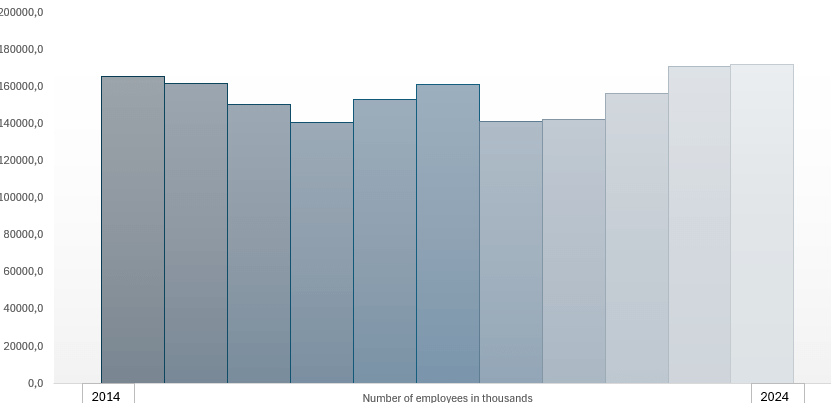

Price to earnings ratio (P/E)

Illustration 12 and 13: Price to earnings ratio for NextEra Energy from 2009 to 2023

For value investors, one of the most critical metrics when evaluating NextEra’s stock is the price-to-earnings (P/E) ratio, as it helps assess whether the company is undervalued or overvalued. Even if a company has strong financials, purchasing its stock at a high price can lead to poor returns. For example, imagine a business generating solid profits of $1 million per year. If the owner offers to sell you the business for just $1, it would be an incredible deal. But if the owner asks for $1 trillion, even though the business is profitable, the price would be absurdly overvalued. The stock market works similarly—companies can be priced cheaply on some days and excessively expensive on others.

Warren Buffett, a legendary value investor, typically considers stocks with a P/E ratio of 15 or lower as “bargains.” A high P/E ratio suggests that investors are paying a premium for the company’s earnings, expecting significant growth. However, this also indicates that the stock is expensive relative to its earnings, which can be a red flag for value investors. NextEra’s P/E ratio has been on a relatively stable level from 2010 to 2018. From 2018 as renewable stocks became popular on the stock market its P/E skyrocket to a high of 107.21 in 2022 which is strongly overprices. Before the bubble burst and it came back to 17.19 in 2024.

The mania for renewable energy stocks seems to have slowed down after the bubble burst in 2022. For potential investors, the P/E of 20.2 in 2025 seems fairly priced, meaning that you will not be buying at a bargain but also not overpaying for the stock. If you believe in the company’s future earnings potential and strong fundamentals, it could be a good time to enter at a reasonable valuation and hold for long-term growth.


Dividend

Illustration 14: NextEra Energy’s dividend yield and dividend payout from 1995 to 2025

NextEra Energy stands out among renewable energy companies by offering a consistent dividend, making it an attractive option for income-focused investors. In 2025, NextEra’s annual dividend is $1.55 per share, reflecting its commitment to returning value to shareholders. Additionally, the company has a strong track record of increasing its dividend, with a five-year annualized growth rate of approximately 10%, demonstrating steady financial health and shareholder rewards.

NextEra Energy has demonstrated remarkable consistency in its dividend payments, making it a reliable choice for income-focused investors. The company has increased its dividend for over 25 consecutive years, reflecting strong earnings growth and disciplined financial management. Even during economic downturns and market volatility, NextEra has continued to raise its payouts, reinforcing its commitment to returning value to shareholders. This level of consistency is a positive sign, as it indicates that the company generates stable cash flows and prioritizes rewarding long-term investors while continuing to invest in its renewable energy expansion. However, as can be seen in illustration 14, despite the dividend payout increasing, the dividend yield has been on a steady decline.

While NextEra’s dividend yield of around 2.2% (as of 2025) may not be the highest in the utility sector, it remains a reliable source of income, especially when combined with the company’s long-term growth prospects in renewable energy. For investors seeking a mix of dividend income and exposure to clean energy, NextEra presents a compelling case. However, given its high debt levels and capital-intensive business model, investors should monitor whether the company can sustain its dividend growth while continuing to invest in future expansion.

To summarize:

Green Flag:

  • Consistent Dividend Growth: NextEra has a strong history of dividend increases, making it a solid choice for income investors.
  • Balanced Strategy: The company provides both income and long-term growth potential, appealing to a broad range of investors.

🚩 Red Flag:

  • Debt Reliance: Maintaining dividends alongside significant capital expenditures requires careful financial management.
  • Moderate Yield: While NextEra pays dividends, its yield is lower than some traditional utility stocks.

Insider Trading

Illustration 14: Recent Insider Selling for NextEra Energy

A crucial metric to consider when evaluating whether a company is worth investing in is insider trading activity—specifically, whether company insiders have been buying or selling shares over the past year. It’s particularly important to assess who has been trading, as directors should be monitored even more closely than officers.

As can be seen from the table above, there has been no selling by any mayor insiders recently. The insiders who have been selling stock has been lower level officers and directors of subsidiaries. This is a green flag for investors since it shows that insiders are confident in the company as they have not sold their shares.

Other Company Info

As illustrated below, NextEra Energy currently employs approximately 16,800 individuals, reflecting a steady increase from 14,900 employees in 2020. The company was originally founded in 1925 as Florida Power & Light Company and later rebranded as NextEra Energy in 2010 to reflect its expansion into renewable energy. It is publicly traded on the New York Stock Exchange under the ticker symbol NEE. Operating within the Utilities sector, NextEra Energy is classified under the Electric Utilities industry. The company has approximately 2.06 billion shares outstanding and a market capitalization of around $120 billion USD as of 2024.

Headquartered at 700 Universe Boulevard, Juno Beach, Florida 33408, United States, NextEra Energy’s official website is www.nexteraenergy.com.

Illustration 15-17: : Number of employees at NextEra Energy and its location in Juno Beach, Florida.

Final Verdict

NextEra Energy offers a compelling opportunity for investors seeking exposure to renewable energy, particularly wind and solar power, as well as energy storage solutions. The company has secured significant contracts with major corporations like Google and Walmart and continues to expand its clean energy initiatives. With a strong focus on sustainability and innovation, NextEra is well-positioned to capitalize on the increasing demand for carbon-free energy and play a leading role in the transition to a greener economy.

However, while NextEra Energy has experienced strong growth, there are some concerns related to its financial performance. Despite increasing revenue, high capital expenditures and significant debt levels to fund its renewable energy projects have put pressure on profitability. Additionally, the company’s cost of sales (COGS) remains substantial, impacting margins. While NextEra has maintained a stable dividend and solid market position, its reliance on debt and ongoing capital investment may raise concerns for some investors.

That said, it is important to note that NextEra Energy is a leader in the renewable energy space and is poised for long-term growth given the ongoing expansion of clean energy infrastructure. For growth-oriented investors who believe in the future of renewable energy and are willing to accept potential short-term financial volatility, NextEra presents a strong investment opportunity. However, for more conservative investors seeking a company with consistent profitability and low financial risk, NextEra Energy may not be the ideal choice.

Canadian Solar: A comprehensive overview and stock analysis of one of the leading Solar Companies

Introduction

Canadian Solar Inc. is one of the largest and most established solar energy companies in the world. It has made significant contributions to the global transition toward renewable energy, specifically solar power. With a presence in over 20 countries, Canadian Solar has successfully integrated itself into both the manufacturing of solar photovoltaic (PV) products and the development of solar projects. In this article, we will explore the history, operations, competitive positioning, financials, the future prospects of Canadian Solar and of course make a comprehensive analysis of the stock of Canadian Solar.

History and Founding

Canadian Solar was founded in 2001 by Dr. Shawn Qu, a former University of Toronto researcher with a background in electrical engineering. Dr. Qu, originally from China, started the company in Ontario, Canada, with the goal of providing high-performance solar modules at competitive prices. The company’s initial focus was on manufacturing solar cells and modules, and its breakthrough came with its focus on high efficiency and the development of advanced technologies in the solar industry.

The decision to base the company in Canada was a strategic move, given the country’s growing interest in clean energy and environmental sustainability. However, Canadian Solar’s roots were international, as Dr. Qu leveraged relationships in China for access to affordable manufacturing resources. The company quickly expanded from its Canadian base and set up large-scale manufacturing operations in China, where it remains one of the leading solar module manufacturers today.

Canadian Solar’s commitment to innovation and sustainability has allowed it to grow from a small, niche manufacturer to a global leader in solar energy. The company’s products are now used in residential, commercial, and utility-scale solar projects around the world, making Canadian Solar a key player in the global energy transition.

Canadian Solar Energy Solutions - Energy Partners

Illustration 1: Canadian Solar logo with sun and rays symbolizing commitment to solar power.

Operations and Products

Canadian Solar operates in two major segments: Solar Module Manufacturing and Solar Power Projects.

Solar Module Manufacturing Canadian Solar produces a wide range of photovoltaic (PV) products, including solar modules, inverters, and energy storage systems. Their solar panels are among the most efficient on the market, with varying products designed for different types of consumers, ranging from residential to large-scale commercial and utility installations. The company uses advanced technology such as PERC (Passivated Emitter and Rear Cell) to ensure high efficiency and durability of their modules.

Solar Power Projects Beyond manufacturing, Canadian Solar is actively involved in the development, financing, and operation of solar power projects globally. This segment includes utility-scale solar farms, distributed solar energy systems for commercial and industrial clients, and energy storage solutions.


Canadian Solar has completed over 10 GW of solar projects worldwide, cementing its position as a leading solar energy provider. The company focuses on end-to-end solar solutions, offering customers everything from project development to system integration, operation, and maintenance.

In addition to these, Canadian Solar has made significant strides in the energy storage market. As the world shifts towards renewable energy, energy storage solutions are seen as a key enabler for balancing intermittent power generation from solar and wind energy. Canadian Solar’s energy storage division, which works in tandem with their solar projects, provides customers with grid-independent solutions that help store excess energy for later use.

Revenue Breakdown

The revenue breakdown of Canadian Solar is as follows:

1. Solar Module Manufacturing: This segment represents the largest portion of Canadian Solar’s revenue, contributing approximately 60-70%. The company’s solar modules are sold to both residential and commercial customers and are used in utility-scale projects. This portion of the business continues to grow as demand for solar energy increases globally, driven by favorable government policies, falling solar costs, and rising environmental concerns.

2. Solar Power Projects: The company’s solar power projects segment accounts for around 25-35% of its revenue. This portion includes the sale of solar power plants, as well as ongoing income generated from the operation of these plants. Over the years, Canadian Solar has managed to increase its share of revenue from projects, reflecting the growing demand for large-scale solar farms and distributed generation systems.

3. Energy Storage and Other Products: Although a smaller segment, energy storage systems and other ancillary products are becoming an increasingly important part of Canadian Solar’s portfolio. This segment contributes roughly 5-10% of the company’s total revenue.

The Most Recent Developments In Energy Storage Technology

Illustration 2: Energy Storage is quickly becoming a growing sector for Canadian Solar.

Canadian Solar has also been successful in managing costs and improving operational efficiency. The company’s gross margin has steadily improved due to its focus on high-efficiency products and scaling its manufacturing operations.

Key Competitors

Canadian Solar operates in a very highly competitive market. Its key competitors include:

  • First Solar (FSLR): A US-based solar energy company, First Solar is one of the leading manufacturers of thin-film solar modules. Unlike Canadian Solar, which primarily produces crystalline silicon modules, First Solar specializes in cadmium telluride (CdTe) technology. First Solar is known for its utility-scale solar projects, similar to Canadian Solar’s project development segment.

  • JinkoSolar (JKS): Another Chinese solar giant, JinkoSolar is one of the largest manufacturers of solar panels globally. JinkoSolar’s strength lies in its focus on technology, with an emphasis on increasing panel efficiency and reducing costs. The company’s global footprint is comparable to Canadian Solar’s, and its competitive pricing makes it a formidable rival.
  • Trina Solar (TSL): Trina Solar is another major Chinese player in the solar market. Like Canadian Solar, it operates in both module manufacturing and project development. Trina Solar has a strong presence in Europe, the Americas, and Asia.
  • LONGi Green Energy (601012.SS): LONGi is one of the largest manufacturers of monocrystalline silicon solar products. With a focus on technology and efficiency, LONGi competes directly with Canadian Solar in the module manufacturing market.
  • SunPower (SPWR): Based in the United States, SunPower is a major player in both residential and commercial solar installations. SunPower differentiates itself by offering premium solar products, while Canadian Solar offers a broader range of modules for different market segments.

To sum up, the solar power market is highly competitive with many competitors to challenge Canadian Solar.

Market Position and Competitive Advantages

Despite very high competion Canadian Solar holds a competitive edge in several areas:

Global Reach: With manufacturing facilities in China, Canada, and other parts of the world, Canadian Solar has a robust global supply chain and can cater to customers in diverse markets. Its presence in the Americas, Europe, and Asia ensures that it remains competitive in the global solar market.

Innovation and Technology: Canadian Solar places a strong emphasis on research and development (R&D). The company consistently strives to improve the efficiency and durability of its solar panels, which has helped it maintain its competitive edge. Canadian Solar is at the forefront of solar cell and panel technology, incorporating advanced technologies like PERC and bifacial modules.

Reproducing scientific studies: A Good Housekeeping Seal of Approval

Illustration 3: Canadian Solar’s is well known for being invested in research and development.

Cost Leadership: One of the key drivers behind Canadian Solar’s success is its ability to maintain a competitive price point while offering high-quality products. By leveraging economies of scale and low-cost manufacturing in China, Canadian Solar can keep its prices lower than many competitors while maintaining margins.


Comprehensive Solutions: Unlike some competitors that focus primarily on module manufacturing, Canadian Solar offers a comprehensive solution, including project development and energy storage. This ability to offer turnkey solutions, from manufacturing to operation and maintenance, is a significant advantage in attracting large-scale customers.

Future Outlook

Looking ahead, Canadian Solar is well-positioned to continue its growth. The global transition to renewable energy is accelerating, with solar energy at the forefront. The company’s strong brand, technological innovation, and global footprint provide a solid foundation for its future growth. Canadian Solar is also well-positioned to benefit from government incentives and policies aimed at promoting renewable energy adoption.

With increasing demand for solar energy, growing interest in energy storage, and continued advancements in panel technology, Canadian Solar is expected to remain a leader in the solar industry.

Furthermore, the company’s expansion into emerging markets like India, Africa, and Latin America presents significant growth opportunities.

Stock Analysis

In this section we will analyze Canadian Solar’s stock to see if it is a good stock to buy or not. Our philosophy is value investing meaning that we try to find good quality companies that are undervalued. However, we will give a holistic overview so all kind of investors with different philosophies can judge the stock for themselves.

Revenue and Profits

To determine a company’s worth and if it is worth investing in, the company’s revenue and profits are a natural starting point to analyze. It should never bee forgotten that a stock represents a company just like the small businesses in your home town. If someone asked you if you want to buy their company, the first question would naturally be how much the company makes and the same question when trying to analyze if a company registered in the stock exchange is worth buying.


Illustration 4 and 5: Revenue of Canadian Solar from 2009 to 2023.

As seen in Illustrations 4 and 5, Canadian Solar’s revenue has been increasing over the long term, particularly in recent years. This growth is driven by rising global demand for solar energy, increased module shipments, and expansion into energy storage and project development. Additionally, favorable government policies and renewable energy commitments continue to fuel sales, positioning the company for sustained growth.

However, despite this overall upward trend, Canadian Solar’s revenue growth has been inconsistent. As shown in Illustrations 4 and 5, there have been years—such as 2012, 2016, and 2019—where revenue declined. This volatility is partly due to intense competition in the solar industry, fluctuating market conditions, and policy shifts affecting demand. For investors, this inconsistency raises concerns, as it suggests that Canadian Solar may not deliver steady revenue growth year after year, making it a potentially riskier investment compared to companies with more predictable financial performance.

Even though revenue growth has been inconsistent, the long-term trend remains upward. Considering the rising global demand for energy, the increasing popularity of solar power, and the momentum of the green energy transition, Canadian Solar is well-positioned for future growth. These factors, combined with the company’s expanding product offerings and global presence, suggest a promising outlook despite short-term volatility.

Illustration 6 and 7: Net Income of Canadian Solar from 2009 to 2023.

Net income is a crucial metric to evaluate when determining whether a company is a worthwhile investment. It represents a company’s net profit or loss after accounting for all revenues, income items, and expenses, calculated as Net Income = Revenue – Expenses.

As seen in Illustrations 6 and 7, Canadian Solar’s net profit has shown a slight upward trend but has mostly remained relatively flat with fluctuations since 2014, peaking around 250. This inconsistency is a red flag for potential investors, as it indicates that despite growing revenue, the company has struggled to achieve steady profit growth. Factors such as pricing pressure, industry competition, and fluctuating costs may be limiting profitability, making it difficult for investors to rely on sustained earnings growth. When investing in a company, increasing profits is one of the most—if not the most—important factors for investors. However, Canadian Solar has struggled to achieve consistent profitability, as its net income has remained relatively stable over the years despite growing revenue. This lack of sustained profit growth raises concerns about the company’s ability to improve margins and generate higher returns for shareholders in the long run.

Revenue breakdown

Illustration 8: Revenue Breakdown for Canadian Solar

As seen in Illustration 8, Canadian Solar is a pure-play solar energy company, generating all its revenue from the solar industry. This makes it an ideal investment opportunity for those seeking direct exposure to the solar sector. However, for investors looking for diversification within the broader utility sector, Canadian Solar may not be the best fit, as it lacks revenue streams from other energy sources or utility-related businesses.

Additionally, Illustration 8 highlights that the cost of sales in the solar energy industry is significantly high, which consumes a large portion of Canadian Solar’s revenue. On top of that, the company allocates substantial funds toward R&D, administration, and marketing, further limiting its net profit. As a result, despite strong revenue figures, the company’s actual profitability remains relatively low, which could be a concern for investors focused on earnings growth.

Earnings per shar (EPS)

Earnings Per Share (EPS) is a key financial metric that measures a company’s profitability on a per-share basis. It indicates how much profit a company generates for each outstanding share of its stock, and is used o assess a company’s financial health, profitability, and potential for growth. In other words this metric can tell us how profitable the business is,

Illustration 9: Earnings per share for Canadian Solar from 2009 to 2023.

The EPS figure itself isn’t the primary focus for value investors—it can be 0.2 or 10, but what truly matters is the company’s ability to generate consistent earnings growth. A steadily increasing EPS over time signals strong financial health, profitability, and long-term value creation.

Canadian Solar’s earnings per share (EPS) performance from 2009 to 2023 presents a mixed picture for investors. While the company has demonstrated resilience and growth in revenue over the long term, its EPS has been highly volatile, with significant fluctuations rather than a consistent upward trend. Periods of strong earnings, such as in 2014, have been followed by years of weaker performance, making it difficult for investors to predict steady profit growth. This inconsistency can be a red flag for long-term investors who prioritize stable and growing earnings, as it suggests that Canadian Solar’s profitability is sensitive to external factors like pricing pressure, raw material costs, and government policies.

Assets and Liabilities

Illustration 10 and 11:  Assets, Liabilities and Total Shareholder Equity for Canadian Solar from 2009 to 2023.

When evaluating a company as a potential investment, understanding its assets and liabilities is crucial. If a local business owner offered to sell their shop to you, one of the first questions—after determining its profitability—would be about its equity and assets. The same principle applies when assessing publicly traded companies like Dominion Energy.

As shown in Illustrations 10 and 11, Canadian Solar has a substantial asset base, totaling $11.9 billion in 2024. This steady asset growth over time is a positive sign, indicating that the company is expanding its operations, investing in new technologies, and strengthening its market position. A growing asset base often reflects a company’s ability to scale its business, acquire new projects, and improve its production capacity, which is particularly important in the highly competitive solar energy industry.

At the same time, Canadian Solar’s total liabilities have also increased significantly, rising from $573 million in 2009 to $8.2 billion in 2024. While such a sharp increase in debt might raise concerns for some investors, it is not necessarily a red flag given the nature of the solar energy business. Solar companies typically operate in a capital-intensive environment where they must secure substantial financing to fund large-scale projects, develop infrastructure, and maintain their competitive edge. Debt financing is often necessary for expanding solar farms, increasing manufacturing capacity, and advancing energy storage solutions, all of which contribute to long-term growth.

The key factor for investors is whether Canadian Solar can effectively manage its debt while maintaining strong revenue and profitability. If the company can generate consistent cash flow and sustain high demand for its products and services, its rising liabilities may not be a major issue. However, if debt levels continue to grow faster than revenue or profits, it could indicate financial strain, making it important for investors to monitor the company’s ability to service its obligations while maintaining profitability.

The cash on hand for Canadian Solar is a green flag for potential investors, as the company has $2.9 billion in readily available cash as of 2023. This strong cash reserve provides the company with flexibility and liquidity, enabling it to navigate market fluctuations, invest in new projects, and meet its short-term financial obligations without relying heavily on external financing.

Additionally, Canadian Solar’s long-term debt of $1.65 billion in 2023 is significantly lower than its available cash, which is a positive sign for investors. This indicates that the company has a solid financial cushion and is not overly reliant on debt to fund its operations. It suggests that Canadian Solar is in a strong position to manage its liabilities, fund future growth, and weather economic downturns without significant financial strain. This balance between cash and debt is reassuring for investors, as it reflects financial stability and prudent management of resources.

As seen in Illustration 11, Total Shareholder Equity—calculated as total assets minus total liabilities—has consistently grown over the past 14 years. This is a positive indicator for potential investors, as it suggests that Canadian Solar is building value over time rather than eroding its financial foundation. A steadily increasing shareholder equity indicates that the company’s assets are growing at a faster rate than its liabilities, which is a green flag for financial health. This trend suggests that Canadian Solar is successfully expanding its operations while maintaining a solid balance sheet. Additionally, rising equity provides a buffer against financial downturns, making the company more resilient in times of economic uncertainty. However, investors should also consider how this growth is achieved—whether through profitable operations or increased debt financing—to fully assess the sustainability of this trend.

Debt to Equity Ratio

Illustration 12 and 13: The Debt to Equity ratio of Canadian Solar from 2009 to 2024.

The Debt-to-Equity (D/E) ratio is an important financial metric for assessing Canadian Solar’s financial leverage and risk. It compares the amount of debt the company uses to finance its operations relative to its shareholder equity. A high D/E ratio suggests that the company relies more heavily on debt to fuel growth, which could increase financial risk, especially during economic downturns when managing debt obligations becomes more challenging. In contrast, a lower D/E ratio indicates that Canadian Solar is primarily financed through equity, reducing financial risk but potentially limiting its ability to rapidly expand.

In recent years, Canadian Solar has maintained a relatively high D/E ratio, reflecting its reliance on both debt and equity financing to support its operations. This is typical for companies in the solar industry, as they often need to take on debt to fund large-scale projects, infrastructure, and expansion into new areas like energy storage. However, while leveraging debt is common in the sector, investors should remain cautious and monitor Canadian Solar’s ability to manage its increasing debt load. A high D/E ratio, particularly during periods of rising interest rates or market volatility, can place pressure on profitability and financial stability.

As of 2023, Canadian Solar’s D/E ratio reached nearly 6, and it was also high in 2016 and 2017, exceeding 5. While the company has made strides in reducing its debt and increasing equity over time, its D/E ratio remains substantially higher than the level recommended by investors like Warren Buffett, who prefers a ratio below 0.5. This suggests that while the company has made progress, Canadian Solar still carries a significant debt burden that investors should carefully assess to ensure it does not hinder long-term growth or financial health.

Price to earnings ratio (P/E)

Illustration 14 and 15: The price to earning ratio for Canadian Solar from 2010 to 2024. The P/E ratio was negative and/or not available for 2012 and 2013.

For value investors, one of the most critical metrics when evaluating Canadian Solar’s stock is the price-to-earnings (P/E) ratio, as it helps assess whether the company is undervalued or overvalued. Even if a company has strong financials, purchasing its stock at a high price can lead to poor returns. For example, imagine a business generating solid profits of $1 million per year. If the owner offers to sell you the business for just $1, it would be an incredible deal. But if the owner asks for $1 trillion, even though the business is profitable, the price would be absurdly overvalued. The stock market works similarly—companies can be priced cheaply on some days and excessively expensive on others.

Warren Buffett, a legendary value investor, typically considers stocks with a P/E ratio of 15 or lower as “bargains.” A high P/E ratio suggests that investors are paying a premium for the company’s earnings, expecting significant growth. However, this also indicates that the stock is expensive relative to its earnings, which can be a red flag for value investors. Canadian Solar’s P/E ratio has fluctuated widely over the years. For example, it was in bargain territory at 4.93 in 2011, before reaching a strongly overpriced level of 62.2 in 2021. However, with the current P/E ratio of 29.90 at 16 February 2025, Canadian Solar’s stock can be seen as fairly priced, meaning it is neither undervalued nor an ideal investment for value investors seeking a strong bargain.

The strongly fluctuating prices for Canadian Solar indicates that the company’s stock price is volatile relative to its earnings, and signal uncertainty in the market or changing investor expectations about future growth. For potential investors the fluctuating prices gives them the opportunity to buy the stock at bargain price, but they should be very careful not buy at the top.

Dividend

Canadian Solar does not currently offer a dividend, focusing instead on reinvesting its profits into growth initiatives, including expanding solar projects and developing energy storage solutions. This approach is common for growth-focused companies, especially in the renewable energy sector, where significant capital is needed for expansion.

While Canadian Solar doesn’t provide regular income through dividends, its strategy of reinvestment can be appealing to growth investors looking for long-term capital appreciation rather than immediate returns. However, the lack of dividends may be a red flag for income-focused investors who rely on steady income from their investments. This strategy could also limit some investor interest, especially those seeking consistent payouts.

To summarize:

✅ Green Flag:

  • Growth Potential: By reinvesting profits, Canadian Solar is positioning itself for long-term growth in the rapidly expanding solar and renewable energy sectors.
  • Capital Allocation: The company prioritizes strategic investments in projects and innovation over dividend payouts.

🚩 Red Flag:

  • No Dividend: The lack of dividends may deter income-seeking investors, as Canadian Solar reinvests all profits rather than distributing earnings to shareholders.

Insider Trading

A key metric to consider when evaluating Canadian Solar as an investment is insider trading activity, specifically whether company insiders have been buying or selling shares in the past year. It’s important to focus on who is making these transactions, with particular attention to directors, as their actions often provide more insight into the company’s future prospects than those of officers.

As shown in recent data, there has been no insider selling at Canadian Solar. This is a green flag for investors, as it suggests that insiders have confidence in the company’s future performance and are holding on to their shares, rather than liquidating them.

Other Company info

As of the latest data, Canadian Solar employs approximately 22,200 people, reflecting steady growth from around 8,700 employees in 2014. The company was founded in 2001 and is headquartered in Ontario, Canada. It is listed on the NASDAQ exchange under the ticker CSIQ and operates within the Solar Energy industry under the broader Renewable Energy sector. Canadian Solar currently has approximately 73.3 million shares outstanding and a market capitalization of around USD 4.58 billion.

The company’s corporate headquarters is located at 545 Speedvale Avenue West, Guelph, Ontario N1K 1E6, Canada. For more information, you can visit their official website at www.canadiansolar.com.

Illustration 16-18: Number of employees at Canadian Solar and its location in Ontario, Canada.

Canadian Solar presents a promising long-term opportunity, particularly for investors interested in the renewable energy sector. The company is making significant strides in solar energy, energy storage, and utility-scale projects, positioning itself well for the growing demand for sustainable energy solutions. However, its financial health warrants careful consideration.

Although Canadian Solar has a solid asset base, its rising debt levels and increasing liabilities each year contribute to heightened financial risk. A significant portion of its revenue is consumed by costs of goods sold and operating expenses, limiting its profitability. As a result, while Canadian Solar has shown growth, its profitability has been inconsistent, and some of its expansion plans have not met expectations.

From a value investing standpoint, Canadian Solar does not appear to be undervalued, which may make it less appealing for investors seeking stocks with strong financials available at a discount. While the company holds substantial growth potential in the renewable energy sector, it’s crucial for investors to consider the associated risks, especially given its financial structure and profitability challenges. A key concern is that despite the increase in revenue, Canadian Solar’s net profit has remained stagnant, signaling potential inefficiencies or other underlying issues that may affect future profitability. Given these factors, our recommendation is to proceed with caution. If you find our analysis valuable, consider subscribing by entering your email below.

Starting your own Business vs. Investing in Stocks: Which Path to Wealth is Right for you?

Introduction

The decision between starting your own business or investing in stocks is one of the most critical financial choices an individual can make. Both paths offer unique opportunities for wealth creation, but they also come with distinct risks and challenges. This article aims to explore all the possible factors to consider when choosing between entrepreneurship and stock market investing, including risk tolerance, capital availability, time commitment, skillset, personal goals, and economic conditions.

Understanding the Fundamentals

Before diving into the key factors, let’s define each option clearly:

  • Starting a Business involves creating and managing your own company, that offers goods or services. It requires a business idea, operational planning, marketing, and a long-term commitment to growth and management.
  • Investing in Self-Picked Stocks means selecting and purchasing shares of companies based on research and analysis, aiming for capital appreciation, dividends, or both. This can be everything from small penny stocks to the stocks of some of the biggest and most well established companies in the world.

Investing in stocks and starting a business both involve risk, research, and the potential for long-term wealth, but they differ in control and involvement. Investors rely on companies to grow their money, often passively, while entrepreneurs actively build and manage their businesses.

Both require patience, strategy, and the ability to handle uncertainty, but a business offers more control over success, whereas stocks provide diversification and liquidity. Ultimately, one is about owning a piece of someone else’s success, while the other is about creating your own. Each approach can lead to financial success but in very different ways. The choice depends on individual circumstances, risk appetite, and long-term objectives

1. Risk Tolerance

Starting a Business: Involves high risk, with a significant percentage of startups failing within the first few years. Risks include financial loss, market competition, operational challenges, and economic downturns.

Illustration 1: If entrepreneurship or the stock market is the best alternative depends on how much risk you are willing to take on.

The failure rate if newly started and established companies is quite high. After the first year, about 20% of new businesses fail. After 3 years: Around 45% of businesses fail (~55% survive). After 5 years: Roughly 50%–60% of businesses fail (~40%–50% survive). And after 10 years: Around 70%–90% of businesses fail.


It’s important to note that these figures only reflect business survival rates, not actual success. Among the companies that avoid bankruptcy, 80–90% remain small, with modest profits or just breaking even. Around 5–10% achieve moderate success, growing into stable mid-sized businesses, while 1–5% experience significant growth, becoming highly profitable and expanding nationally or internationally. Fewer than 0.1% reach unicorn status, with a valuation of $1 billion or more. Moderate is here defined as a company that has a net profit of USD 500 000 to USD 20 000 000.

Investing in Stocks: Stock market investments also carry risks, such as market volatility, economic downturns, and company-specific risks. However, diversified investing can help mitigate these risks.

The average person in stock investing tends to underperform the market, with individual investors typically achieving returns around 3%–5% annually, while the S&P 500 historically averages 7%–10% per year, adjusted for inflation. Many investors struggle with poor timing, often buying high and selling low, or making emotional decisions during market volatility. Active traders, trying to pick stocks or time the market, often face higher fees and taxes, which further erode returns. In contrast, those who invest passively in diversified index funds generally align more closely with the market’s long-term average returns, making it a more reliable strategy for most investors.

However, the average stock investor do get a much better return on money, on average, compared to an entrepreneur.

Illustration 2: If you are good with Uncertainty, entrepreneurship can be for you.

Key Consideration: If you have a high-risk tolerance and are comfortable with uncertainty, entrepreneurship could be a good fit. However, if you prefer more calculated risks with the option for diversification, investing in stocks might be the better route. Both options involve risk, but the right choice depends on your personal risk tolerance. Remember, the higher the risk, the greater the potential return—whether you’re choosing stocks or deciding whether to start a business.

2. Capital Requirements

Starting a Business: Starting a business requires significant upfront investment for product development, inventory, marketing, and operational costs. These initial expenses can be substantial, as you’ll need to cover everything from creating your product or service to securing a physical location or paying for website hosting. Rent, employee salaries, and advertising campaigns can also add up quickly. Many entrepreneurs underestimate the financial strain at the beginning, and without enough funding, businesses can easily fail.


You’ll need to save up enough money to cover all these costs before you even start generating income. Inventory purchases, production costs, and operational overheads are not cheap, and it’s easy to feel overwhelmed by the scale of these expenses. If you don’t have the right resources or backup funding, it can be difficult to maintain momentum during the early stages, especially if cash flow is slow. Unlike investing in stocks, which can be done with a relatively small initial capital, starting a business demands a much higher upfront commitment.

Illustration 3: Starting a Business often requires saved capital.

Investing in Stocks: Requires less capital initially. With as little as a few hundred dollars, you can start investing in stocks. While the capital required to start investing in stocks is relatively low, it’s important to remember that achieving significant returns often requires a long-term commitment and a consistent investment strategy. While you can start small, many investors opt to increase their capital gradually, taking advantage of compounding returns. However, it’s essential to be mindful of the costs involved, such as trading fees, commissions, or taxes on dividends and capital gains, which can eat into your profits.

Key Consideration: If you have substantial capital and access to funding, starting a business may be feasible. If capital is limited, stock investing offers a lower barrier to entry.

3. Time Commitment

Starting a Business: Starting a business requires full-time dedication, particularly in the early stages when the foundation is being built. Running a business demands long hours, as entrepreneurs must juggle various tasks, from product development and marketing to managing finances and customer service. It’s a constant cycle of problem-solving and adapting to unforeseen challenges, whether it’s adjusting to market changes, troubleshooting operational issues, or making tough decisions. The ability to remain flexible and resilient is crucial, as the business landscape can shift quickly and often requires entrepreneurs to pivot or refine their approach to stay competitive.

On average, entrepreneurs tend to work 8 to 12 hours a day. In the early stages of a business, this can often stretch beyond 12 hours a day, especially when the entrepreneur is handling multiple roles like marketing, customer service, and operations. As the business matures and more employees are hired, the hours may become more manageable, but many entrepreneurs still put in long days, sometimes working evenings or weekends to stay on top of tasks and ensure the business continues to grow.

Illustration 4: Starting a Business can take significant time.


Investing in Stocks: While active trading requires significant research, long-term investing can be more passive. Stock investing generally requires fewer hours per day compared to running a business. For most investors, he daily time commitment can be quite minimal. On average, investors may spend 30 minutes to an hour a day checking their portfolios, staying updated on market trends, or reviewing the performance of specific stocks.

For those actively trading or managing their investments, it could require more time, possibly 2 to 4 hours a day, particularly if they are making frequent trades or conducting in-depth research. However, stock investing doesn’t typically demand the constant attention that a business requires, and the time commitment can be adjusted based on the investor’s approach—whether it’s passive, active, or a mix of both. If you are picking your own stock, conducting fundamental analysis of all the different companies could take significant time.

Key Consideration: If you prefer flexibility and passive income, stock investing may be a better choice. If you are passionate about building something and willing to dedicate years to it, entrepreneurship might be the way to go.

4. Skillset and Expertise

Starting a Business: Starting a business requires a broad set of skills, including knowledge of business operations, finance, marketing, management, and industry-specific expertise. Entrepreneurs need to understand how to efficiently manage resources, create a profitable business model, and navigate regulatory requirements. Financial knowledge is crucial for managing cash flow, budgeting, and ensuring the business remains solvent. Additionally, marketing and management skills are essential for attracting customers and leading a team, while industry-specific knowledge helps ensure the business can compete effectively in its sector.

Investing in Stocks: Investing in stocks requires a solid understanding of financial markets, stock valuation, economic trends, and risk management. Investors need to assess a company’s financial health, understand how market forces can affect stock prices, and evaluate the potential for future growth. They must also manage risk, which involves diversifying investments and understanding how broader economic conditions can impact their portfolio. Staying informed about global and local market trends, as well as financial reports, is key to making informed investment decisions.

Illustration 5: Expertise is an important factor to take into account.

Key Consideration: f you have strong business acumen and leadership skills, running a business might be a better fit for you. Entrepreneurship allows you to directly apply your skills in management, problem-solving, and decision-making. On the other hand, if you enjoy analyzing companies, financial data, and understanding market trends, stock investing could be a better option. Both paths require a keen understanding of numbers, but the level of involvement and the type of expertise needed differ significantly.

5. Potential Returns and Scalability

Starting a Business: Starting a business can offer unlimited earnings if successful, but profits depend heavily on execution, market demand, and the scalability of the business model.


Investing in Stocks: Stocks can also provide unlimited earnings, depending on the type of stocks and the performance of the companies you invest in. While stock market returns are generally more predictable, with historical averages around 7-10% annually, certain high-growth stocks or successful investments can lead to substantial, even life-changing returns. However, like any investment, there is risk involved, and not all stocks will provide the same level of growth.

Illustration 6: Scalability is an important factor to take into account.

Key Consideration: If you are willing to take on the risk for potentially higher earnings, starting a business could be ideal. However, if you prefer steady growth with more predictable returns, investing in stocks may be the better choice, with the opportunity for unlimited earnings depending on your investment choices.

6. Control and Decision-Making

Starting a Business: Starting a business offers full control over decision-making, allowing entrepreneurs to shape the direction of the company, set goals, and implement strategies. However, this autonomy comes with the responsibility for both the successes and failures of the business. Entrepreneurs must navigate challenges, adapt to changes, and make critical decisions across all aspects of the business, from operations to finances and marketing.

It also means that entrepreneurs will have to face a lot more stress and work, as mentioned, longer hours. They also need to have a much broader skillset, taking decision in everything from marketing issues to supply chain issues.

Investing in Stocks: When investing in stocks, you have control over which stocks to buy and sell, but you don’t have direct influence over the day-to-day operations or strategic decisions of the companies in which you invest. Your role is limited to making investment decisions based on research and analysis, leaving the management and execution to the company’s leadership team. While you can vote on certain company matters (in the case of voting shares), your impact on decisions is minimal compared to owning and running a business.

Key Consideration: If you value autonomy and want to have complete control over your decisions and the direction of a business, entrepreneurship offers that control. On the other hand, if you prefer to invest in established companies and trust in their management teams to execute plans, stock investing is a good option, allowing you to benefit from their expertise without the responsibility of day-to-day management.

7. Market and Economic Conditions

Starting a Business: Market trends, customer demand, and overall economic conditions play a significant role in determining the viability and success of a business. If the market is favorable, with strong consumer demand and economic stability, it can provide a solid foundation for a new venture. However, economic downturns, shifts in consumer preferences, or high competition can make it difficult for a business to succeed, even if the entrepreneur has a strong plan in place.

Investing in Stocks: Similarly, market cycles have a major impact on stock prices, and economic downturns can reduce the value of investments, lower returns, or lead to losses. Stock prices are often affected by broader economic conditions such as inflation, interest rates, and corporate earnings. While investors can benefit from economic booms and growing markets, economic recessions or market volatility can negatively influence the performance of stocks.


Key Consideration: If the economy is booming and there is strong demand for your business idea, it could be an ideal time to start a business. On the other hand, if markets are stable and showing steady growth, investing in stocks may offer a safer, more predictable opportunity with the potential for growth. The decision depends largely on your perception of the market’s current and future conditions. However, both starting a business and investing in stocks will be affected by the economy and market conditions, and it is near impossible timing the market.

8. Tax Cons

Starting a Business: Business owners can benefit from a variety of tax deductions that can help reduce their taxable income. These include deductions for business expenses like operational costs, office supplies, salaries, marketing, and even depreciation of assets. By deducting these expenses, business owners can lower their overall tax burden, making it more cost-effective to run and grow a business. However, the specific deductions available may vary depending on the country and local tax laws.

Investing in Stocks: When it comes to investing in stocks, capital gains tax applies to profits made from selling investments. However, there are tax-efficient strategies that can help reduce liabilities, such as holding investments for the long term to qualify for lower long-term capital gains tax rates or using tax-advantaged retirement accounts like IRAs or 401(k)s. These strategies can minimize the amount of taxes owed on investment profits, allowing investors to keep more of their earnings.

What is Professional Tax: Check Tax Slab Rates & Exemption

Illustration 7: One of the most important factors that is very often forgotten. There can be a lot of money to be saved in deductions.

Key Consideration: Depending on the tax laws in your country, one option may be more tax-efficient than the other. For instance, owning a business may offer more immediate tax benefits through deductions, while investing in stocks might provide more favorable tax treatment on long-term gains or through retirement accounts. The right choice will depend on your specific financial situation and the tax regulations in your area.

9. Emotional and Psychological Factors

Starting a Business: Starting a business involves significant emotional and psychological challenges. Entrepreneurs often face high levels of stress due to the uncertainty of the venture’s success, tight deadlines, and the need to make tough decisions on a daily basis. There are frequent emotional ups and downs, from the excitement of achieving milestones to the pressure of overcoming setbacks. Running a business requires a strong sense of persistence, resilience, and the ability to manage stress while navigating unpredictable challenges.


Illustration 8: The emotional and psychological effect is also a factor to take into account.

Investing in Stocks: Investing in stocks can also be stressful, particularly during market downturns or when investments don’t perform as expected. However, it is generally less emotionally taxing than running a business because investors have less daily involvement in managing the companies they invest in. While market volatility can lead to anxiety, stock investors typically have a more analytical, long-term focus and may be able to detach emotionally from short-term fluctuations.

Key Consideration: If you thrive under pressure and can manage uncertainty effectively, entrepreneurship might be the right path for you. It requires a hands-on approach and the ability to stay focused despite challenges. On the other hand, if you prefer a more analytical and systematic approach to decision-making, stock investing may be a better fit, offering the opportunity to reduce emotional strain while still achieving financial growth.

10. Exit Strategy

Starting a Business: Exiting a business can be a complex and time-consuming process. The most common exit strategies include selling the business, merging with another company, or liquidating the assets. Each option requires careful planning and consideration, as it often involves negotiations, legal procedures, and tax implications. The process can take months or even years, depending on the business size and market conditions, and may not always result in a favorable return.

Investing in Stocks: Stocks, on the other hand, are liquid assets that can be sold at any time, providing more flexibility and ease of access to your money. Unlike a business, which requires a detailed exit strategy, stocks can be quickly converted into cash based on market conditions. This liquidity makes investing in stocks a more accessible option for those who may need to access their funds more readily or prefer to have more control over when and how they liquidate their investments.

Key Consideration: If you value flexibility and easier access to your money, investing in stocks is likely the better option. The liquidity of stocks allows for quicker exits and fewer complications, whereas exiting a business often involves a more involved and uncertain process.


Conclusion: Which One Is Right for You?

Choosing between starting a business and investing in stocks depends on your personal preferences, financial situation, and risk tolerance.

  • Go for starting a business if:
    • You have a high-risk tolerance.
    • You have capital and funding options.
    • You are passionate about building something from scratch.
    • You can handle stress and uncertainty.
    • You want full control over your financial future
  • Go for investing in stocks if:
    • You prefer a passive income strategy.
    • You have limited capital.
    • You enjoy analyzing financial markets.
    • You want a liquid and flexible investment.
    • You prefer less direct involvement in management.